



Category Archives: marriage advice
We Asked Local Wedding Experts for their Tips and Tricks

Jump to section:
~ SEW PERFECT
An alterations expert on fittings, lace, silk and more.
~ PRETTY COOL
A beauty expert talks hair and makeup.
~ VOWS TO KEEP
A justice of the peace on what makes a successful ceremony.
~ WARRIOR WISDOM
Wedding coordinator Maggie Heely dishes on planning etiquette and gives marital advice.
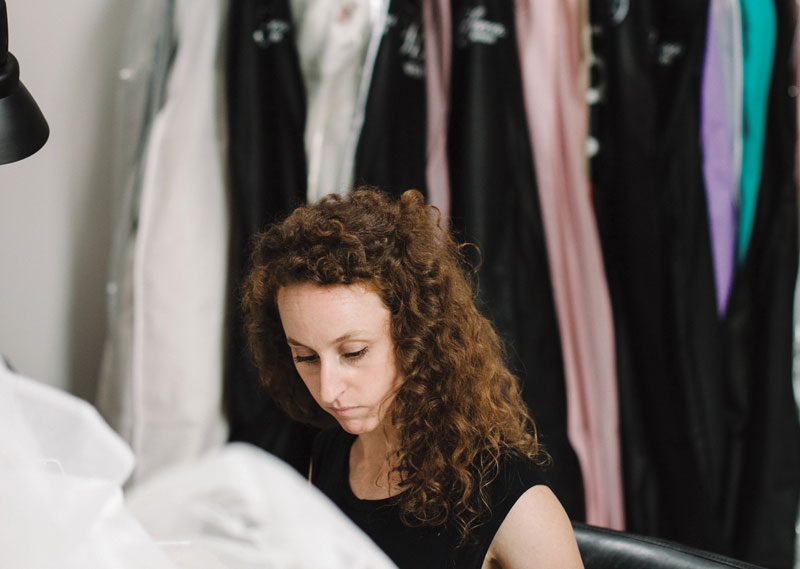
In the five years that Michelle Thomas has been doing alterations, she has fitted hundreds of wedding dresses. Here, she shares her advice.
Where did you learn to sew?
“I had very basic knowledge of sewing. When I went to Western Kentucky University, I studied fashion merchandising. I didn’t know it at the time, but in that major, you had to take some sewing classes. I took the classes and fell in love with sewing. That major was a lot about retail, and I didn’t want to do retail. I wanted to sew! But nowadays, how exactly do you find a job being a seamstress? There were very few. I actually had a friend whose mother worked in the alterations department of a bridal shop, and I talked to her and asked, ‘Hey, do you guys need help?’ They were kind enough to take me on and train me and that’s how I got started.”
We were shocked to learn how much alterations can cost. What is the average cost and the work that goes into them?
“There are several factors that go into the cost — the type of dress you have, its fabrications and what you need done. Lace and heavily beaded dresses are generally more costly, just because they take a lot longer to work on. When you have a lace or beaded dress, I have to physically take off the lace, and when it comes to beading, you have to hand-bead it back on. I would say my average would be $300 to $350. The most I’ve ever had was maybe $470, but the dress was a lot to work on. It takes more than you think. I can’t just whip it up. It can take several hours, it can take several days, it can take several weeks to work on a dress. I can only go so fast, and I need to give my hands a break. Definitely consider alterations in the wedding-dress budget.”
How far in advance should a bride book?
“At least three months so we have time for any changes and a better idea of your body type on your day. I will schedule a first fitting. At that first fitting I’ll tell them to bring any undergarments they plan on wearing with the dress, whether that’s Spanx, a slip or another skirt. And bring the shoes. You really don’t need the shoes until later, but bring them with you, and at the first fitting we will get the dress and pin it and take a look at what needs to be done. I’ll schedule a second fitting and we’ll check to see how everything I pinned is fitting. If you need a third, we’ll schedule to finish up.”
What are some challenges you come across?
“This is an extreme, but at the bridal shop there was a lady who came with a picture and said, ‘I want to look like this celebrity,’ and we’re looking at her, and she looks great, but she doesn’t have that body. You can’t expect a dress to morph your body. I think it’s wise to pick a dress that fits your body type and that you really, really love. Instead of one that you think is OK and you come to me and think I can completely transform the design. I can’t do that.”
Any horror stories you want to share?
“A horror story would be a bride being indecisive. For instance, I had a bride who wanted her dress tight-fitting. I do it, she comes back and wants it done differently. I do it, and she comes back again and wants it done differently. I did it and finally she came back and wanted it differently. Her wedding was less than two weeks away at this point and I had to tell her I wouldn’t do it.”

Carley Randall went to cosmetology school in 2013 but has been doing hair and makeup her entire life. She and her team of two have worked countless weddings and photo shoots. Here’s what she’s learned.
What are challenges you come across in your work?
“Let’s just say there has to be mutual trust between the artist and the client. And if you don’t trust me to do my art or trust me enough to say, ‘I’d like this change,’ then you’re probably not going to be happy with the end result. Feel free to speak up and say, ‘I’d like a little less or a little more,’ and know at the end of the day that your artist wants to make you happy. Also know that we’re coming from a certain experience level. Remember that you’re getting married once; some makeup artists and hair stylists do hundreds of weddings a year. We know what’s going to last longer, and you know your personal self in a way that we don’t. Communicate with us. Remember that you’re not going to be someone else on your wedding day and your skin tone is your skin tone and your hair texture is your hair texture. Make sure you’re working with an artist who wants to enhance your natural beauty and not make you look like a cookie-cutter bride.”
What do you wish people better understood about getting hair and makeup done?
“Hair and makeup is a much more involved process than it seems on the surface. My team, for instance, we come with everything you need for the day. We offer a day-rate service for up to eight hours because you forget that you need help along the way — someone to help you remember where your bags go, someone to help you pick up in the bridal suite, someone to help you with your dress when you’ve lost all your bridesmaids when they’re out and about, someone to kind of help control the emotions in the room, someone who has a steamer to make sure the bridesmaids are taken care of. There are a million details during the day, so make sure you have every detail taken care of or work with artists who are willing to do all of that for you.”
In-person versus photograph-level makeup — how do you achieve that balance?
“You have to be aware of who your photographers are and whether they’re using digital or film. Have an artist who’s aware of how the lighting is going to translate and someone who is willing to check out your photographer’s work to make sure that what you want translates on film, and don’t be afraid to wear a little more in person. You may feel like it’s abnormal to you because you’d never wear that much makeup on a Tuesday or Wednesday to work, but also realize that everyone expects you to have on makeup at your wedding. No one’s going to be overwhelmed when you come in with a full face of foundation. They’re probably going to say, ‘She looks beautiful.’ They’re not going to be like, ‘Oh, my gosh, her fake eyelashes.’ They’ll probably be like, ‘Did you know her eyes were that gorgeous?’ Trust that if it’s a little more, you’ll still look beautiful and you can make it look natural.”
Do you have any favorite moments?
“My favorite moment is — well, there’s always a moment in the day when the bride is getting her hair and makeup done and the day starts to resonate with her and she gets really silent. This is going to sound strange, but there’s something very humbling for me to be involved in that kind of very intimate, private, peaceful and sweet time. It’s such an honor for me to be the person in your space for that time and moment. Because you can always see the weight of a girl’s decision hit her and it’s just the absolute best.”

Justice of the peace Gary Fields has performed more than 10,000 wedding ceremonies since 1997. He and his partner Sharon Thornsberry, a minister, work as a consulting team.
Why do people book a justice of the peace for their wedding?
Fields: “I’ve had calls at the last minute because ‘Uncle John got cold feet.’ And you don’t know what kind of mood the bride and groom are going to be in when they arrive. I try to assess that and address it to break the anxiety with humor.”
Thornsberry: “We make our weddings about the couple. We’ve been to several ceremonies where there wasn’t a personal feel and it had nothing to do with the couple. And occasionally we’ll look at each other and say, ‘We don’t do that, do we?’”
What kind of ceremonial services do you offer?
Fields: “We’ll do whatever kind of ceremony you want; if you want a civil ceremony, religious — you tell us and that’s how we’re going to do it. Whatever your request, we’ll try to fulfill it. But of all the themed ceremonies, I don’t do Elvis!”
What’s your process like?
Fields: “We do a lot of small stuff and get a lot of spontaneous calls. I’ve done ceremonies for various reasons — for those wanting to get married in hospice, second weddings and simple elopements.”
Thornsberry: “We have so much fun with the small weddings. I am a teacher and I have married a couple outside of my school before with two witnesses.”
Fields: “We do a consultation. I write everything up from the start of the ceremony to the exit. And I like to sit down with them and give them a basic rundown of ideas and then change it the way they want. I like to talk to the photographers too, so that we both know the important moments of the ceremony and how they can get those pictures.”
How much does it cost?
Fields: “It depends on the ceremony. We’ve done as cheap as $75 and up to $325.”
What’s your favorite part of the ceremony?
Thornsberry: “When the bride walks up and is being given away and you get to see the emotion on the groom’s face. He’s crying and she’s so just pretty.”
Fields: “I like to watch the facial expressions. I did a wedding where the bride got up there and started crying and she went on about how she didn’t expect to cry. So everyone is running around looking for a tissue and the groom pulls out a handkerchief and he says, ‘I knew you were going to need this.’ I also like to do something called an ambush, where I have the groom hug the mother-in-law, and I make sure the photographer captures those moments. Because it’s truly special and catches everyone off-guard.”
What is your advice to couples?
Thornsberry: “Try not to do the rehearsal the night before because anything you imagine can go wrong will and we recommend relaxing that night.”
Fields: “The most important thing when you’re getting married: Look at your partner when you say your vows.”

Photo:Pexels.com
Maggie Heely is the owner and lead coordinator of Weekend Wedding Warrior, a wedding and event coordination company in Louisville and Lexington. She is also a licensed marriage/family therapist in the state of Kentucky and a graduate of Northwestern University’s Family Institute.
What should I look for when booking vendors? How can I know I’m not getting into a contract I’ll regret?
You will select and contract so many different vendors when planning a wedding, sometimes it is hard to know who you can trust. Though Louisville is a big city, it really is a small town. My best advice is to ask around about the vendors you are considering. Ask other couples you know who are married; ask the vendors or venue you have already selected. Check TheKnot.com and WeddingWire.com for reviews. These are all different ways of ensuring that you are getting a reputable wedding vendor. It is so easy to make a beautiful website these days, but you need to be certain that the vendors you contract also have a great reputation for delivering their services. Please make sure that (1) you always have a contract with a vendor and (2) you read the contract over thoroughly. If there is anything you are unsure of or would like to change, just ask! A professional vendor will be able to explain it or change it so that everyone feels comfortable.
What type of bar should we have? How can I cut costs and still have a full bar?
Most typically, weddings have open bars for their guests to enjoy. An open bar has a variety of options for your guests to choose from that the host pays for. Traditionally, the groom’s family pays for the bar. Sometimes people have limited bars, which include just beer and wine, and sometimes bourbon or a signature cocktail. Then there are cash bars where guests pay for drinks themselves. Cash bars can be perceived as tacky, so if budget is an issue I would recommend having a limited bar that is hosted. Other ways to decrease the amount that you spend on alcohol at your wedding are:
1. Find a venue and caterer that allows you to purchase your own alcohol. You will still need a licensed bartender, but purchasing the alcohol on your own (for example, at Costco) will be much more cost-effective than getting it through a caterer. There are also some local liquor stores that will let you take back anything unopened, so you don’t have to worry about if you are buying too much or too little.
2. Close the bars as you transition from cocktail hour to dinner. This will not only help your guests get seated quicker, but it will decrease the amount of time the bar is being utilized. You can also keep the bar closed during dinner, but then I would highly recommend having wine service at the table so your guests aren’t completely without a drink.
3. Skip the champagne toast. This isn’t my personal favorite thing to skip (I love champagne!), but it will help you out financially to not pour champagne to every single guest, especially since not everyone will drink it.
4. Probably the most obvious option is to have a well bar, meaning that your brands are on the lower end. This will be much more cost-effective than a top-shelf bar. If there is something that you particularly love, you can always buy a bottle of that for yourself and let your bar staff know that it’s just for the couple or the wedding party.
5. Switch to beer and wine after a certain point. Once the dancing gets started or in the last two hours, you can switch an open bar to a limited bar to save money. I would always recommend closing the bars completely 15-30 minutes before the end of the music/reception so people have time to finish their last drink before the end of the reception.
Which vendors should I tip and how much?
My rule of thumb for tipping is that you are expected to tip anyone who is working your wedding but who does not own the business they are working for. The idea behind this is that the total amount that you are paying for that service does not go directly to that person and therefore a tip is appreciated. For example, if your photographer is John Doe of John Doe Photography, then you wouldn’t be expected to tip them, but if your DJ is Billy Bob of John Doe Entertainment, then a tip would be expected. It is always expected for you to tip catering staff (including bartenders and kitchen staff), drivers of any transportation (assuming they don’t own the transportation company), hair/makeup stylists (once again assuming they don’t own the company they work for). Please keep in mind that you can always tip a vendor if you feel like they have gone above and beyond or if you are looking for a way to show them you appreciate them. Tips should always be in the form of cash, not check. If it’s in a check they have to claim it as income and it is taxed. Here is a breakdown by vendor:
Catering: 15-20 percent of the bill, given in cash to the catering manager to divide among the staff. Or $20-$50 per server, bartender and kitchen staff.
Wedding Planner/Coordinator: This is not expected, but if you think they have gone above and beyond, $100-$200 would be a nice gesture.
Photographers/Videographer: This would not be expected, especially if they own their own company. If they don’t own the company or if there is a second shooter, $50-$100 per person is thoughtful.
Officiant: If the officiant is not charging for their service, $100 is appropriate. If they are a part of a church, making a $100 donation to the church is thoughtful.
Florist/Cake: A tip is not expected.
Band/DJ: Typically $25-$50 per person or 15 percent divided amongst the members.
Transportation: 15 percent if gratuity is not included in your contract.
Hair/Makeup: 15-20 percent, just like you would at your local salon.
If you are ever unhappy with a service, then do not tip them! I know that tipping is expected in the service industry, but it shouldn’t be. It should be the reflection of someone’s efforts, and if you think they did a bad job then don’t tip them and make sure to tell them or their manager so that they are aware of you being unhappy. Tipping at the end of the night is the best way to make sure you are giving appropriately. You can give a lump sum to your wedding coordinator and they can divide it as they see appropriate if you don’t want to have to worry about it on the night of.
10-year marriage advice:
I recently celebrated my 10-year wedding anniversary and people have been asking me what my secrets are for a happy and healthy marriage. As with all marriages, my husband and I have certainly seen our ups and downs. I had heard about the stress that children can put on a marriage, but I truly think it will break an unstable relationship. It is great to say, ‘Make time for yourself’ and ‘Put your spouse first.’ When you are in the thick of it with small children, there are many days you can’t figure out how to shower, let alone care for your spouse’s needs. The key is to first know/understand your own feelings and motivation and then communicate it kindly to your partner. Easier said than done! For example, I can see myself getting annoyed or impatient with my husband if we haven’t spent much quality time together recently. When I notice that feeling, I check in with myself about it. Is it that we haven’t had time together? Is there something bothering me at work? Did he do something specifically that triggered me or offended me? If it is about our lack of connection lately, I find an appropriate time to give my husband a heads-up. “Hey, I realized it’s been awhile since we got to hang out. I miss you. Can we set up a date soon?” If he did something specifically that triggered or offended me, I come to him and say, “Hey, when you ______, I felt really hurt. Here is how I would have liked to see it go.” Men especially need examples of how they can change or improve, but it has to be done in a kind and vulnerable way, not in an accusing way — otherwise you’ll trigger their defensiveness (I’m admittedly not the best at this). Then the next key is VALIDATE, VALIDATE, VALIDATE! Often our partner doesn’t want us to fix their problems as much as they just want to feel like someone else gets it and doesn’t think they are crazy for feeling that way. If you want to have a successful marriage, you have to often put your feelings aside and validate your partner’s feelings first; then after they feel heard you can voice your side/feelings.
This originally appeared in the Fall/Winter 2018 issue of Louisville Bride as the section “Ask the Experts.” To subscribe to Louisville Magazine, click here. To find us on newsstands, click here.
Cover photo: Pexels.com
If You Do These 7 Things In Your Marriage, It's Basically Unbreakable

You have what it takes.
By Seth Simons
Greg Behrendt knows a thing or two about marriage and relationships. Before he was an acclaimed author of self-help books like He’s Just Not That Into You, he worked as a script consultant for Sex and the City, one of the defining cultural documents on love and romance in the 21st century. It was there, in the course of giving advice to a coworker, that he stumbled into the phrase that became a New York Times bestseller (co-written with Liz Tucillo) and a major motion picture starring Ben Affleck, Jennifer Aniston, and Drew Barrymore.
Behrendt, who also works as a stand-up comedian and guitarist in a punk band, has since written three books of relationship advice with his wife, Amiira Ruotuola-Behrendt. Their latest, the bluntly titled How to Keep Your Marriage From Sucking, out on July 17th is a how to book that explains through anecdotes of their own stumblings and shortcomings, how to do it right.
We asked Bedhrendt about the book and what he’s learned from his own marriage. He offered up these seven pieces of advice to keep.
1. Think of marriage as a daily practice
“I’m a sober guy, so I look at my life at a day at a time as opposed to forever,” Behrendt says. That means thinking of each day as a chance to tune out the world and reaffirm your bond with your partner. “If you as a couple kind of remind yourself that on a daily basis you sort of started your own — maybe religion is not the right word—but in a way, your particular relationship is unique and it needs to be honored as such,” he advises. “At a minimum, [spend] five minutes a day holding hands or talking or whatever you decide that intimacy is, so that you’ve checked in with each other and checked out of everything else that’s going on.”
And while Behrendt acknowledges that it’ll be tougher to make the time on some days than others, thinking of marriage as a daily practice can alleviate the daunting feelings that come with a lifetime commitment. “I only have to stay married to midnight. I get married again [and] re-approach it the next day.”
2. Make sure you’re both on the same page
Behrendt and his wife rushed into their engagement without making sure both parties were on the same page. That led to a very rocky start of their marriage. “In a microcosm, it’s all the same problems that we crossed in our marriage later on,” he recalls. “Being okay with something you’re not okay with; not speaking; doing things too quickly because you think the other person expects it; not knowing what the other person expects because you never asked them; writing a monologue about them in your head that is based on things that aren’t true; not fact-checking, but reacting.”
All the more reason to check in with your partner every day.
3. Remember that only you control your own happiness
As much as you and your partner love each other, there’s only one person in charge of your own happiness—and to pretend otherwise is to impose an unfair burden on the person you love.
“You’re just a person, and you’re ultimately the only person who’s responsible for your own happiness,” Behrendt says. “When you get together, you somehow feel like that person has now participated in your life and now is responsible for your own happiness. That’s not something they can do; I can’t make anybody happy.”
4. Find the balance between partner and parent
Raising kids is a full-time job; so is being a spouse. And just as it’s essential to nurture your children, it’s equally essential to nurture your marriage, too. “I find that a lot of guys I know feel like, ‘I just thought it was going to be a little bit different, I spend no time with my wife,’” Behrendt says. “It’s really important to make the marriage super important, because that’s all you have keeping it together. And even your kids want that—at a certain point I’m sure they’re going to be like, ‘Don’t you guys have something to do?’ So for me, that’s the best example you can show your kids: while they’re super important, you know, I married your mom and she’s my person.”
5. Sometimes divorce is the best answer…
Few people want to admit that in some circumstances, splitting up is what’s best for everyone. Behrendt learned this difficult lesson from his father, after his mother passed away in 2004. “My father said, ‘I’ll tell you what I wish I’d done differently,’” he recalls. “‘I wish I would’ve asked her for divorce, because that might’ve made a difference in everybody’s life. There was no reason for everybody to be unhappy.’” Sometimes, he says, the most unselfish decision you can make is to “extract yourself from something where everybody’s unhappy, because sometimes that’s what gets everybody moving to the other place.”
6. …But sometimes it isn’t
On the other hand, Behrendt cautions against using divorce as a way to avoid confronting difficult, but ultimately solvable problems. “Sometimes people get divorced for the wrong reasons,” he says. “I actually know some people that are like, ‘I think if I had just waited out, or talked about this one thing, I’d still be with the same person, I don’t really want anybody else.’ But it got too tough, too much stuff got piled on top.”
So, you know, probably don’t make any life-changing without doing everything you can to make that pile a little bit shorter.
7. When in doubt, ask
One of the most important habits you can develop, according to Behrendt, is asking your partner a simple question: how can I help? “That’s the question that will save you most at the time,” he says. “If somebody tells you this whole big thing about what happened at work, a lot of times they didn’t even put a question on the end and you start giving them an answer. That’s not what they want.” Defaulting to an offer of support—rather than giving it unasked—reinforces the strength of the partnership, even if your partner doesn’t end up needing it.
“Nobody wants to be carried,” he concludes, “but everybody wants to know that there’s a possibility they could get help.”
This article was originally published at Fatherly. Reprinted with permission from the author.

Here's a Good Reason to Spend Less on Your Wedding

Getting married is a major milestone, and a potentially expensive one at that. The average U.S. wedding now costs an almost absurd $33,391, and in major cities, like New York, that figure is close to $77,000. Yowza.
Of course, there are lots of good reasons not to spend a fortune on a one-day event. Most Americans are behind on savings, with 40% lacking the funds to cover a mere $400 emergency. But finances aside, here’s another compelling reason to keep your wedding budget to a minimum: It might help stave off divorce.
IMAGE SOURCE: GETTY IMAGES.
According to research by economics professors Andrew Francis-Tan and Hugo M Mialon, having a less expensive wedding correlates to a stronger likelihood of having a marriage last. Specifically, couples whose weddings cost less than $1,000 are less likely to get divorced than those who spend more, while couples whose weddings cost over $20,000 are more likely to see their marriages dissolve.
Now this isn’t to say that having a cheaper wedding guarantees long-term happiness. Clearly, there are many factors that dictate whether a couple ultimately ends up getting divorced. Still, it’s only one of many good reasons to keep your wedding costs to a minimum.
A better use for that money
Tempting as it may be to spend a ton of money on your dream wedding, before you do so, think about what you might be sacrificing for a one-day affair. As mentioned above, most Americans don’t have a fully loaded emergency fund with six months’ worth of living expenses. If you’re one of them, then the $33,000 and change you might otherwise spend on a wedding could instead buy you peace of mind in the face of life’s unknowns.
Then there’s retirement to think about. Imagine that instead of spending $33,391 on a wedding, you spend one-third of that amount and invest the rest over a 30-year period. If your portfolio generates an average annual 7% return during that time, you’ll be sitting on $169,000 after three decades, which will go a long way during your golden years.
Another option? Use that money to pay off your student loans, assuming you’re still carrying them. Or, apply it to your existing credit card balance and break free from that debt.
Finally, you might consider spending less on a wedding and saving that money to buy your first home. Younger American adults these days are waiting longer than ever to buy property, and much of that trend boils down to not being financially prepared. So if you’re sitting on a chunk of wedding money, think about whether you’d rather have a big party or a place to call your own.
Now none of this is meant to imply that you can’t splurge a little on your wedding. If you have the funds and want a formal affair, go for it. But you don’t need to go crazy, either. Rather than pay a premium for every little detail, decide which ones are most important to you and spend your money there. For example, if you’re a foodie, spring for a high-end caterer, but skip the flowers and ask a friend to take pictures rather than hire a photographer.
One more thing: If you are going to ignore this advice and spend a boatload of money on your wedding, be sure not to rack up debt in the process. An estimated 74% of couples who are planning to tie the knot by the end of the year anticipate taking on debt in the process, and that’s a mistake that can not only strain their finances but their marriages on a whole.
The $16,728 Social Security bonus most retirees completely overlook
If you’re like most Americans, you’re a few years (or more) behind on your retirement savings. But a handful of little-known “Social Security secrets” could help ensure a boost in your retirement income. For example: one easy trick could pay you as much as $16,728 more… each year! Once you learn how to maximize your Social Security benefits, we think you could retire confidently with the peace of mind we’re all after. Simply click here to discover how to learn more about these strategies.