


Category Archives: marriage advice
Married to an addict? Don't be a bystander to the wrath of substance abuse

You’ve tried everything: crying, yelling, nurturing, and even bribing. You’re married to an addict and you’re at the end of your rope trying to fix them. Don’t give up hope.
According to the National Survey on Drug Use and Health, more than 20 million Americans struggle with addiction to alcohol or drugs.
Perhaps you weren’t aware of your spouse’s addiction or didn’t know the intensity of their disease when you first got married. But now that you’re the spouse of someone struggling with substance abuse, you want things to change.
Don’t be discouraged. If your spouse accepts help through NA, AA, or through marriage counseling, you can get through this troubling time and restore your marriage bond.
Signs You’re in Love with an Addict
You may picture an alcoholic as a screaming, disorderly spouse riddled with financial trouble. You might imagine they are constantly intoxicated or can’t hold a job. But the truth is, addicts can hide in plain sight.
“My spouse goes to work every day and doesn’t start drinking until the evenings. That’s normal, isn’t it?” You may have asked yourself this very question.
If you’re a victim of domestic violence at the hands of an addict, you already know there is a huge problem in your relationship. Yet, some addicts have subtler tells that may leave their spouse’s wondering what they’re really dealing with. Here are the most common signs that you are married to an addict.
They abuse verbally, specifically when they are under the influence
They are frequently agitated or easily bothered
They perpetrate domestic violence when under the influence
They drink specifically to get drunk
They drink alone
They perpetrate sexual abuse
They have blackouts
They lower your self-esteem
They have poor communication skills
They make you feel underappreciated and used
What to do When You’re Married to an Addict
Stop Blaming Yourself
Your spouse may try and blame you for their addiction, saying they were never like this until they met you. This is a common lie told by alcoholics to try and control their spouse or hurt their feelings.
Your partner’s addiction has nothing to do with you. Likely this is a behavior that stems from family genes, a triggering or traumatic event from their past, or a mental disorder. They will continue to drink or do drugs regardless of how loving, understanding, or harsh you may be with them.
Get Informed about Addiction
One of the most important pieces of marriage advice when dealing with domestic violence or addiction is to get informed. For example, addiction may not be apparent at the beginning of your relationship.
Read about addiction and other spouse’s experiences with their partners. See what methods worked to save their marriage. Understand all you can about this disease and what you can do to remedy the situation, if anything.
It is also important to get informed about what is considered a dangerous living situation. If there is domestic violence in your relationship( https://www.marriage.com/advice/domestic-violence-and-abuse/ ), it is in the best interest of you and any children you may have to remove yourself from that hostile situation.
Don’t Submit to Denial
There is a stigma that surrounds addiction, even if you are the spouse of an addict. This stigma may cause you to be in denial about what is really going on in your marriage. When you begin to doubt yourself, remember this solid marriage counseling advice: you can’t change what you don’t acknowledge.
In order for anything to change for the better in your marriage, you have to admit what the real problems in your relationship are.
Find a Support Group
One piece of marriage advice you should follow is to find a support group. You should not have to go through your suffering alone. Find a forum online for support or visit a local group.
(You can look up support groups privately by using In Private Browsing. Access this by hitting CTRL+SHIFT+N on your keyboard when your browser is open. This will prevent your spouse from finding your searches in the history tab.)
Organizations like Al Anon are designed for family and friends of addicts who can come together and talk about their addicted loved ones. You can learn from others experiences and help support each other during this time.
If you are suffering from domestic violence in your marriage, call 1−800−799−7233 or text 1−800−787−3224 and get help from the National Domestic Violence Hotline. You can also visit their website for live chat services, available 24/7 in more than 170 different languages.
Attend Marriage Counseling
Marriage counseling can be a great start for troubled couples. Your spouse may not be open to attending rehab or AA groups, but they may keep an open mind about working on your marriage through counseling.
This is beneficial on many levels for both you and your spouse. Counseling will help you both work on communicating. You will both be encouraging to speak openly and honestly to one another and to listen to what your spouse has to say.
This can clear up any misunderstandings you are having. It will also let your spouse see exactly how their behavior is hurting you.
Your marriage counselor, when seen by yourself, can also help suggest ways you can avoid enabling your addicted spouse and get back to creating healthy communication and love in your marriage. It may also be cathartic to be able to talk to someone about the addiction or abuse that is going on in your home.
When seen solo, your counselor may also be able to suggest safe ways to separate from your spouse if you are in a dangerous situation.
On a more positive note, a marriage counseling session may also break through the barriers your spouse is putting up and can encourage them to attend rehab and conquer their addiction.
Do not deal with a dangerous or domestic violence situation alone. There is never any excuse for being treated poorly in your marriage. If your spouse is struggling with an addiction, seek help from marriage counseling and agencies such as Narcotic Anonymous or Alcoholics Anonymous.
***********************
Join the conversation, become a Fix blogger. Share your experience, strength, and hope, or sound off on the issues affecting the addiction/recovery community. Create your account and start writing: https://www.thefix.com/add-community-content.
'I can't marry him': Woman begs for advice about upcoming wedding
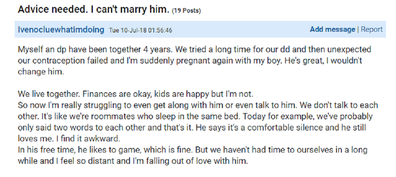
While most women feel excitement at the prospect of getting married, one woman says she’s dreading the thought, despite their long history and two children together.
“Myself and my DP (Dear Partner) have been together [for] four years,” she writes on parenting forum mumsnet.
“We tried for a long time for our DD (Dear Daughter) and then unexpectedly our contraception failed and I’m suddenly pregnant again with my boy.”
The mum says she loves her children and wouldn’t change them for the world, but that while her kids are happy, she is not.
In this week’s episode of Honey Mums, Deb Knight talks to popular blogger Mrs Woog about friendship and family. (Article continues.)
“We live together,” she says. “Finances are okay, kids are happy but I’m not.”
She says she finds herself struggling to get along with or even talk to her partner.
“We don’t talk to each other,” she writes. “It’s like we’re roommates who sleep in the same bed. Today, for example, we’ve probably only said two words to each other and that’s it.
“He says it’s a comfortable silence and he still loves me.”
However she says she finds their relationship “awkward.”
“In his free time, he likes to game, which is fine,” she says. “But we haven’t had time to ourselves in a long while and I feel so distant and I’m falling out of love with him.”
She says she’s tried to talk to him about it but feels he brushes her off by saying everything is “fine”.
The situation is even more complicated for the woman because her parents are paying for their upcoming wedding as a gift.
(mumsnet)
“My parents are giving us the gift of getting married as my dad is ill and [we] are not sure how long he has left,” she writes.
She then says it’s only recently that it’s hit her that she doesn’t actually want to marry her partner.
“There’s nothing in common,” she says. “We don’t talk to one another. We aren’t even in the same room majority of the time we are together. And he prefers gaming to spending time with me.”
The woman writes that even when she tries to make conversation with her partner, their relationship “just doesn’t work anymore.”
It’s just getting so difficult,” she continues. “I’ve come down so ill tonight and I feel so neglected. I wanted him to come to bed and/or help me with the kids if they wake up — I can’t sit up, I keep fainting — and he told me he wanted to game instead.
“I was awake when he came to bed and he just looked at me, rolled over and went to sleep.
“Please talk me through this,” she says. “I can’t see myself loving him to the point I want to be married anymore. I can’t even see this being long-term. He just brushes me off whenever I try to talk about us.”
 (Getty)
Majority of responses urge her not to get married.
“You don’t have to marry him,” writes starryeyed19. “Being married to someone who doesn’t listen to you will break you. Give yourself permission to say no. To do the things that you need to do to help preserve your sense of self.”
“Tell your parents how you feel,” suggests CatOwned. “I doubt your DF (Dear Father) would be happy to see you marrying because of him. If you were my DD, I would gladly use the wedding money to help you get established after separating.”
Arum51 suggests delaying the wedding instead of breaking up. “Of course he thinks everything is fine,” they write. “He’s got a very nice life. You need to break through his little bubble, because he currently thinks that if he can go on denying there’s a problem, he’ll be able to keep doing what he’s doing.
“Tell him the wedding is off. You’re prepared to let him stay for a while, to see if this is salvageable. However, big changes in his life are going to have to happen, starting with cold turkey on the gaming. He starts talking to you; you go places and do things together.”
User Rednaxela also suggests the woman continue to work on the relationship. “Be prepared to keep reinforcing the message with actions and repeated reminders. Think of it as training him to consider your needs. He is the father of your kids, he doesn’t hit you or have an alcohol problem. The relationship is worth fighting for. You do that by training him to behave differently.”
However another forum user strongly disagrees with the advice to keep trying.
“With respect, this is bollocks,” they say. “If he won’t even acknowledge how you feel on a simple, fundamental basis…? It’s not your job to fix him. It’s not your job to train him or change him.”
Share your story by sending an email to Jo Abi at jabi@nine.com.au or via Twitter @joabi or Instagram @joabi961
What Living Together Before Marriage Really Means For Your Relationship

Once upon a time, living with your significant other before getting married was extremely taboo. Nowadays, however, if a friend tells me she’s not planning to move in with her guy or gal until after they walk down the aisle, I find myself laughing nervously and asking, as tactfully as possible, what the hell she’s thinking.
According to the National Center for Family and Marriage Research, the number of women between the ages of 19-44 who lived with a partner before their first marriage increased by 82 percent between 1987 and 2010. For many people, shacking up is one way to find out if you and your partner can co-exist in a shared space in order to make your relationship last a lifetime.
Of course, it’s not for everyone. Not everyone who chooses to co-sign on an apartment lease before they co-sign on a marriage license actually make it. The question is, why? Patrick Ishizuka, a postdoctoral fellow at the Cornell Population Center, explored the topic through an economic lens in a study published earlier this year.
When you consider all the benefits associated with marriage, it’s not unreasonable to think cohabitation might have similar perks—after all, the biggest tangible difference between marriage and cohabitation is a sheet of paper. But, Ishizuka writes, according to past research, the relationships of couples who live together before marriage are generally characterized by “relatively short durations and high levels of instability.” Studies have shown that the average timeframe of these unions is less than two years, with only 40 percent ending in marriage.
To understand how cohabitation is unique in the way it influences the connections between the relationship, money, and work, Ishizuka looked at data gathered from thousands of households between the years 1996-2013. Among his sample, slightly more than half of couples who lived together and experienced some kind of relationship transition ended up breaking it off: 1,121 couples dissolved, while 1,104 went on to get married. In fact, the odds of moving on to marriage declined by 28 percent between 1996 to 2008.
Interestingly, Ishizuka’s study went on to show that marriage is increasingly becoming a numbers game: His analysis showed “that wealth independently predicts marriage, with couples that own a home and receive interest from financial assets being more likely to marry,” he writes. In other words, the more money you make, the more likely you are to get married, especially if you and your partner make about the same. Alternatively, couples who aren’t as well off are more likely to separate.
See more: How Should You Really Be Splitting the Bills With Your Partner?
As someone who shares a home with her longtime boyfriend and writes for a living—i.e., I’m definitely not doing this to make a ton of money—the study’s results are a bit depressing. But Ishizuka’s findings do offer one glimmer of hope for those of us who are a little economically disadvantaged but still want to marry our equally disadvantaged partners: Cohabiters tend to have more egalitarian views about economic gender roles than married couples. He puts to rest that tired theory that couples in which the woman earns more than her male partner—also known as the “male breadwinner perspective”—are more likely to break up before marriage because of the man’s fragile ego.
“Equality appears to promote stability,” Ishizuka said in a statement. In fact, he continued, it’s what may actually “hold these couples together.”
JJ's Engaged (and here's the “card” we made)

JJ came back from vacation refreshed, rested… and ENGAGED!
So, naturally, his radio family had to say “Congratulations” AND give some (good?) marriage advice.
This is our “audio card” to him – LISTEN ABOVE!
A few photos from the big proposal:

The revealing of the ring!


JJ & Jill. The happy (engaged!) couple!
Congratulations from your KFGO Family!
(Amy Iler & JJ Gordon are talk-show hosts at 790 AM KFGO in Fargo-Moorhead. “It Takes 2 with Amy & JJ” can be heard weekdays 11am-2pm. Follow Amy on Twitter @AmyKFGO. Follow JJ on Twitter @JJGodon701.)