



Category Archives: Marriage & Divorce
Ask Roxane: 'Where the Hell Is the Love of My Life?'

Dear Roxane,
I am a 43-year-old, single, never-been-married, educated mother of one and would like advice on love. I’m navigating dating life and need to fully understand the difference between loving someone, being in love and having a soul mate. I love the idea of love and would very much like to spend the rest of my life with a man, but find myself having commitment issues because I am afraid of choosing wrong. I see couples that have been married 10, 15, 20 years who get divorced and seem to be completely fine with it. It’s scary to me because I would like my marriage to last a lifetime. Am I overthinking this totally or being too paranoid? Or do you really never know, because only time will tell?
Sincerely,
Where the hell is the love of my life?
Dear Searching for the Love of Her Life,
We live in a culture that idealizes the idea of love, and the idea that there is one true person who will complete you, fulfill all your dreams and love you forever. We are told from an early age that our true love is out there, waiting for us and so we yearn to find them, to know what it feels like to experience true love, to know you have made the right choice. The truth about love is that it is often bewildering and unknowable. You may never know if you have made the right choice. But when love is true, you embrace all the unknowns, regardless.
I am 44, in a complicated romantic situation, never been married. I am no expert on love. I love the idea of love but I have lived and loved long enough to recognize that there is a difference between the idea of love and the reality of love.
You never really know if a marriage or relationship will last a lifetime. You can want that. You can work hard to make a relationship work and have the best of intentions and still, things might not work out but that doesn’t mean you have wasted your time or failed. Many people who choose divorce are completely fine with it because they know the difference between the idea of love and the reality of love. They know there is nothing to be gained from staying in a marriage simply because the idea of love demands pretending everything is fine when such is not the case. What may seem cavalier to you is most likely a decision that has been agonized over. Few people take divorce lightly because it is a profoundly painful thing to end a commitment you nurtured and fought for and hoped would last a lifetime.
In your letter, you are very much focused on what could be rather than what is. You worry about choosing wrong but are not considering that you might choose right for a lifetime or right for a moment. When you meet someone and start dating, you have no idea where things will lead. You have hopes, yes, and dreams, but you also have to get from one day to the next, getting to know a person, deciding to deepen the relationship and, sometimes, choosing to formalize a commitment. It is so very important to know what you want from a relationship but you also have to create space for a relationship to develop without worrying about what the relationship will or won’t become. You have to be in the relationship in the present, from one day to the next, and some of those days will be glorious, but some of them are going to be a complete disaster. You would like a marriage to last a lifetime, but you are, perhaps, overlooking what it takes to love someone for a lifetime. You are overlooking the small joys and sorrows and frustrations of threading all the days that make up a lifetime of loving someone.
Ask 33 people about the difference between loving someone, being in love and soul mates, and you will get 33 different answers, so I will simply tell you what these things are to me. I must also warn you, I am a passionate, foolish romantic. I believe in love and grand gestures. I am all about the chase, seduction and woo, not just during the shimmering early days of a relationship but also years in when you’re thinking about the maddening ways your person behaves but still, isn’t today a good day to send them some sunflowers or bring them their favorite coffee?
When you find the one you just know. But that isn’t guaranteed. Some people never find the one, or there are several people for whom you have such feelings or you think you have found the one and they change or you change in ways you can no longer tolerate. Love is so damn messy. There are days when I hate love as much as I love it, when I just want to walk away, give up but still, something holds me there, to the center of my gravity.
Loving someone is recognizing the role they play or have played in your life and honoring that presence. Sometimes, love feels like an obligation but it is one you are willing to fulfill. Sometimes it takes hard work but you are willing to put in that work. Love is the constant you hold on to when you don’t particularly like the one you love. Love is recognizing the ways in which, for better and worse, someone has contributed to your life. It is up to you to decide what loving someone, being in love with someone and a soul mate mean.
Being in love is wild, breathtaking, infuriating. It is butterflies in your stomach when you think about your person, when you see them, when you hold them. It’s the electricity when your skin meets. It’s smiling at your person with wide eyes and an open heart and seeing them smile back at you in the same way. It’s wanting to hold someone’s hand, even when your hand is hot, a little sweaty. It’s lust and the heat of wanting, wanting, wanting. It’s seeing who someone truly is, the best and most terrible parts of them, and choosing not to look away from everything you see, actively embracing everything you see. It’s the willingness to have difficult but honest conversations. It’s compromising on the structure of your relationship. It’s about patience and being flexible and getting irritated or furious with a person but still holding on. It’s wanting to be the best version of yourself for your person but also for yourself, especially for yourself. It’s the pride you feel in their accomplishments and being as happy for their successes as you are for your own, if not more. It’s their hurts becoming your hurts. It’s feeling their absence when you are apart and the rush of joy when that absence ends. It’s liking someone as much as you love them, being interested in who they are, marveling at the ways they are interested in you. It’s a gut instinct. You just feel it. You know it in your bones. It isn’t perfect, not at all. It doesn’t need to be. It is, simply, what fills you up.
As for soul mates, I did not believe such a thing existed until I did. A soul mate is someone so deeply part of you that they feel like a vital organ, living outside of your skin. They are the hottest part of the sun, your true north, your home, the one from whom you will never walk away, no matter what the material conditions of your relationship might be. Your soul mate is the one you wait for knowing no matter what happens, that they are worth the wait. Your soul mate is the person you choose because you look at them, always and think, “You … there you are.”
But it truly doesn’t matter how I or anyone else understand love. You get to decide what loving someone, being in love with someone and having a soul mate mean. You get to choose the kind of person you want to spend your life with and for how long and what that relationship looks like. You get to fight for what you want so long as the person you love is fighting alongside you.
I hope you find that person you are looking for. I hope when you meet him, you don’t worry about how the relationship might end. I hope you find joy and fulfillment in the very act of loving and being loved, no matter what may come.
Roxane Gay (@rgay), an associate professor at Purdue University, is the author, most recently, of “Hunger” and a contributing opinion writer.
“Ask Roxane” is an advice column that appears periodically in The New York Times Opinion section.
If you’re looking for some comic relief and live in the San Francisco area, come to The New York Times Opinion Live on Friday, Oct. 19, for an evening of politics and advice — and advice on coping with politics — with Roxane Gay, Michelle Goldberg and Jennine Capó Crucet, hosted by the Sunday Review editor, Rachel Dry. Get tickets here.
Follow The New York Times Opinion section on Facebook and Twitter (@NYTopinion), and sign up for the Opinion Today newsletter.
'The Big Bang Theory' cast is so happy to have Bob Newhart back for the final season – watch!
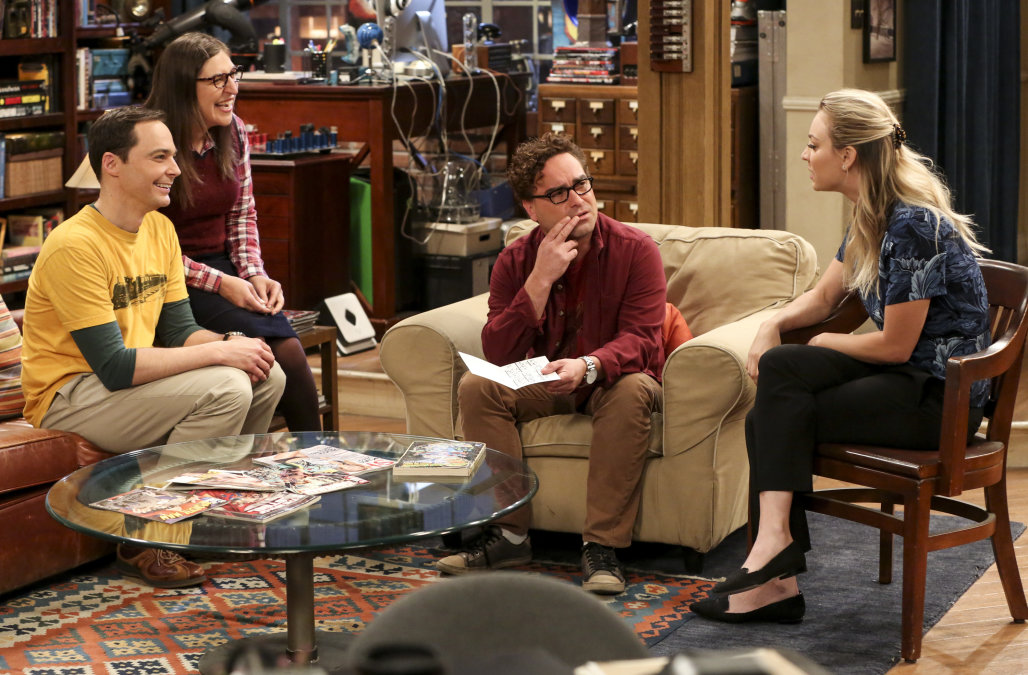
Bob Newhart is back!
The Emmy Award-winning comedy legend is returning to The Big Bang Theory for its 12th and final season – and only ET has your first look at what could be his last episode of the series.
So just what will Professor Proton turned Sheldon’s sarcastic subconscious be up to this time? “Bob’s back to offer advice because when you have marital problems, you go to Bob Newhart in Jedi robes,” Jim Parsons quips in the video above.
“I’m kind of Obi-Wan – whatever that means,” the 89-year-old star says with a smile to the cameras. “Whenever Jim has a problem then he comes to me. He and Amy had a fight and he came to me and wanted my advice on how to handle their first fight.”
Press play on the video above for a special sneak peek at the hilarious marriage advice Arthur offers while they dine together in Sheldon’s dreams.
The Big Bang Theory’s final season airs Thursdays at 8 p.m. ET/PT on CBS.
RELATED CONTENT:
Behind the Scenes of Bob Newhart’s Return to ‘The Big Bang Theory’ (Exclusive)
EXCLUSIVE: Bob Newhart Reflects on ‘Mary Tyler Moore Show’ Legacy
Busy Philipps says she had 'emotional boyfriend,' Michelle Williams stopped her from divorcing Marc Silverstein

Busy Philipps revealed she was prepared to divorce husband Marc Silverstein after seeking out an “emotional boyfriend” when their marriage was on the rocks — until her best friend Michelle Williams stepped in and gave her some advice.
Philipps wrote in her new memoir “This Will Only Hurt a Little” that she sought out support from another man when her marriage to Silverstein began crumbling.
“There was a man I was friends with, another dad. We’d been having lunch and stuff. Texting. Talking on the phone a lot,” Philipps wrote in her book, People reported. “Honestly, I had a crush on him. I like him. Maybe I even loved him? He clearly liked me too.”
Philipps recalled asking Silverstein for a divorce in December 2016 because she just “couldn’t do it anymore.” She revealed the couple’s relationship had been suffering for a while, but Silverstein was still “shocked” by the news and asked for a second chance.
Busy Philipps said friend Michelle Williams gave her some advice when she contemplated divorcing husband Marc Silverstein. (Reuters)
“He didn’t want to get divorced. He wanted a chance to change,” she wrote. “He said I owed our family that.”
Philipps sought out advice from her friends, including Williams who advised the former “Freaks and Geeks” star to think about keeping her family together.
“It would be really awful for two years and then you would find a new normal but honestly, if you can keep your family intact, I think you should do it,” Philipps recalled Williams saying.
Her therapist also said, “Listen. Divorce f— up children. It just does.”

Busy Philipps said she almost divorced husband Marc Silverstein. (Getty Images)
Philipps and Silverstein, who got married in 2007, ultimately began attending therapy again, but the actress continued talking to her “emotional boyfriend.”
“This time, Marc got his own therapist. And we started to work through it. But I also kept talking to my emotional boyfriend (for lack of a better term). I know. That part is so s—–. I’m sorry. I really am. I really truly am.”
The couple has two daughters, Birdie Leigh, 10, and Cricket Pearl, 5.
I'll Have What She's Having: Books for Better Sex and Better Relationships

Having recently found myself single again, I approached the latest crop of books on sex and relationships with more than scholarly interest. Anything new happen while I’ve been on ice for the past 25 years? Let’s find out.
If you’ve ever had a sexual fantasy and thought, “Oh God, what’s wrong with me?” a quick read of TELL ME WHAT YOU WANT: The Science of Sexual Desire and How It Can Help You Improve Your Sex Life (Da Capo, $27) might ease your mind. Sure, maybe I’d had some odd thoughts, but did I have vomerophilia, the condition of being sexually aroused by vomit? No, I did not. Nor do I want to be a human cow, which means — well, look it up. So, all in all, I’m vanilla (which is both an expression and part of the buffet of sexual food fantasies).
Justin Lehmiller, Ph.D., a research fellow at the Kinsey Institute, surveyed almost 4,000 Americans of various religions, ethnic groups and economic backgrounds to see what races our motors. Group sex is by far the most common fantasy, followed closely by receiving or inflicting pain. (You didn’t think those millions of copies of “Fifty Shades of Grey” were all bought by the same randy gal, right?) There were many startling findings, at least to me. For example, men and women aren’t wildly different in their fantasy lives, although women are more fluid in their sexuality and care more than men about where the sexual act takes place (presumably in the room with the best lighting and window treatments).
I was less surprised to learn that people who identify as either Republican or Democrat really are different in their fantasy lives. Republicans are publicly more conservative in their tastes, but in their private lives are more likely than Democrats to crave taboo situations like exhibitionism, voyeurism and fetishism. American political affiliations have implications for body features too. “I found that among men and women, both gay and straight,” Lehmiller writes, “Republicans were more likely to fantasize about larger penises than Democrats.” He speculates that they’re more likely to see the penis as a symbol of power or toughness. I can’t possibly imagine how he could come to this conclusion.
Lehmiller isn’t just putting out a compendium of our raciest thoughts; he tries to explain what those thoughts do for the health of our psyches. And he believes they do a great deal. We need our fantasies both for ourselves and, often, to share with our partners, even when it’s uncomfortable. He gives concrete advice on how to do this without making them feel threatened.
Incidentally, not all fantasies are about being transgressive. Many people simply dream of sex with a loved one, often an absent loved one. The teenager who masturbated to the fantasy of making love to his ex-girlfriend, ending with him cooking her a romantic dinner … well, I almost cried. (And wondered whom I could fix him up with.)
It may be preferable to regard HOW TO KEEP YOUR MARRIAGE FROM SUCKING: The Keys to Keep Your Wedlock Out of Deadlock (Diversion, $22.99) as a book of comedy rather than self-help because the married authors, Greg Behrendt (who wrote “She’s Just Not That Into You”) and Amiira Ruotola, are very funny people who are more at home with punch lines and movie scenes than helpful advice. The key to a good marriage is in the setup, they say, using a regrettable metaphor: the planting of flowers of goodness that will get you through the weeds of badness. “The practice, not the goal, is to learn how to love each other even when you struggle to like each other.” O.K., fine. But before we get to this common-sense conclusion, we need a weedwacker to get through a lot of dopey ideas. Should we really get married because it makes it harder to walk away? Do we all need a movie “trailer moment” of a marriage proposal so our mates won’t resent us in the future? Not merging your finances is a recipe for disaster? (I’d argue that more often it’s the exact opposite.)
The best reason to read “How to Keep Your Marriage From Sucking” isn’t the advice but the fabulous cautionary tales from the marriages of the authors’ friends. Here’s a valuable lesson: If you’re a would-be groom, don’t enthusiastically spell out “Will you marry me?” in s’mores right outside your tent while on a romantic camping trip. Adorable to wake up to, theoretically — and in reality an invitation to marauding raccoons, who bit the future groom on the hand when he tried to rescue the ring he’d set next to his culinary masterpiece. Well, that’s one way to make memories.
My aunt — and probably yours too — had a favorite expression when my cousins and I would gas on and on about some new love interest: “You think you discovered sex?” I was reminded of Aunt Alberta while reading GIRL BONER: The Good Girl’s Guide to Sexual Empowerment (Amberjack, $24.99). Its author, the sexuality podcaster August McLaughlin, writes as if she discovered sex, and she really wants to share the news. Her book is terrifically encouraging, if not exactly filled with surprises. Masturbation, good! Fat-shaming, bad! “Embracing our sexuality and capacity for pleasure can be as crucial to living a full, healthy life as eating a balanced diet, breathing well and getting sufficient nightly sleep.” True words, those.
McLaughlin has written a thorough primer on everything from sex toys to bondage to “no means no,” intended for young women readers who might be new to the idea that they deserve, and own, their personal pleasure. I just wish it weren’t written with a level of preciousness that made me want to scream my literary safe word. “In the mirror I could see my vaginal lips bulging outward, like fiery rosebuds blooming.” “Make sure your nipples get some TLC. … Because, delicious!” I don’t know what a chapter that involves her family’s history of sexual abuse should be called, but I can promise you it’s not “Porn Perks, Problems and the Penises in Between.”
The book I least looked forward to reading — because I thought it would be gloomy — turned out to be the best of the bunch. IF YOU’RE IN MY OFFICE, IT’S ALREADY TOO LATE: A Divorce Lawyer’s Guide to Staying Together (Holt, $26) has the best description of the institution: “Divorce is, at best, a knife fight in a closet. And the kids are in the closet with you. … And the lights are off.”
Fifty-six percent of all American marriages end in divorce — and the divorce lawyer James J. Sexton claims he wrote this book to help you beat the odds. So he’ll teach you what his years of observing warring couples have taught him. It turns out to be a lot, starting with: You need to stay interesting to your mate, which generally involves staying interesting to yourself. Lose your identity in marriage, and you’re likely to lose the marriage.
It’s not novel to tell people that they need to know how to communicate better, but Sexton’s advice is both spot on and very specific — and he sugarcoats nothing. (Including himself: He too is divorced.) He points out, for example, that what we all like to think of as constructive criticism of our mate is actually just criticism. He’s a big believer in training people through redirection and praise for even tiny changes, kind of like throwing bushels of “Whoosa Good Boy!” at your dog. And this guy is nothing if not a realist. Holding sex back as punishment is counterproductive, but suddenly becoming way more affectionate and enthusiastic when your mate does something right: That’s the way to go.
The book is riddled with jaw-dropping stories about people’s insane behavior when things go wrong. Sexton is a very hard guy to shock. This is his interior monologue when a new client says, ‘You’re not going to believe what I’m going to tell you.” “Really? Because unless you’re a nun” and you’re sleeping with “your cousin while married to a hit man for the Russian mob who has liquidated all of their drug money and converted it into Nigerian currency that you’ve transferred to your tattooed bisexual lover who happens to be a sitting judge, you’re not making a blip on my shock radar.” Sexton has seen some stuff. There are not one but two chapters on what he calls “nanny fascination,” which sounds about right to me. In fact, if I were advertising the book rather than reviewing it, this would be the headline.
Of course, I was nosily waiting to find out what happened in Sexton’s own marriage. We never learn. But perhaps there’s a hint in his unequivocal advice about Facebook: Leave it. Or, as he titles his chapter on the perils of social media: “If We Were Designing an Infidelity-Generating Machine, It Would Be Facebook.” Who would have guessed that the person who gives the best advice about marriage was the guy responsible for getting you out of yours?