



Category Archives: Relationships
The 'Halal Dating Guru' Who Gives Muslim Women Relationship Advice On YouTube

Navigating the world of dating, sex and love is a minefield at the best of times, but when you throw religion into the mix it can be even more complicated. For Muslim women in particular, it can be difficult speaking openly about relationship issues and concerns, which some put down to a lack of sex-positivity in the faith and its strict rules around relationships and sex outside marriage.
This dating coach helps women in science and engineering fields find love

Dating coach Holly Shaftel wants to engineer the perfect match for millennial women in STEM
Dating isn’t rocket science.
But it can certainly feel that way at times, according to Holly Shaftel, a millennial working at NASA who has made it her mission to help women in the science, technology, engineering and math fields find love.
“I’ve always been interested in the science behind love and sex appeal,” Shaftel, 29, told Moneyish. “Women deal with a lot of sexism in STEM fields, and that can sometimes carry over into dating, where men are intimidated by female intelligence.”
Her own personal struggles with dating while working as a science editor inspired her to to get a life coaching certification and start her own private dating coaching business.
“Being in this male-dominated field, interviewing scientists who are often male, I felt this inferiority complex. I felt intimidated. I felt like I had to make more of an effort to prove myself as a woman,” she said. “I talked to other women [in my field] and they felt that way, too.”
Shaftel uses a few different techniques in her practice, the first one being a 70-question assessment with prompts such as, “I’d rather give than receive,” and “I am fearless,” where clients are told to answer honestly. This helps Shaftel gauge their outlook on life and dating. Each client’s session varies depending on the person, but can include: fine-tuning how to write a strong dating profile; tips on building confidence with self-love exercises; and discussing how to make time for dating while climbing the career ladder in one’s STEM field. Her services don’t come cheap — a one-time payment of $400 gets you the assessment, and then a dating coach session and future customized coaching can cost upwards of $3,000. She’s already helped dozens of her own friends, however, and while the business is geared towards women in STEM, Shaftel says anyone can sign up for her coaching.
“We tackle things like, ‘You’re moving up in your STEM career and breaking those glass ceilings, but you can’t find the time to date somehow.’ I’ll help you find time to date and manage your life,” she said.
Women make up 24% of the STEM workforce, and although they are still paid less than their male counterparts, the pay gap between the genders in STEM fields is still less than it is on average for all workers, according to government data. So no matter who’s doing them, STEM jobs pay significantly more than non-STEM jobs, on average. Indeed, data from the National Association of Colleges and Employers found that the projected average salary of a 2017 grad with an engineering degree is about $66,000; computer science grads net $65,500; and math and science majors earn $59,368. Meanwhile, a humanities grad can expect to make just $48,700.
SEE ALSO: 12 badass women that inspire girls to get into STEM
Research suggests that some successful STEM women may be afraid to share their achievements with potential dates, however, because they are worried that they will intimate potential partners. Researchers at the Harvard Business Review surveyed male and female students. Each group was asked about their professional preferences, including compensation, and were told that their answers would help them get a job after graduation. When told that the career office would be reviewing their answers, women responded similarly to their male counterparts, with just a small drop in requested compensation. However, the single women in the study downplayed their career ambitions in the answers when they were told their answers would be viewed by classmates. Instead, they said they would accept getting paid a staggering $18,000 less in salary, and rated themselves as less ambitious. Male respondents and women in relationships responded the same in both circumstances.
But Shaftel doesn’t think you should play down your smarts. Indeed, she’s seen women do it and doesn’t think that it works. “I felt like I was smarter,” she said. “I said, ‘Do I have to be this woman?’ I felt like I had so much more to offer.”
Shaftel practiced what she now preaches in her own dating life by taking pride in her work instead of downplaying it. She recalled showing her now-boyfriend of four years an Earth science mobile app that she worked on at her day job.
“After I showed him how it worked, he said to me, ‘Wow, I’ve never nerded off with a woman before,’” she said, realizing that, “Confidence and brains trump all.”
Shaftel is determined to change the stigmas by “bushwhacking through the ineffective advice and sexist bulls—t out there,” as she writes on her website. One prompt she gives clients to boost their egos is having them keep a journal of all of their positive qualities and attributes, or “what makes you amazing.”
© 2018 Dow Jones & Company, Inc. All Rights Reserved
Amy Dickinson: Kids take a back seat when grandfather needs care

Dear Amy: My parents have taken in my 95-year-old grandfather. Money is not a problem, so he could have gone into a nursing home or into assisted living. My grandfather has six other kids, and no one else wanted him to live with them.
I feel as if I have lost my parents until my grandfather passes. I’ll invite them to come to their grandchild’s “grandparent day” at school, and it’s, “No, we can’t leave Dad alone,” or, “Oh, we can’t make it to the twins’ birthday party, because we can’t leave Dad.”
I live almost two hours away, and my grandfather won’t go anyplace other than the doctor or church. No other family member is available or trustworthy enough to watch him.
Amy, this could go on for years!
I was never close to him. He is difficult to get along with and could not tell you one thing about me as a child, because he (and my grandmother, who died years ago) didn’t take an interest in most of their grandchildren. Fortunately, my other grandparents were total rock stars, so I was not deprived.
Every time I talk to my mother now, it’s all about my grandfather. I DON’T CARE!
Short of cutting off ties with my parents, what am I supposed to do?
I expressed all my opposition to this before he moved in. I said that it was a bad idea. I was not listened to.
I do still try to visit them once a month, but it’s hard. I work full time and have to do things like take care of my kids’ laundry and buy groceries.
My folks used to travel to see us once or twice a month — sometimes more often.
I miss my parents, and my kids miss their grandparents! — Want Them Back
Dear Want: As much as I would like to answer your letter by saying, “I DON’T CARE!,” I won’t do that, because I have a shred of compassion toward you. And you should have a shred of compassion toward your parents. It is hard to imagine that these people you are so desperate to spend time with raised such a selfish, self-centered person.
For the next phase of their lives, your folks are going to be wrapped up in this hard thing they are doing. Your mother is going to be at least as concerned about your grandfather as you are about your kids’ laundry. So yes, for now her life will be all about him. Deal with it.
You should suck it up, and find ways to support your parents during this challenging time. If you want to see them, take the kids to visit. It would probably be good for your children to witness some multigenerational loving kindness.
Dear Amy: I need advice on how to help my sister, “Betsy.” Betsy was married for eight years to a guy who lied, took drugs and was verbally abusive.
Thank goodness, they got divorced two years ago.
Since then she has tried flirting with some guys at her work, only to be shot down. Basically, they only like her as a friend.
She briefly tried online dating, again without much success. She talked to a couple of guys (at different times) who said they would like to get to know her better, but they ghosted her after she suggested meeting in person.
This has led to loneliness and self-pity. She says she wishes she was numb so she doesn’t have to feel the heartache.
Amy, she is a sweetheart. She is smart and very caring. How can I help her out of this downward spiral? — Worried Sister
Dear Worried Sister: Rather than focusing too intensively on your sister’s dating problems, you should encourage her to work on some social and friendship skills, in order for her to become more self-actualized. Professional counseling or coaching will help. When she feels better and more in control, she’ll have an easier time coping with her meeting and dating challenges.
And dating is a challenge for everyone. Your sister will need both confidence and patience.
Overview
Photo Credit: Hero Images Inc. / Alamy Stock Photo
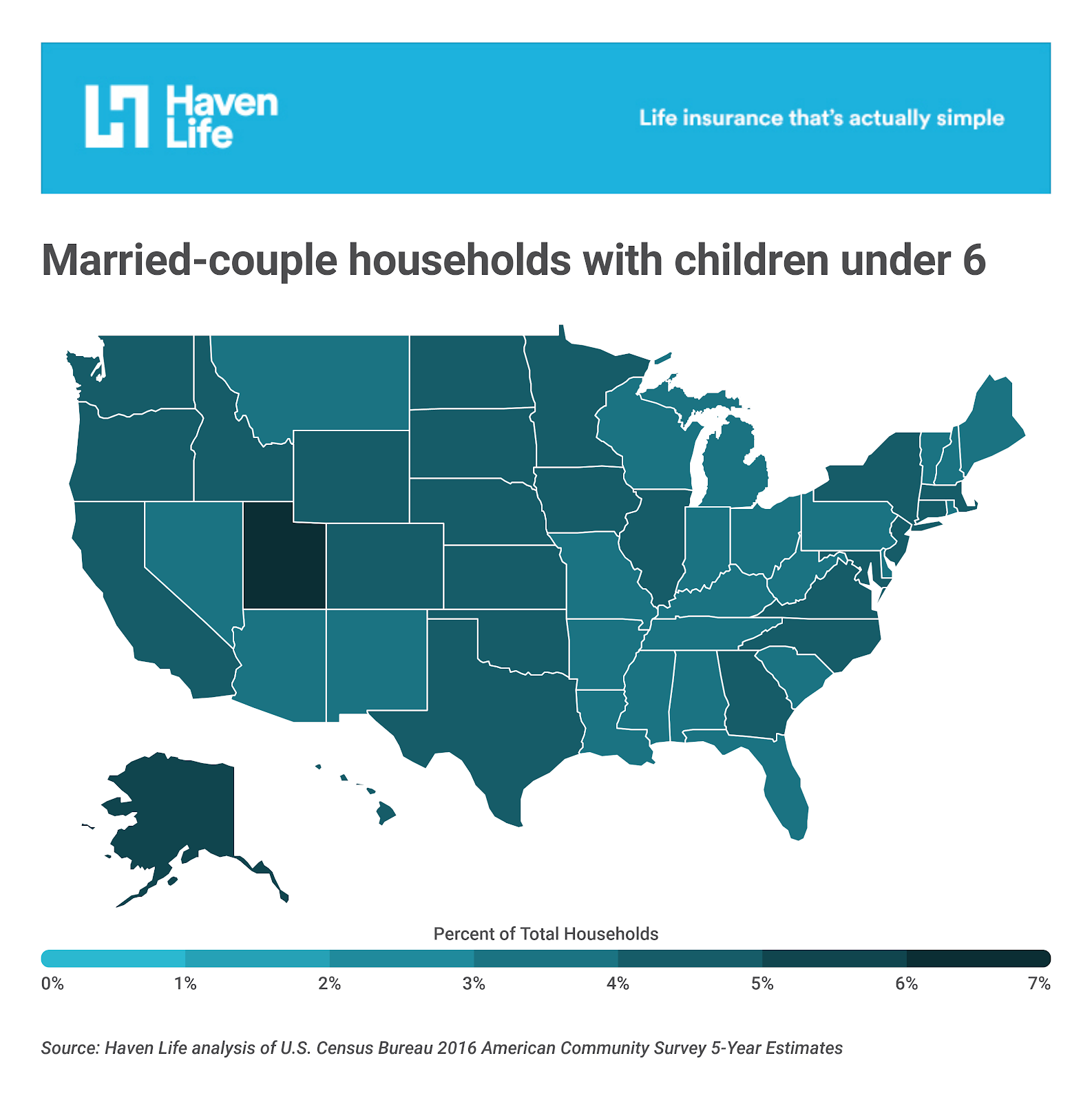
There are 5 million married-couple households in the United States with children under the age of six, accounting for about 4.3 percent of all households in the country. This percentage has remained fairly consistent in recent years, with little fluctuation between 2005 and present, according to data from the U.S. Census Bureau. What has changed is that millennials are now the ones starting families.
According to the Pew Research Center, nearly half of all millennial women were mothers by 2016. Even though millennials have waited longer than previous generations to have kids, they accounted for 82 percent of births that same year.
With so many millennials starting families, they’re often faced with important considerations for their future: job security, safety, education for their children, and more. Where they choose to live has a major impact on all these factors.
To better understand where families with young children are most heavily concentrated, researchers at Haven Life, an online life insurance agency, analyzed data from the U.S. Census Bureau. Its researchers identified the 15 metropolitan areas with the highest share of married-couple families with children under age six, along with a collection of different factors to help determine what makes these cities more appealing for parents.
While this study isn’t restricted to millennial families, the overwhelming majority of families with children in this age cohort are millennial. Here’s what they found.
Takeaways
- Across the country’s largest metropolitan areas, the proportion of households that are married-couple households with children under age six ranges from a low of 1.6 percent in Punta Gorda, FL to a high of 10.2 percent in Provo-Orem, UT.
- Married-couple families with young children are more likely to be found in cities where residents have a higher degree of education, as measured by the percentage of the population with at least a bachelor’s degree.
- These families are usually found in cities with lower unemployment rates and higher household incomes
The following 15 metropolitan areas have the largest proportions of married-couple households with young children.
15. Fayetteville, NC Metro Area

Photo Credit: Chris Boswell / Alamy Stock Photo
- Married-couple households with children under 6 years: 5.8%
- Bachelor’s degree or higher: 23.2%
- 2016 Unemployment rate: 11.4%
- Median household income: $44,532
- Median home value: $212,900
The seat of Cumberland County and the site of Fort Bragg, Fayetteville has one of the largest shares of young families of any city in the U.S. However, unemployment is high and educational attainment is low, with less than a quarter of the population having earned their bachelor’s degree.
14. Des Moines-West Des Moines, IA Metro Area

Photo Credit: Dave Newman / Alamy Stock Photo
- Married-couple households with children under 6 years: 5.8%
- Bachelor’s degree or higher: 35.9%
- 2016 Unemployment rate: 4.8%
- Median household income: $63,534
- Median home value: $184,300
The state capital of Iowa features both affordable real estate and decent job prospects. Its proximity to presidential politics also makes it a great location for the civic-minded (Des Moines is the site of the first caucuses during the primaries in an election year).
13. Colorado Springs, CO Metro Area

Photo Credit: Colin D. Young / Alamy Stock Photo
- Married-couple households with children under 6 years: 5.9%
- Bachelor’s degree or higher: 36.4%
- 2016 Unemployment rate: 7.4%
- Median household income: $60,335
- Median home value: $280,900
Colorado Springs is one of the world’s athletic hubs, serving as home base for both the United States Olympic Committee and Olympic Training Center. While notable for its access to the outdoors, the cost of living is significantly higher than some other options on this list, but income is also higher and the unemployment rate is close to the national average.
12. Greeley, CO Metro Area

Photo Credit: Marek Uliasz / Alamy Stock Photo
- Married-couple households with children under 6 years: 5.9%
- Bachelor’s degree or higher: 26.8%
- 2016 Unemployment rate: 6.0%
- Median household income: $62,820
- Median home value: $315,400
Greeley’s housing is pricier and its educational attainment lower than some other options on this list. However, it sits just under fifty miles from Denver and is close to the mountains, making it a great choice for families that enjoy weekend getaways.
11. Idaho Falls, ID Metro Area

Photo Credit: Richard Schafer / Alamy Stock Photo
- Married-couple households with children under 6 years: 5.9%
- Bachelor’s degree or higher: 26.2%
- 2016 Unemployment rate: 4.8%
- Median household income: $52,939
- Median home value: $193,500
Idaho Falls has one of the lowest unemployment rates on this list, sitting well below the national average. Combined with relatively inexpensive housing, it’s a fine option for families on a budget.
10. Raleigh, NC Metro Area

Photo Credit: Sean Pavone / Alamy Stock Photo
- Married-couple households with children under 6 years: 6.0%
- Bachelor’s degree or higher: 44.3%
- 2016 Unemployment rate: 6.0%
- Median household income: $65,834
- Median home value: $256,100
The North Carolina state capital is home to numerous research centers, alongside its sister cities of Chapel Hill and Durham, making it an attractive option for parents in STEM fields and academia.
9. Columbia, MO Metro Area

Photo Credit: LanaG / Alamy Stock Photo
- Married-couple households with children under 6 years: 6.2%
- Bachelor’s degree or higher: 46.8%
- 2016 Unemployment rate: 4.6%
- Median household income: $50,813
- Median home value: $177,600
Columbia has a lot to offer: low unemployment, affordable housing, and strong educational attainment, thanks in part to the University of Missouri.
8. Fargo, ND-MN Metro Area

Photo Credit: John Brueske / Alamy Stock Photo
- Married-couple households with children under 6 years: 6.3%
- Bachelor’s degree or higher: 36.2%
- 2016 Unemployment rate: 3.0%
- Median household income: $55,941
- Median home value: $212,900
Fargo comes in as the northernmost cities on the list. Affordable housing and a low unemployment rate mean that many families will find themselves comfortable here, provided that they’re prepared for frigid winters.
7. Salt Lake City, UT Metro Area

Photo Credit: Andriy Kravchenko / Alamy Stock Photo
- Married-couple households with children under 6 years: 6.4%
- Bachelor’s degree or higher: 32.2%
- 2016 Unemployment rate: 5.2%
- Median household income: $64,564
- Median home value: $340,800
While Salt Lake City’s housing prices can be steep for families on a budget, its location near various parks, mountains, and nature preserves make it worth the price of admission for many families. Additionally, median household income is well above the national median.
6. Killeen-Temple, TX Metro Area

Photo Credit: Billy Hathorn / Wikimedia Commons
- Married-couple households with children under 6 years: 6.4%
- Bachelor’s degree or higher: 21.6%
- 2016 Unemployment rate: 8.8%
- Median household income: $51,169
- Median home value: $130,300
Home to Fort Hood, Killeen’s economy is tied inextricably to its military presence. While high unemployment and its remote location will turn off some parents, its low property values make it a good option for families looking to keep costs down.
5. San Jose-Sunnyvale-Santa Clara, CA Metro Area

Photo Credit: Marcelo Vinante / Alamy Stock Photo
- Married-couple households with children under 6 years: 7.2%
- Bachelor’s degree or higher: 48.3%
- 2016 Unemployment rate: 6.7%
- Median household income: $100,469
- Median home value: $1,292,600
Located in the heart of Silicon Valley, San Jose is a landing pad for many young parents in tech. However, it is also by far the most expensive location on the list, making home ownership impossible for many young families moving to the city even with their high incomes.
4. Ogden-Clearfield, UT Metro Area

Photo Credit: Witold Skrypczak / Alamy Stock Photo
- Married-couple households with children under 6 years: 7.4%
- Bachelor’s degree or higher: 29.5%
- 2016 Unemployment rate: 4.5%
- Median household income: $65,687
- Median home value: $287,800
Nestled in Utah’s Wasatch Mountains, Ogden is situated just north of Salt Lake City. With that little extra distance comes a significant drop in the median home value, equivalent to more than $50,000.
3. Clarksville, TN-KY Metro Area

Photo Credit: Jugarum of English Wikipedia / Wikimedia Commons
- Married-couple households with children under 6 years: 8.2%
- Bachelor’s degree or higher: 22.7%
- 2016 Unemployment rate: 8.8%
- Median household income: $47,816
- Median home value: $139,900
High unemployment, low incomes, and low educational attainment will understandably scare off many parents. However, Clarksville—the fifth-largest city in Tennessee—has some of the lowest home prices of any location on this list, making home ownership attainable for many families relocating to the city and its greater metropolitan area.
2. Logan, UT-ID Metro Area

Photo Credit: Photononstop / Alamy Stock Photo
- Married-couple households with children under 6 years: 8.5%
- Bachelor’s degree or higher: 34.4%
- 2016 Unemployment rate: 4.5%
- Median household income: $51,777
- Median home value: $242,700
Logan features one of the lowest unemployment rates on this list, reasonable property values, a high percentage of families with young kids, and even Utah State University’s main campus. The city is a great choice for any family looking for the best of all worlds.
1. Provo-Orem, UT Metro Area

Photo Credit: Aurora Photos / Alamy Stock Photo
- Married-couple households with children under 6 years: 10.2%
- Bachelor’s degree or higher: 37.7%
- 2016 Unemployment rate: 4.9%
- Median household income: $63,994
- Median home value: $323,300
While property values are pricier than many options on this list, above average incomes and the large percentage of families with young kids will make the Provo-Orem metropolitan area attractive to parents looking for a community of similarly-situated people. Additionally, its proximity to Salt Lake City, the Wasatch mountains, and numerous ski resorts make Provo a desirable location for families who love the outdoors.
Methodology
Only metropolitan areas with more than 65,000 residents were considered, based on the 2016 U.S. Census 5-Year Estimates. Family composition, educational attainment, income, and poverty data are taken from the 2016 American Community Survey 5-Year Estimates. Median home value data is the current Zillow Home Value Index (ZHVI) provided by Zillow Research. Metros are ordered by the percent of total households that are married-couple households with children under six years old only.
Haven Life Insurance Agency LLC (Haven Life) conducted this research for educational/informational purposes only. Haven Life is an online life insurance agency offering term life insurance issued by Massachusetts Mutual Life Insurance Company. Haven Life does not provide tax, legal, investment, or housing/real estate advice, and the information in the study should not be relied on as such. You should consult your own tax, legal, investment, and other advisors, as appropriate, before engaging in any transaction.
4 tips to heal after a non-breakup from your non-relationship

Way back when, in fall 2017 into winter 2018, I was seeing someone…sort of. It wasn’t a relationship per se, but it wasn’t totally platonic either. The whole experience was confusing: How much of it was objective(ish) truth, and how much of it was my subconscious projection and misinterpretation? Not knowing these answers made understanding how to handle the inevitable breakup feel impossible. Because, like that supposed tree falling in the woods, can there even be a breakup when there’s no relationship to effectively end?
We met through mutual friends and quickly began texting and going on dates—yes, the dinners, movie nights, and shows were indisputably dates. But beyond knowing that we were, in some sense of the word, dating, I didn’t have much of an understanding of our relationship. We never really discussed it, partially because I was not in a rush to DTR, but also because things just seemed to working. I didn’t want to harsh the vibe or create weirdness where none currently existed.
Month after month, it went on, until one day, it was unceremoniously over. Of course, since we were never really together, there was no breakup. I felt confused and pretty mad while I unsuccessfully searched for closure. But what was I even looking for?
There is a huge gray area between being single and being in a relationship, yet there’s also a huge lack of language to articulate this space.
While I’d like to believe this experience was unique to me (mostly for the emotional health and greater good of the world), such is not at all the case in modern dating. There is a huge gray area between being single and being in a relationship, yet there’s also a huge lack of language to articulate this space. While terms like orbiting and ghosting explain the often-shitty aftermath of these early, not-yet-official relationships, there isn’t simply isn’t an apt way to describe them in their prime.
So, by way of traditional closure, your prospects are slim unless you’re willing to confront your sort-of ex (I’m not). Instead, focus on what you can control, namely yourself. Below are expert-approved tips for how to handle a breakup—or rather a non-breakup—from a non-relationship.
Keep reading for 4 steps to heal after a non-relationship ends.
Photo: Stocksy/Alexey Kuzma
1. Acknowledge your feelings (and their validity)
In traditional (read: defined) relationships, there is an accepted grieving period following a breakup, says Carolina Castanos, PhD, founder of MovingOn. When the situation may not seem worthy of the emotional bells and whistles that tend to accompany full-blown breakups, however, the recovery period here can take on a different, less identifiable form. “In a non-relationship, grief can take a different shape, as there is uncertainty regarding what you meant to the other person,” she says.
“Ambiguous boundaries of the relationship do not diminish the feelings you may have developed.” —Jess Carbino, PhD
This can make parsing your feelings on the matter difficult because it can give way to notions of unworthiness. Still, Dr. Castanos champions the importance of not only identifying your emotions, but understanding that you’re allowed to feel all of ’em. Jess Carbino, PhD—a doc and Bumble’s in-house sociologist—agrees. “Ambiguous boundaries of the relationship do not diminish the feelings you may have developed,” she says.
2. Sort your emotions
Next, Dr. Castanos says it’s helpful to wallow with purpose. “Allow yourself time to grieve, and make sure you know who these feelings are toward,” she says. “Feel them and put words to them.”
In my situation, I was frustrated with myself for not being shrewd, and angry with him for being dismissive and emotionally manipulative. Decoding the confusion helps to clear the general fog.
3. Contextualize the relationship
You may never know how the other person regarded your relationship, but Dr. Carbino says you can analyze your own opinions about this to great effect. “In terms of finding closure when boundaries or definitions or unclear, it is helpful to consider how you defined the relationship and what it represents to you.” By doing this, you can draw boundaries that’ll help your see clear closure for yourself.
4. Find the silver lining—because there is one
One borderline-positive effect of my situation is it forced me to think about what I need from a partner. While defining the relationship has always been a panic-inducing topic for me because it always seems to indicate more seriousness than I’m prepared for, Dr. Carbino says it’s a good idea to still at least have The Talk with yourself. “We all need boundaries so that we can have clear expectations about how to operate in the world,” she says.
Do I need strict definitions and boundaries, a traditional union, or simply more emotional openness punctuating a still-ambiguous setup? I don’t have the exact answers yet, but at least I know what I’m not looking for: a non-relationship rooted in a complete lack of communication.
This is how you should approach dating if you have social anxiety and how it changes when you’re in your thirties.