




Category Archives: Relationships
Love Yoga? Hate Tinder? MeetMindful Was Made for You!
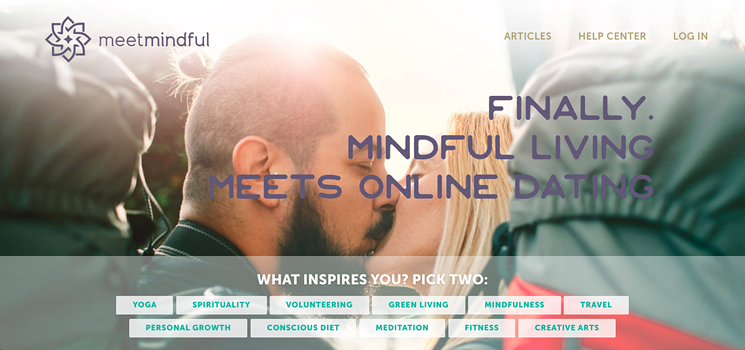
Amy Baglan, co-founder of the online dating platform MeetMindful, is convinced that technology has disrupted the way human beings are supposed to connect with each other.
“Social media and technology in general has taught us that it’s okay to connect on really surface-level, quick ways, and that’s not how I think we’re wired as humans,” Baglan says. “There is an underlying anxiety that it’s not enough, that something’s missing.”
That underlying anxiety is what MeetMindful, her Denver-based startup, set out to address. Baglan wants her niche dating site to be a tech fix for tech stress — enabling people to connect in meaningful ways with others who are also interested in “mindful living.”
That term might bring to mind yogis and vegans, but according to Baglan, MeetMindful is popular with a wide audience of people who are dedicated to holistic health and personal growth. “This stuff isn’t just fringe hippie shit anymore,” she says.
The origins of MeetMindful date back to 2006, when Baglan was the vice president of a New York City startup, Ez Texting. She started to practice yoga and meditation, and found that they “filled a void” in her personal life. In 2010, she quit her job, sold all her stuff, and embarked on a journey to India and Southeast Asia. “It was very Eat, Pray, Love,” she says, laughing. “I wanted to take life by the reins and create something that was in line with my values and my passions.”
MeetMindful wants to be the first stop for singles interested in mindful living practices.
MeetMindful
While abroad, Baglan studied partner yoga and Thai massage, and met communities of ex-pats who were invested in various ”mindful living” practices. “It didn’t matter what somebody’s practice was or what they were studying, because that ebbs and flows throughout someone’s lifetime,” Baglan notes. “What mattered was this similar dedication to the integration of mind, body and spirit.”
In 2012, Baglan returned to the United States and moved to Denver, a city she’d visited once, on a whim. Right off the bat, she founded a company called Yoga Dates, which hosted events like “Yoga Speed Dating” and “Vinyasa and Vino.” The events were instantly popular, Baglan recalls, and they were a hit not only with yogis, but with people who were tired of trying to meet potential partners on sites like eHarmony and match.com. Baglan realized that the community of singles interested in some kind of holistic wellness practice was larger than she’d assumed, and it got her thinking about an online platform that would not only reach a wider audience, but provide a more consistent way for yoga aficionados to meet each other — and also save Baglan from having to coordinate meet-up logistics herself.
In 2014, Baglan met Adam Taylor, and together they created a successful prototype of the site she’d envisioned. The next year, Baglan and Taylor launched a beta version and were accepted into Techstars Boulder Accelerator. The Techstars program, which Baglan says was a “big catalyst in our growth,” was co-founded by gubernatorial candidate Jared Polis; it provides mentorship, networking opportunities and seed funds for a selective class of startup entrepreneurs each year. MeetMindful has been growing ever since, nearly doubling the size of its team over the past six months and recently raising $5.5 million in a round of investments.
Although marketing efforts are concentrated in seven major cities, MeetMindful is now available worldwide. Although Baglan declines to share how many singles have joined the site, she notes that the Denver/ Boulder area is the most active on MeetMindful.
One of the challenges Baglan faces is that MeetMindful is a social network designed for and marketed toward people who might be skeptical of meeting potential romantic partners online, seeing online dating as inauthentic.
As a result, the company has had to look beyond the usual social-media platform strategy of “hooking” users with almost addictive features. Baglan has paid close attention to how Tinder and other swipe-to-date apps have changed the dating scene for millennials — adversely, she thinks, noting that most people end up using the apps for superficial conversations or “mindless swiping” rather than real connections.
 EXPAND
What shows up first in a MeetMindful profile? Not only your pictures, name, and age, but your “mantra” and the mindfulness practices you’re most interested in.
MeetMindful
A 2016 study by researchers in the Netherlands indicated that while millennials might be using Tinder to find love rather than no-strings-attached hookups, they were getting sucked into another primary motivation that surfaced in the study: “self worth and validation.” And when consumer-financing company LenEdu analyzed data compiled from polls of college students, 44 percent of Tinder users said that their main reason for using the app is “confidence-boosting procrastination.” But Tinder may not even fulfill that motivation: A study by the University of North Texas revealed that men who use Tinder have lower self-esteem than men who don’t, and indicated that all Tinder users tend to have a more negative perception of their own body image.
Profiles on MeetMindful are much more comprehensive than Tinder’s allotted six pictures, location, age and short bio. Users are asked to share a “mantra,” a favorite quote that appears on the top of their profile along with the mindfulness practices to which they are most dedicated. The next section asks users to share how their friends would describe them, then describe themselves in their own words. The remaining questions on the profile, according to Baglan, are meant to both establish open honesty and offer opportunities for users to make the move: suggestions for what potential partners should ask about, and “imperfections I’m embracing or changing.” Users can also identify their diet, religion, level of physical activity, and whether they smoke, use drugs or drink. Then they can select and publicize their “dealbreakers” (i.e. “Vegans aren’t for me,” or “Previously married people aren’t for me”).
This approach struck a chord with Longmont resident George Morris, who joined MeetMindful in February 2017. “I was highly skeptical when I was first using it,” Morris says. “I thought, ‘Another dating site, been there done that.’” But Morris was pleasantly surprised by how many women on the site were just the type of person he’d been looking to meet: “mindful, athletic, live an intentional type of lifestlye.” He soon met his current girlfriend; they’ve been dating for a year and a half.
Even though they enjoy many of the same activities, Morris thinks it’s unlikely that they would have started dating without the app. “You’re not going to yoga class thinking you’re gonna find someone to date; you’re going to be mindful. It’s kind of the last place you want to go to meet someone,” he explains. But MeetMindful saved him from having to think of a pick-up line while trying to meditate in his satsang class. Through the site, he was able to make a deep connection quickly, he says.
That’s partly because MeetMindful has integrated features into the site and app that gently urge people to date mindfully, keeping in sight their goals of making meaningful connections and taking them into the real world. “We want people to actually do this with intention,” Baglan says. To further that, the company plans to roll out a new pricing model this fall that actively works against the typical Tinder tendency of mindlessly swiping. Right now, MeetMindful users must purchase the premium version in order to message their matches. The in-the-works free version prioritizes communication over mindless swiping: Users will be able to message their matches for free, but can only see a limited number of profiles each day, and they must view each profile for a certain amount of time before deciding whether to “like” them or not. “We’ve made it so you have to actually look at the person before you make a decision, and not just their picture,” Baglan explains.
MeetMindful publishes a dating advice column on the website, where mindful-dating gurus post articles ranging from “How to Make the Move from Online to a Real Life Date” to guidelines on addressing holistic health seekers’ deepest concerns, such as “How Can I Tell If My Partner Has Genuine Self-Love?” Community guidelines are in the works, as is a feature that will allow users to politely say “Thanks, but no thanks” to decline a date, rather than ghosting their matches by simply not responding to them.
Baglan hints that even bigger changes are on the way, which may lead MeetMindful to expand beyond dating. “We want to be the place for anyone who’s interested in learning about this stuff. This is the place they can go for making inspiring connections both online and offline in real life,” she says.
If all goes well, Baglan envisions MeetMindful facilitating the kind of community-building she saw in her travels abroad. “The mantra that we’ve been saying recently is that personal growth shouldn’t happen alone,” she concludes. “That’s going to be our guiding light.”
Q&A: Andrea Horwath on parenting, dating and dealing with Doug Ford

In the election, you nearly doubled your seats. On the other hand, you’re not premier. Do you see it as a win or a loss?
It’s a bit of both. Not being able to implement our ideas is disappointing, but we will be a strong opposition to Mr. Ford. We’ll remind him that 60 per cent of voters didn’t choose him, or the public service reductions, layoffs and corporate tax cuts he represents.
Ideologically speaking, Ford is much further from you than Wynne was. Which would you rather have as premier?
I truly couldn’t decide. That’s a choice between two negatives. I voted for me.
Was sexism a factor in Ms. Wynne’s extreme unpopularity?
I don’t think so. She was elected as premier once before. It was her time to go.
Have you encountered sexism in this job?
Oh, always. Everywhere. Just recently, a Liberal MPP walked up to the front of the legislature, looked me in the eye and said “My, you’re looking lovely today.” What that had to do with the price of eggs, I have no idea.
A slew of new female NDP candidates were elected this time. What’s your advice to them regarding sexism?
That it will happen, and when it does, don’t stand for it. Call it out. Name it.
You’ve said some harsh things about Doug Ford. Now you have to work with him. What’s your relationship like?
We don’t have one. Frankly, I don’t know if we will.
He hasn’t invited you to the family barbecue?
No. Doug and I don’t run in the same circles. I am somebody who actually runs in everyday family circles, with everyday people. I don’t have a business in Chicago and fly there every other weekend.
There were dark days for you in 2014, after you prompted the election and Wynne swept her way to a majority. How close were you to resigning as leader?
I don’t give up easily. It was a disappointing time, but I emerged with the sense that people were ready to give me a second chance.
Employment-wise, you’d been in tough spots before. Hardest jobs: go.
Oh, where to start. Picking fruit, working in an industrial dry cleaner, waitressing at a mall. I was a short-order cook at a golf course and a cocktail waitress in Hamilton.
That last one was where you met Ben, a musician moonlighting as a DJ.
That’s right. It was the ’80s, so he was spinning a mix of disco and some newer stuff.
Your common-law relationship ended in late 2009, just after you were elected leader. Is it fair to say the two were related?
No, it had been rocky for a while. I don’t think a life in politics portends divorce any more than other high-profile, high-pressure occupations.
Do you have a partner now?
I’m seeing someone, but it’s new. The person I turn to most for support is my son, Julian. He gives good advice.
He’s an aspiring rapper and a former dispensary employee. Was it a problem for you that he sold pot pre-legalization?
I wasn’t thrilled by the news but not shocked either. He has had a prescription for cannabis for some time.
How often do you see him?
Every time I’m home in Hamilton. He still lives with me in my condo there. He’s picked up a couple of part-time jobs, but they don’t seem to mix well with his music career. I told him I’d support him a bit longer, but, you know, he’s 25.
I sense a talk coming.
Oh, we’ve had it. He knows he’s on his last push.
What’s the best perk of being Opposition leader?
The new office will be nice. Back when I became leader of the NDP, I went to the government art holdings to find some paintings to put on the walls. It turned out that Kathleen Wynne had already gone in and plucked most of the ones I wanted. So maybe this time I’ll be able to go in and get some art that I like—mostly Canadian artists.
So there could have been a beautiful friendship there, but she stole your art?
Haha. Exactly. Go figure.
This interview has been edited for length and clarity.
5 tips for dating an introvert, according to a psychologist who is one

Opposites attract, or at least they do for psychologist, author of Introvert Power, and self-proclaimed introvert Laurie Helgoe, PhD: Her husband of 35 years is an extrovert.
Still, she tells me, extrovert-introvert relationships can be high maintenance (as anyone who’s ever been in one well knows). “The research seems to suggest that introvert-extrovert dynamics generally pose challenges for the relationship,” she tells me.
There are a lot of differences between those with extroverted personalities and those with introverted personalities—and they go much deeper than a preference for going out versus staying in—but one key variation between the two is often the culprit when conflict arises. “Generally, an extrovert is drawn to higher-stimulus activities and introverts are drawn to lower-stimulus activities,” Dr. Helgoe explains. “So introverts are usually trying to turn down the volume while extroverts are usually trying to turn it up.” Hence, tension.
With that said, Dr. Helgoe tells me that navigating such a relationship can actually help you grow in ways that dating someone who is more similar to you cannot. To help you make it work, she offers some tips for dating an introvert when you’re on the other end of the spectrum.
Keep reading to find out how to make your extrovert-introvert relationship work.
Photo: Stocksy/Luke Liable
1. Remember: Quiet does not mean disengaged
Introverts, says Dr. Helgoe, need a lot of time to process their thoughts before they speak. “We have a higher standard for what we put out,” she explains. “That doesn’t mean we’re better, it just means that we like to develop our ideas internally whereas an extrovert is more comfortable doing so relationally, putting out something that they might not have thought that much about and then kind of going back and forth on it.” Sometimes, she says, extroverts can misinterpret this lack of engagement as a lack of interest, which is just not the case. (It’s actually the opposite!)
2. Try not to talk over the silences
Therefore, to best enable dialogue with an introvert, she says, you need to give them space. This means not filling the dead air with conversation in order to avoid what you, as an extrovert, might perceive to be an awkward or uncomfortable silence. “It can be a conversation-stopper for an introvert if you get into that space too quickly,” Dr. Helgoe explains. “They will start to disengage because they don’t have time to process what you’re saying or think about how they want to respond.” If you allow them time to pause, on the other hand, you’ll likely “get something good” back and the convo can continue.
According to Dr. Helgoe, this knowledge should provide some relief for extroverts who often feel burdened to do all the work in a conversation. “Extroverts will be more likely to talk more when they’re anxious, so it might help to know that an introvert doesn’t really need you to do that—and in fact, might appreciate it if you just kinda look around and sip your coffee and do something else to fill that space,” Dr. Helgoe says.
3. Learn to read body language
With that said, sometimes conflict-adverse introverts can clam up when they’re upset about something, says Dr. Helgoe. And without verbal communication, you might understandably struggle to discern the difference between a pensive introvert and a pissed-off introvert. Dr. Helgoe advises paying attention to non-verbal cues, which she reiterates might be missed if you try to talk through the pauses. A furrowed brow, for example, might indicate the person is thinking (but not mad!), whereas crossed arms may suggest conflict is brewing.
4. Negotiate your social needs
As an extrovert, your need for stimulation often has you craving social situations, says Dr. Helgoe. Introverts, meanwhile, are easily overwhelmed by excess interpersonal interaction, especially if it takes place in big crowds (e.g. a party or a concert). Because of this disparity, compromise is often necessary. “The more that people can be upfront, especially early on in relationships, about what that sweet spot is for them and negotiate around that, I think the better the time the couple will have together,” she says.
This may mean devising a plan in which you attend a party for some finite amount of time before retreating into a more one-on-one situation. Or, Dr. Helgoe says, you can strike a more creative compromise. “An action movie might give the extrovert that stimulus [they crave] while the introvert gets to have a little bit of a break from social interaction,” she says. “So, that might be an example of something that works for both people.”
As an introvert myself, I’ve also found that a key component to navigating this often frustrating difference is to be okay with spending time apart, too. Though you may be bummed to have to go it alone to parties, doing so can help you get out of your comfort zone—which can be a very good thing. Plus, your introvert will be super happy to see you when you get home.
5. Set ground rules for fighting
Remember that whole conflict-adverse thing I mentioned earlier? It can be a huge issue in extrovert-introvert relationships, says Dr. Helgoe. “Fights can be highly stimulating,” she explains, which is why introverts tend to avoid them in favor of brooding. This can drive extroverts—who’d prefer to just hash it out and move on—crazy. To set yourself up for successful conflict resolution, Dr. Helgoe says the first step is to set ground rules. For the extrovert, this might mean asking your significant other to just tell you when they’re upset, assuring them you don’t mind being confronted in the same way they do.
Because introverts tend to need time to process their thoughts, you may need to make room in the process for that as well, Dr. Helgoe says. When I tell her I drive everyone in my life crazy by fighting via email rather than in person because I can’t think clearly when confronted, she tells me this is normal for introverts. Extroverts, who do better with face-to-face conflict, however, don’t need to sacrifice their comfort own level to accommodate their partner’s needs. Instead, Dr. Helgoe suggests they ask introverts who rely on this method of expression to instead read them what they’ve written.
If you do find yourself sparring with an introvert, Dr. Helgoe cautions that you need to be careful not to immediately bulldoze them—ensuring an unfair fight—by raising your voice. “Introverts tend to be highly sensitive individuals, so if somebody’s angry they might over-interpret its severity, actually,” she explains. “Therefore, a little goes a long way with them.”
This, Dr. Helgoe says, is where the introvert may need to reaffirm their boundaries. “[They might be like], ‘Hey, I can’t really process this when you’re talking so loud, can you tone it down?’ or ‘You seem agitated, can we talk about this later when you’re calmer?’” she suggests. Honoring these requests, she says, will help the introvert to actually hear you out. “So much of successful conflict resolution is negotiating in this way so there’s more room for both of you to tell your story.”
Still on rocky ground? Here are 6 signs it’s time for the relationship to end. And if it does, you’re probably going to need these 7 tips for staying happy, confident, and sane while online dating.