



Category Archives: Relationships
7 Things To Know Before You Start Dating a Friend
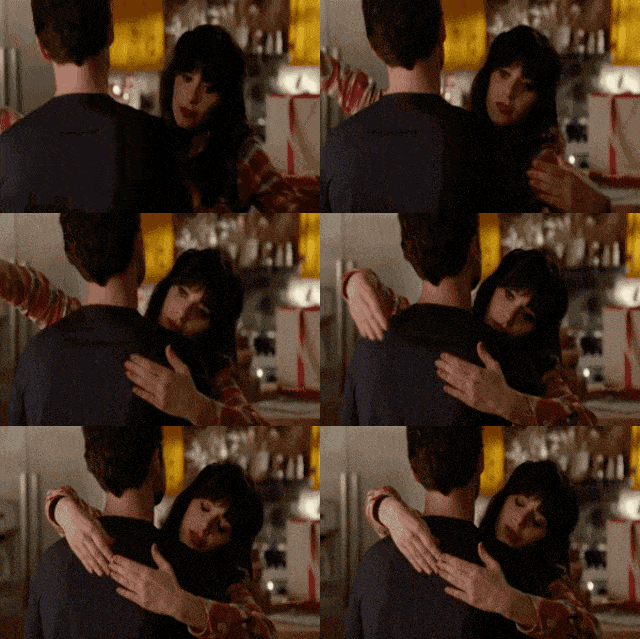
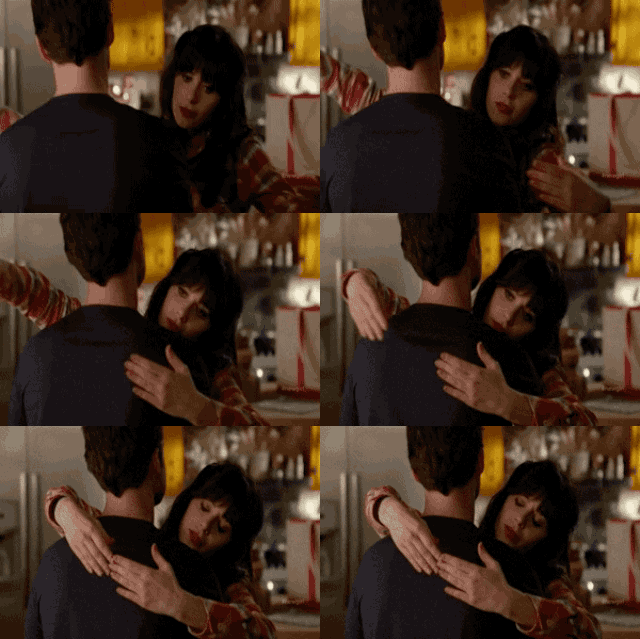
The first kiss my boyfriend and I shared as friends-who-now-know-they-like-each-other was nothing short of terrifying. I pulled him into what I thought would be a sweeping, spark-filled smooch and he just stood there, hardly moving. The rest of the date was even more catastrophic. We nervously drank too much and watched Sweet Home Alabama on his bed without looking at each other. I was convinced we had no chemistry and that I ruined a perfectly-great friendship. (Then date two happened and we successfully made out after talking out the awkwardness sh*t storm that was our first date and all was well!).
Advertisement – Continue Reading Below
Giphy
All to say: I have been there. Sure, friend-to-partner transitions can be magical and simple, but they can also be confusing and anxiety-inducing as all hell if you’re someone who doubts themselves a lot. Luckily, there are steps along the way to make this whole process less like the most stressful thing that’s ever happened to you. Here are seven things to keep in mind if you’re two friends thinking of dating each other:
1. Flirt to test the waters.
It can be tough to suss out if you have mutual feelings when you’re already jokey and sweet to each other. “Flirting is a skillful testing of the waters where you’re protecting yourself from rejection,” says Dr. Theresa DiDonato, Associate Professor of Psychology at Loyola University. “It can give you a safe space to see if the other person flirts back.”
Advertisement – Continue Reading Below
It doesn’t have to be anything too overt right away – we started off with dressing room selfies where we asked each other’s opinions on outfits we already knew we looked really good in. Eventually, I graduated to borderline-sexts about how his legs looked in shorts, but there were so many baby thirst steps in between. The point is you can take your time with getting more flirty and seeing if A.) they seem to return the flirtiness and B.) they’re flirting with just you instead of generally flirting with everyone.
2. Make sure you have the right kind of friendship for a relationship.
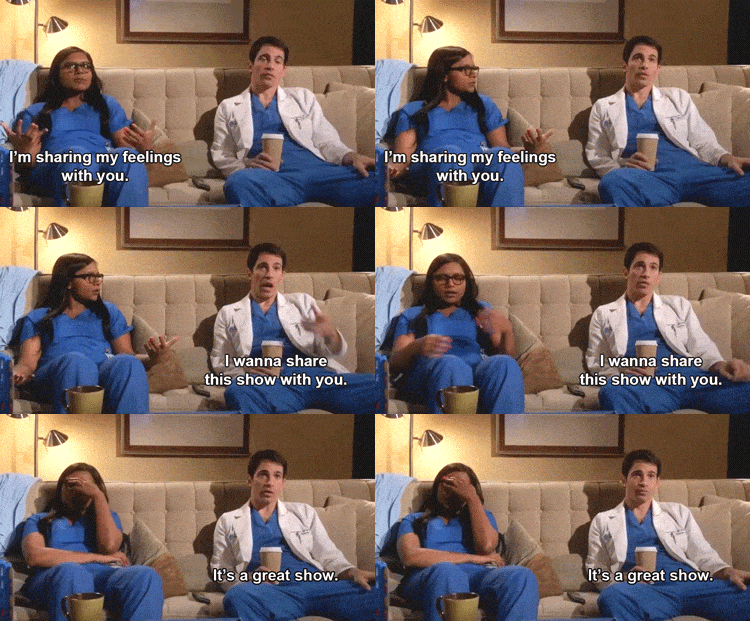
There’s a huge difference between your ride-or-die BFF and someone who’s just really fun to party with. “I would consider the quality of your friendship before transitioning to a relationship,” says Dr. DiDonato. “Do you feel safe and secure in that friendship, or is it an exciting, emotional ride?”

Giphy
Advertisement – Continue Reading Below
Advertisement – Continue Reading Below
Your friend’s robust social life can be hot until they flake on date night over and over again. “Sometimes these dominant traits we love in a person and that drew us in [as friends] becomes the thing we don’t like anymore,” adds DiDonato.
3. Be really honest about why you want to date them.
When you’ve re-downloaded every new dating app only to swear off romance for the rest of your life two hours later, dating a trusted friend can feel like a great option. They’re cute, they’re nice to you, and you can trust them. But there’s so much more to a healthy romantic relationship than just feeling secure.
“There should be some element of sexual attraction or romantic desire,” says Dr. DiDonato. “And even if that’s there, there may not be enough for a healthy, stable, romantic partnership.” She also goes on to mention the importance of shared goals and parallel life plans – dating someone who feels “safe” can backfire when you realize they’re not as motivated or socially active as you.
4. Go all in if you’re going to do this.
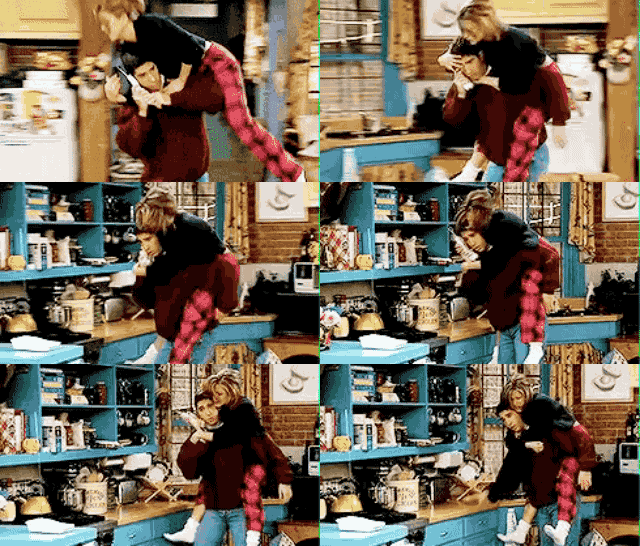
Wavering a little is perfectly normal if you both value your friendship and really don’t want to mess it up. But consistently worrying about the state of your friendship with every new step you take in your romantic development is just no good.

Giphy
Advertisement – Continue Reading Below
“A couple who goes through a breakup might then have to negotiate how they’ll share their network of friends, says Dr. DiDonato. “But at the point where they’re a couple, I don’t think it benefits them to keep saying ‘Ok, if we break up, what’s going to happen?’”
Yes, you are taking a risk on your friendship by dating. Yes, depending on if and how you break up, you may not be friends in the end. But if you can’t stop focusing on the potential future turmoil, you should rethink moving along. “If you’re both truly interested, there’s more to lose if you don’t try than if you do,” says DiDonato.
5. Don’t involve your friends too much in the beginning.
Realizing you might have mutual feelings for a friend can be something you want help sorting through, but if you’re going to talk to someone, consider picking someone who isn’t a shared friend. “It’s not always be a straight path moving from friendship to a romantic relationship – there might be some back-and-forth,” says DiDonato. “Shared friends might be really interested in this thing that’s happening between the both of you, but a romantic relationship is between two people.”
Trust: the last thing you need on top of your nerves is a gaggle of mutual friends eyeing you talking to your friend from across the bar and drunkenly blurting out that you should both just kiss already.
Advertisement – Continue Reading Below
Advertisement – Continue Reading Below
6. Expect that things – including sex – might be really awkward at first.
“People bring different sexual expectations to their relationships, so whether you’re expecting magic the first time or you see your sexual relationship as something that can grow and change, that’s going to influence how satisfied you are not just sexually but in the relationship,” says Dr. DiDonato. “Two individuals who are willing to work on that factor might have an easier time transitioning into a relationship.”

Giphy
If your relationship kicks off with a When Harry Met Sally monologue, more power to you. But it’s definitely not the standard to hold yourselves to. “If you hold those beliefs, you might take any sort of stumbling as a sign that it’s a problem and this relationship that isn’t worth pursuing, rather than recognizing little points of awkwardness and stumbling as something you can work on,” says Dr. DiDonato.
Advertisement – Continue Reading Below
7. Accept that your relationship will get more complicated.
Just because you get to regularly bone your cool friend now doesn’t mean that that’s all your relationship will entail. In many ways, things will get more emotionally complex than your friendship ever was, and that’s a good thing. “Both people need to be on-board with creating a new sense of interdependence and commitment,” says Dr. DiDonato. “It’s not just friends who have a sexual relationship – it’s a romantic partnership. We depend on and our romantic partners depend on us way more than we do as friends.”
Figuring out how to deal with jealousy, or meshing your schedules together, or helping each other through bigger life problems you never knew about before are all a part of it. It’s not as simple as grabbing a random coffee like you used to. But it’s so much better.
Follow Julia on Twitter.
The Ghostwriter Next Door
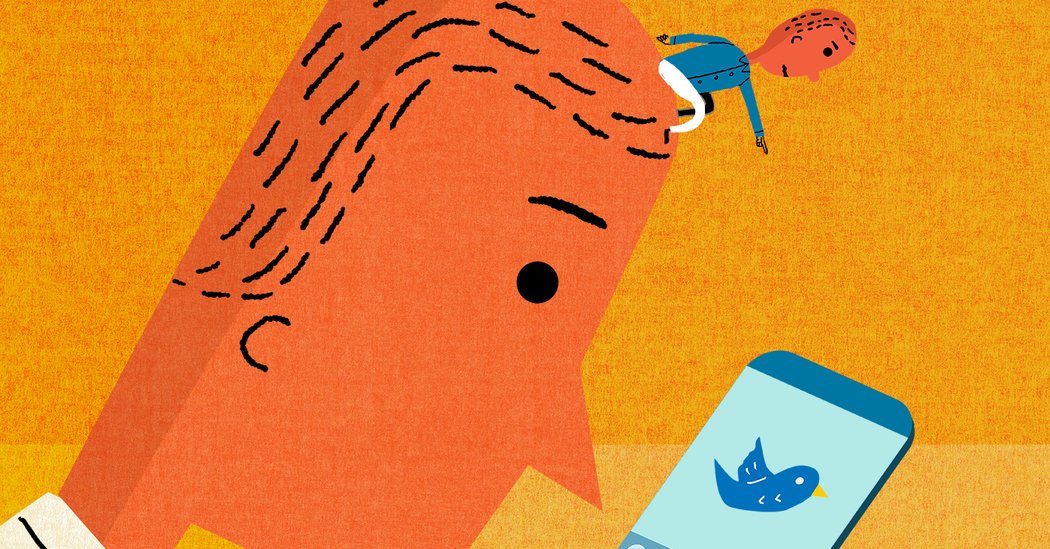
It may also be more common among younger generations. Eric Hegedus, 55, the chair of the physical therapy department at High Point University in North Carolina, says he has never requested ghostwriting assistance.
However, when his daughter, 25, asks him for work-related advice, Dr. Hegedus obliges. “She’ll say, ‘My employer sent me this offer. This is how I’m planning to respond. Will you take a look and let me know if there’s anything else you would ask, or if there’s any way else you would say this?’” he said.
Dr. Hegedus’s daughter doesn’t ask her father for relationship tips. Sometimes, though, her mother, Tess, gets involved on dating apps: matchmaking with cellphone in hand.
“She and my daughter sit side by side. They’re discussing back and forth,” Dr. Hegedus said. “Occasionally, my daughter will say, ‘not that guy,’ and my wife will swipe the wrong direction.”
Professional Help
Inevitably there are now professionals to intervene in such situations.
“I don’t want people to let obstacles, or lack of time, stop them from online dating,” said Erika Ettin, 36, founder of A Little Nudge in Washington, D.C.
Ms. Ettin, an online dating coach with 15 to 20 clients, rewrites profiles, administers advice and swipes on behalf of singles. “I write to potential matches,” she said. “I respond. I delete the inappropriate people.”
The cast of 'Book Club' on their worst dates and when to swipe left
Have you ever wondered where you should go on a first date? How many cats are too many cats for a prospective partner to own? When you should meet your new boyfriend’s parents — or kids?
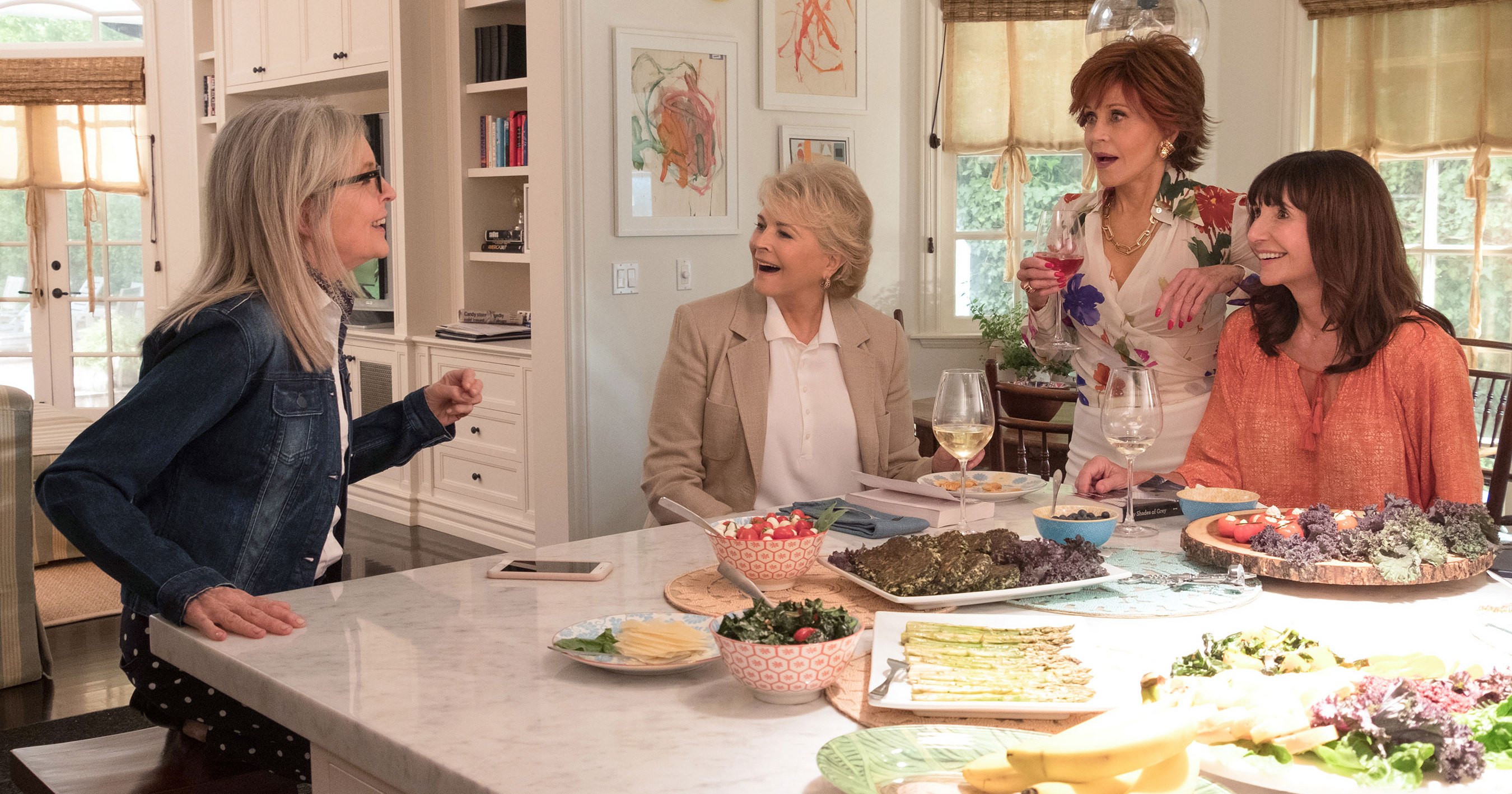
Well, the women of Book Club are here to answer your burning dating questions. It can be tough to navigate the complex world of swiping, ghosting, and texting, but you’ll fare much better knowing that Mary Steenburgen, Candice Bergen, and Jane Fonda don’t think you should waste more than an hour on a date if you’re not hitting it off immediately.
The three veteran actors star (alongside Diane Keaton) in the new rom-com, out May 18, that is technically about four longtime friends who decide to start reading the 50 Shades of Grey series in their book club. The women are all in various stages of unlucky-in-love — from a marriage rut to divorced to widowed to men? Who needs ’em? — and, as can be expected, reading about the kink habits of Christian and Ana put a little pep in everyone’s steps.
In between the book club meetings of all our dreams — it’s your four favorite actresses, plus Nancy Meyers-level cheese boards, plus a seemingly nonstop flow of white wine — they set out to fix what is broken in their respective romantic lives. That means joining the online dating world, giving an old flame a new chance, and an accidentally-on-purpose Viagra-spiked beer. So naturally, when EW got the chance to sit down with Steenburgen, Bergen, and Fonda to talk about Book Club, we had to grill them on all things romance. Watch as they share advice and their own personal horror stories — and definitely try this at home.
Magical Money – the ICO crypto-currency boom
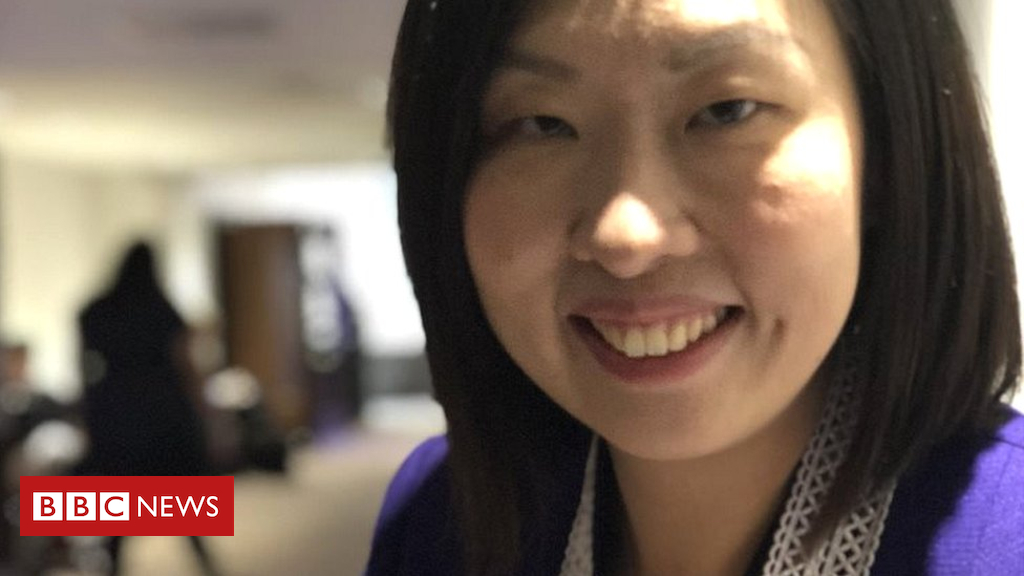
Violet Lim wants to get rich by marrying together internet dating and the latest investment craze.
“Our ICO is about love on the blockchain,” the founder of Viola.ai exclaims.
“You can use it to get curated matches, to buy flowers, to book restaurants or even get dating and relationship advice.”
ICOs – or initial coin offerings to give them their full name – are a way to raise funds by creating a new form of money from thin air.
And in the radio documentary Magical Money we try to find out whether this is a revolution in finance or a bubble that is already bursting.
Singapore-based Violet has been involved in the internet dating industry for years.
But she believes an ICO presents a way to raise $17m (£12.6m) from investors, who will get tokens to use in their dating activities.
Why, I want to know, do you need a token to buy flowers for your loved one and why does the service have to be on this magical blockchain which apparently solves every problem?
“We are trying to solve a very important problem in our industry, which is the lack of trust,” she replies.
And she explains that by entering people’s details on an immutable blockchain, Viola will be able to deal with “love scammers” who hide their true identity.
But her enthusiasm gives way to a degree of despondency soon after, when Google bans crypto-currency and ICO ads on the very day Viola’s public sale gets started.
“[It’s been] a very bad first day followed by a very bad first week,” a more muted Violet tells me.
Exotic cars
Violet is one of dozens of ICO-dependent company founders we first met at an event called London Blockchain Week in January.
They were all convinced of two things: that fashionable blockchain technology could revolutionise just about every industry on earth, and that huge profits could be made by creating new currencies to fund this wave of disruption.
“There’s a craze going on,” says the event’s organiser Luis Carranza.
“It might be a hype cycle, but it also could be the beginning of a new industrial revolution.”
He explains that an ICO involves both creating a new crypto-currency or token like Bitcoin and Ethereum, and selling investors on the idea that these coins will be the foundations on which radical new blockchain projects will be based.
In the programme we follow Viola’s fortunes as well as those of another project.
“Bitcar is a new decentralised platform,” explains founder Gov van Ek.
“And on there will be high-end exotic cars and people will be able to acquire a fractional interest in those cars.”
Investors will never be able to drive the McLarens and Ferraris that Bitcar will one day acquire.
But the idea is that the tokens they obtain via an ICO aiming to raise $25m (£18.5m) will rise in value along with the automobiles.
A belief in the power of blockchain – essentially a database shared across multiple computers where every new entry is added to an unchangeable log – has seen billions of dollars invested in ICOs over the past 18 months.
But finance blogger and former banker Frances Coppola has a warning: “I’m not saying there isn’t value in blockchain, but the way it is getting hyped is ridiculous.”
We asked her to look at the Bitcar and Viola ICOs, and she was not impressed.
Of Viola she asked: “What’s the point?”
And she was not convinced by Violet Lim’s assertion that the blockchain would make dating more secure
“Why on earth would I want my entire dating history up on a public blockchain where everyone could see it?”
Turning to Bitcar, she insisted the fractional car ownership scheme was no more or less than a derivatives market with all the risk that entails.
“If people want to gamble on tokens that might or might not have some hard asset backing which might or might not go up in value, then by all means don’t stop them – but it’s a derivative.”
In Magical Money we also travel to one tiny country that is so enthusiastic about ICOs that even the government has considered having one.
Or rather the smart young group of officials that came up with Estonia’s e-residency programme, which allows anyone to set up a business in the country, have now floated the idea of a crypto-currency called Estcoins.
One of the team tells me the Estcoin concept had flown higher than they had ever thought possible – but reaction was mixed.
“Mostly people wanting to invest – but there was a lot of criticism from high government officials,” explains Ott Vatte.
The country’s central bank pointed out last year that Estonia was part of the eurozone, and so an alternative currency was a non-runner.
The Estcoin team has hastily dialled down its ambitions, planning to make their currency a kind of loyalty scheme for the businesses in the e-Residency scheme.
But it has also helped throw the spotlight on Estonia as a location for successful ICOs.
One of them is WePower, which raised $40m for its blockchain-based renewable energy trading platform.
The firm’s chief technology officer has a more traditional business background than many in the ICO world, having joined from an Estonian energy utility.
Kaspar Kaarlep says an ICO was the only option for getting the company off the ground.
“Today’s capital markets are very difficult,” he says.
“I would even say doing an ICO if you want to do something big in the energy market is the only way to fund it.”
He admits that ICOs have a reputation issue but says it is early days, comparing the scene to the late 1990s when all sorts of weird and wonderful dot-coms got funded.
Placed on hold
The trouble is there is both a startling level of fraud and a high failure rate – a study by a crypto-currency news site found that nearly half of 2017’s ICOs had already failed.
Regulators are taking a closer interest in these schemes and potential investors are being warned that there is a good chance they will lose all of their money.
So, a couple of months after meeting them at London Blockchain Week we contacted our two featured ICOs to see how they were doing. Both had suffered setbacks.
Gov van Ek tells us that Bitcar has only raised $9m of its $25m target.
“We’re not disappointed with that,” he insists. “It’s more than enough to get our platform and our vision going.”
He accepts that a lot of people are losing faith in the crypto-currency market but – like everyone else I’ve met on the ICO scene – he is confident his project will be one of the survivors.
As for dating-on-the-blockchain Viola, its founder and her team have decided to “pause” the sale and are monitoring market conditions to see when will be a good time to restart.
Perhaps these and other ICOs will go on to raise lots of money, transforming entire industries.
Or maybe magical money will prove to be magical thinking and the ICO bubble will burst, leaving thousands of investors poorer and wiser.