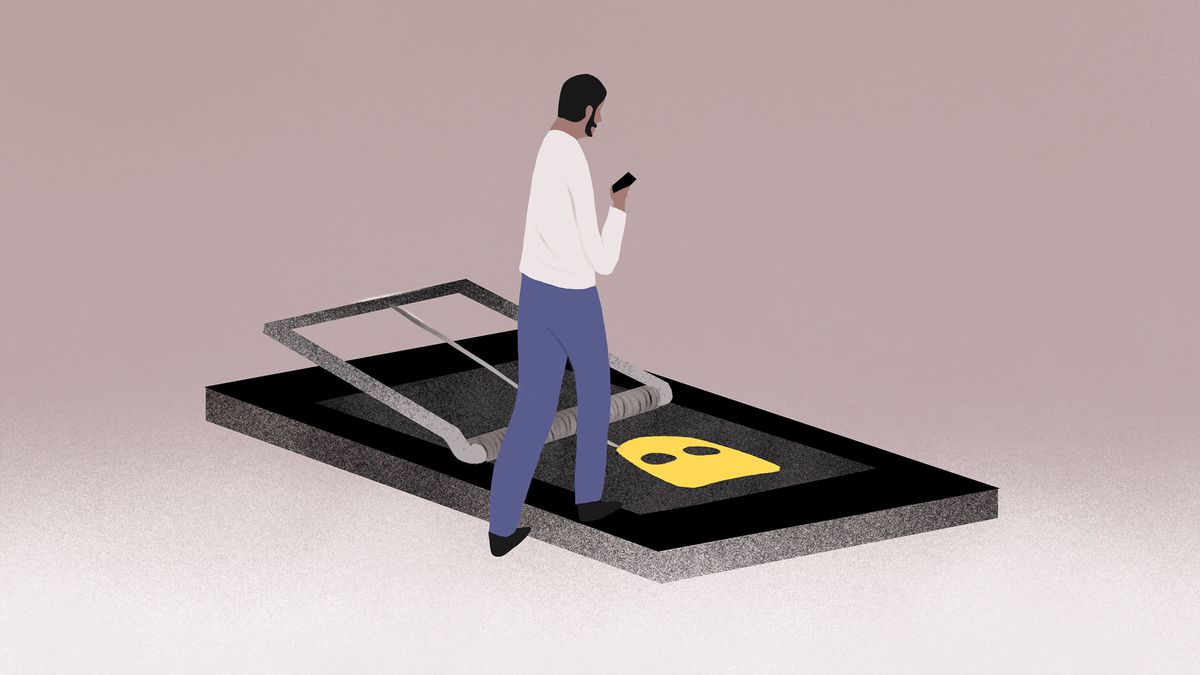





Every morning I wake up to the same routine. I log into the Tinder account of a 45-year-old man from Texas—a client. I flirt with every woman in his queue for 10 minutes, sending their photos and locations to a central database of potential “Opportunities.” For every phone number I get, I make $1.75.
I’m what’s called a “Closer” for the online-dating service ViDA (Virtual Dating Assistants). Men and women (though mostly men) from all over the world pay this company to outsource the labor and tedium of online dating. The matches I speak to on behalf of the Texan man and other clients have no idea they’re chatting with a professional.
It shouldn’t come as a surprise that these ghostwriting services exist. Tinder alone produces more than 12 million matches a day, and if you’re a heterosexual American, you now have a one in three chance of meeting your future husband or wife online. But as e-romance hits an all-time high, our daily dose of rejection, harassment, and heartbreak creeps upward, too. Once you mix in the vague rules of netiquette and a healthy fear of catfishing scams, it’s easy to see why someone might want to outsource their online-dating profile to a pro, if only to keep themselves sane.
But where does the digital social assistant end and the con artist begin?
The online seduction manual
When I tell people that I work as an online-dating assistant, their initial reaction is of morbid curiosity. “How did you even find out about that?” they ask, voices lowering, leaning in.
In November 2017, I ran across an ad seeking “people with good Tinder skills” for a job as a “Virtual Dating Assistant.” At first I thought it was a joke, but I completed their online form out of pure fascination. I received a callback three days later.
Could I work in an “moral gray area?” Would I be comfortable ranking clients’ photographs? Was I dating anyone currently? Apparently, professional writers make for good online-dating assistants; knowing how to seduce strangers with the written word is the company’s mandate, after all. But the intake interviewer seemed just as interested in my ethical flexibility as he was in the journalistic details of my résumé. Could I work in an “moral gray area?” Would I be comfortable ranking clients’ photographs? Was I dating anyone currently?
I learned that there are two main types of writers at the company: “Profile Writers,” who create seductive and click-worthy profiles based on facts our clients have supplied about themselves, and “Closers,” who log in to clients’ dating accounts at least twice a day to respond to messages from matches.
Despite hiring writers to do this work, virtually none of what the company does requires creativity of any kind. Profile Writers follow strict guidelines, often recycling the same half-dozen clichés over and over again. If a client has a dog (jackpot!), all the Profile Writer needs to do is search for the word “dog” in their manual and choose from a list of dog-related one-liners, like this one:
“Hey. As an animal lover, I want to find out your opinion… dressing up your dog: yes or no?”
The process for Closers is a bit more complicated. The initial training period lasts several weeks before we’re given access to clients’ accounts, during which we must read several training manuals and submit draft responses to fake matches. At first, my trainer encouraged me to get creative with my replies, but by the third week, I was still getting back extensive rewrites. My most frequent mistake was asking career-oriented questions, which were deemed too difficult for some women to answer. “She seems more simple,” my trainer would write in response. “Let’s try a different approach.” My meaningful questions would disappear from our shared GoogleDoc, replaced by simpler, condescending small talk.
My Closer manuals were written by the company’s founder, Scott Valdez, a self-taught dating expert with a background in sales. The manuals have titles like Women On Demand and The Automatic Date Transition, and are loaded with his personal insights into the primal female brain. We are to treat them as dating-assistant gospel.
“There’s no question about it,” reads one chapter, “women want to date the alpha male. They are naturally drawn to the ‘leader of the pack.’” Valdez elaborates later in the manual: “The alpha male is the selector, he chooses… he is not chosen.” But how do you present yourself as an Alpha? “Never compliment her without a qualification,” he writes. “Let her know what you want in a woman and make her explain why she fits those criteria.”
“I’m not a psychologist or self-proclaimed expert in the multiple facets of human psychology,” Valdez told Quartz in a phone call. “I consider myself to be a marketer, a matchmaker, and a dating expert.” He lists the books he’s read that inform his methods: Malcolm Gladwell’s Blink, Dan Ariely’s Predictably Irrational, David J. Lieberman’s Get Anyone To Do Anything, (“which kind of scared my mom”), and the classic Men Are From Mars, Women Are From Venus.
“Online dating takes effort, and effort equals time.” “Online dating takes effort, and effort equals time,” he continued. “With [dating apps’] explosion in popularity, it means that you have a huge dating pool at your fingertips, but you’re also in direct competition with everyone else in your area. So if you want to have a chance at meeting your most intriguing matches, you need to have the best possible profile, photos, and messages.”
In my guise as a middle-aged American male, it’s my job to pursue women on our clients’ behalf. These people are often in their early 20s; young women with less dating savvy are easy targets for the company’s methods. “Rule 1: Don’t make her think too hard,” the manual says. “When writing sales copy…the goal is to reduce her ‘cognitive load’ so she’s more likely to reach the end and still have energy to write out a reply.”
What does a “low cognitive load” pick-up line look like? My personal favorite:
“Dear [MATCH NAME], You seem like someone with a lot of confidence. What’s your secret? A) all in one shampoo and conditioner, B) high fiber diet, C) Photoshop”
These pick-up lines are mostly sent by a third type of employee, “Matchmakers,” who send out opening messages en masse across every dating platform imaginable: Tinder, Bumble, match.com, POF, Luxy, and Seeking Arrangement, to name just a few. As part of the company’s all-inclusive service, Matchmakers will scour these platforms for potential matches and then send copy-and pasted opening messages to those who fulfill their clients’ preferences, such as “must love cats” or “should know how to cook.”
But combing through each woman’s profile would require too much time, so Matchmakers are instead taught to generalize a client’s preferences as much as possible and then select an opening line that could work for hundreds of women. For example, does Client X like to travel? That’s easy: Client X’s Matchmaker can search the company manual for the word “travel” and select from a handful of vague travel-related greetings. From there, after the client has approved the message, a one-liner blitz will rain down on dozens of dating sites, targeting hundreds of women with the word “travel” in their profiles.
“We have a lot of ice-breaker messages that are billed around specific interests, like yoga or skiing or having a very short profile,” Valdez told Quartz. ”If there’s a message that the client doesn’t like, we take it out of rotation.” After the Matchmakers have made contact, the Closers then step in to keep up the flirty banter and, hopefully, get their client a date. Clients are sent weekly emails to alert them of numbers we’ve scored or, for Platinum clients, when and where to go for a date we’ve arranged.
This messaging “blast” technique may appear lucrative compared to the average neighborhood yenta, but it has occurred to me that good matchmaking may not be in the company’s financial interest. When a client pairs up, they leave the service. And with ViDA charging each client anywhere from $495 to $1,695 a month for its services, there is a significant financial incentive to keep them coming back.
So, tell me about yourself
Originally a sales guy with no time for “real dates,” Valdez grew ViDA’s brand out of his own experiences in the dating world. Before Tinder normalized “DTF” (“Down To Fuck”) as an opening salute, Valdez would send copy-and-pasted pick-up lines to dozens of women a day and track their effectiveness on spreadsheets. “Online dating is a numbers game,” he would write in the ViDA training manual years later.
His idea for a digital-dating-assistant service started in 2009, when he was frustrated with the amount of time it took to search for matches online. “I was working 60 to 70 hours a week and simply didn’t have time to keep up with online dating,” he said. “Before my life had gotten so crazy, I’d managed to develop some material that worked really well on the dating sites I was using. But I was at the point where I was only able to return messages sporadically, which obviously didn’t go too well with the matches I was interested in.”
“I thought, ‘Why couldn’t I just take what I had developed, and train someone else to sound like me, and outsource my online dating to him?’” “I found myself wishing there were two of me,” he continued. “I thought, ‘Why couldn’t I just take what I had developed, and train someone else to sound like me, and outsource my online dating to him?’” After finding someone on Craigslist who “did a really great job,” Valdez started thinking about how many people were in the same position: time-poor professionals who might benefit from some of the lessons he’d learnt. “If it weren’t for my relentless dedication to cracking the code to meeting and attracting the right person, I probably wouldn’t have met the girl I’m with now.”
Today the company employs 80 people and boasts 2,500 “satisfied customers.” But the same cannot be said for all of its employees.
I asked my coworkers how they handle the moral flexibility that the work demands. One male Closer told me that it felt rewarding to “help men too old to understand the internet,” and that “some people are too busy for all that.” Another writer told me that “finding love is a mysterious process, so we use data.”
The service’s data-driven approach to professional flirting became clear to me during my training. “We’ve discovered that a surprisingly large portion of the online dating process can be systematized into what is essentially clerical work,” read one line in my training manual. “Really, when you think about it, you’re writing sales copy.”
To this end, every message I send is logged into an automated system that analyzes response rates. Closers regularly discuss what works and what doesn’t, swapping tips in extensive email chains. There are required monthly team meetings, in which Closers help workshop opening messages and pitch new ideas. While the list of company-approved opening lines is constantly evolving, the formula is almost always the same: a vague reference to something on the match’s profile, followed by an extremely easy question, like “I see you’re into yoga…. so answer this question once and for all: which is better, hot or not?”
Paradoxically, ViDA’s manual says that honesty is key to seduction. One chapter titled Don’t Lie includes lines like, “There are few things women hate more than insincerity” and “If you’ve told your date you’re a six-foot-tall astronaut when actually you’re 5 ft 9 and sell insurance, she’s going to find out.”
“It’s about trust and making sure we represent them in a way that’s comfortable for them and feels authentic, because at the end of the day they’re going to be the one going on the date,” he added over the phone. “It’s important that everything that we do feels right and feels true to who they are.”
But I’m not an astronaut or an insurance salesman. I’m a woman sitting in my living room in Montréal, running proxies on my smartphone and laptop. I’m logged into my client’s Tinder and match.com accounts, appearing on these platforms (with the help of numerous fake GPS services) to be the man I’m pretending to be. I sit on my couch and wait for messages to arrive in their inbox.
“Oh, you like Pink Floyd?” I write to one match. “Cool. I saw them in concert in ‘77.” This technically isn’t a fib: My client did see Pink Floyd in 1977—though I wasn’t born until 1992.
I was three weeks into my contract when I encountered a client whose age was listed as 25. Written beside his photos was a casual disclaimer: “…he’s actually 33 but wants to present like 25 to attract younger ladies.” Shaving two or three years off of a client’s age was common practice, but eight years felt predatory. I sent an email inquiring about the company’s policies, and never heard back.
“If a client requests it, we may add an inch or two onto the displayed height or shave a year or two off the listed age, but we don’t like to do anything that’s really big,” Valdez explained to Quartz. “The goal is for the client to meet their matches face to face and hopefully spark a long-term relationship. So big lies about important facts undermine that goal. We make sure our clients understand that.”
If a woman doesn’t respond to our cheesy pick-up lines or cough up her number by the third message, I’m instructed to move on, as the match is no longer cost-effective. Despite my attempts at embracing the “Alpha Male” attitude, the training staff have repeatedly told me that my writing is “too female,” a characteristic that has never been fully explained. To mitigate this “error,” I’ve been told I need to use shorter sentences, ask fewer questions, use fewer smileys, wait longer to reply, and set up dates before even asking if the woman is interested. If a woman doesn’t respond to our cheesy pick-up lines or cough up her number by the third message, I’m instructed to move on, as the match is no longer cost-effective.
Closers aren’t paid for the time they spend waiting for new messages, so I reread my clients’ intake questionnaires in order to bill my base salary of $12 an hour. Every client must answer 50 or so questions about themselves when they first sign up and go through a 90-minute interview, supplying Profile Writers and Closers with nuggets of mundane information. Most of it is useless when it comes to fuel for flirtatious banter—like “I took piano lessons until I was 5 years old,” or “I had fun at my sister’s wedding”—but these lifeless anecdotes are all we have to draw from.
Several times a day, female staffers receive Photo Ranking Requests, in which we rank new clients’ photos in order of attractiveness. This helps Matchmakers select which photos to use when building or updating a client’s dating profile. “We don’t like to declare that this client’s a 9, this client’s a 6, or compare our clients in any way,” Valdez said. “We do, however, rank the attractiveness of a single client’s photos against one another. We just employ a data-driven ranking process for choosing the most attractive pictures…We do this internally to determine a client’s optimal photo lineup.” He mentioned that OkCupid used to run a similar service, and Tinder can also optimize your photographs so that the most popular are shown first.
One Profile Writer I spoke with (I’ll call him Doug) was candid about his dilemmas over the company’s practices. After working as a Closer for two years, Doug had asked to switch to Profile Writing. He’d taken to referring to Closer work as “the dark side.”
Doug told me that a lot of clients never call the women “who have been really engaged emotionally and are responding to our messages.” Once Closers receive their commission for getting a number ($1.75 each), they move on. But if a woman never hears from the client—the man she believes she’s been corresponding with the whole time—she might send more messages through the app, upset that she hasn’t heard from him. But the Closer is no longer allowed to reply, so he ghosts her. There’s no more money to be made.
“I am creating these bitter women out there,” he said. “I ask myself if I’m part of the problem.”
Doug learned to unmatch from women once he’d received his commission. It was easier for him that way.
Fool’s gold
What kind of person would pay strangers to score them dates online, and then not even bother to call? Clients who can afford to ignore phone numbers because they receive so many a week are internally referred to as “Cash Cows.” They go on several dates a week for months or sometimes years on end, traveling frequently to new areas and an ever-expanding pool of women. These clients tend to be younger men in high-powered finance jobs.
Valdez said that the typical client profile tends to be somebody between the ages of about 28 and 52, with most being in their 30s. (He also claims that one third of their clients are female.) From there, it divides into two camps: those who “have more money than time,” and those who are just plain frustrated. “Entrepreneurs, doctors, lawyers,” he lists. “Programmers, too—especially programmers in the Bay Area. We get a lot of them.”
“[ViDA allows] them to delegate this particular aspect of their lives to an expert, just as many have financial planners, landscapers, personal trainers, and mechanics on speed dial.” These types of professionals are money rich but time poor, he explains. Valdez referenced a recent survey that shows online love seekers are spending 10 hours a week on dating sites and apps. “Our clients have successful careers,” he said. “They work, they travel often, and they just don’t have that time. So the need a company like ViDA fills is allowing them to delegate this particular aspect of their lives to an expert, just as many have financial planners, landscapers, personal trainers, and mechanics on speed dial.”
Indeed, there are plenty of older men seeking age-appropriate, long-term relationships online. These are the types of clients Doug and Valdez always refer to when justifying the service, as our work helps them navigate unfamiliar territory. After all, internet culture does not come naturally to some, and many of our clients are widowed or divorced retirees.
I asked one of my trainers if the company takes on any married clients. Men looking to quietly set up extramarital affairs would benefit from the company’s all-hands approach; they wouldn’t even need to install the dating apps or visit the websites we use. Matchmakers will select their best photos, Profile Writers will make them sound appealing, and Closers will do all the flirting for them. Our clients need only check whatever email they’ve provided for date locations and phone numbers.
My trainer was quick to reassure me that they refuse those prospective clients. “Even if the guy’s lying about it, Scott has a whole system for how we deal with that situation.”
When asked about this policy directly, Valdez pointed out that their website clearly states that they do not take on married clients or those looking to cheat; he also said that the extensive on-boarding process tends to weed out any immoral actors. “I couldn’t sleep well at night knowing we are helping people wreck their families. We’ve never knowingly helped cheaters,” he says. “There are a lot of other ways I’d prefer to make money than helping people mess up their family.”
Is it even legal?
The company’s practices may be unethical—but they’re not illegal. Once the company obtains the client’s permission to impersonate them online, there are no laws against what Closers do.
Instead, it’s left to individual platforms to crack down on fake accounts. OKCupid, for instance, makes it clear in their terms of service that third parties are not allowed to open accounts, and it’s not uncommon for clients’ profiles to get flagged and deleted. But from a legal perspective, unless a Closer harasses or threatens a match, exposes a client’s confidential information, or asks for money, everything they do is legal according to US, Canadian, and UK law.
But legality aside, these cut-and-paste flirtations perpetuate negative gender stereotypes, and they reinforce an oversimplified (and destructive) view of romantic expectations.
Men and women on online-dating platforms therefore learn to emulate personalities that yield quantifiable results. As dating platforms become flooded with calculated, flirtatious spam, men and women on these sites learn to emulate personalities that yield quantifiable results. This means playing down unique traits and unorthodox views to the point where a total stranger—like me—could literally do it in their place. By trying to appeal to dozens, if not hundreds, of strangers at the same time, we forfeit our ability to take risks and experiment with social norms; only placing safe bets robs us of new and genuine experiences.
But the steepest price of this online anonymity appears to be human decency, which—as I’m often reminded at ViDA—doesn’t lead to dates.
For example, one match told me that she’d just put down her family dog. Still in training, I wasn’t sure what to do. I wrote out an apology for her loss and sent it to my instructor for approval. He crossed out my response and wrote underneath: “Alpha Males don’t apologize.” What we sent back instead was an upbeat story about our client’s two dogs, which was a shamefully inconsiderate reply in my view. I expected to never hear back from her, but three exchanges later, she was sending me her phone number.
It was my first commission: $1.75.
Had she blamed my client’s callous response on internet miscommunication? Or was she learning—just as I was—that reaching out for a unique connection online would lead only to awkwardness and rejection? Every time she has an interaction in which her feelings are ignored—whether it’s online or in-person—I worry that she’ll learn not to talk about her emotional needs, or any needs of any kind.
As the disillusioned masses learn to offer less and expect nothing, companies like these can take advantage of this extraordinarily low barrier to entry. That cringe-worthy shampoo vs. Photoshop line might sound impossibly lame—but it works. (And at least it’s not the bare minimum “DTF?” or an unsolicited dick pic.) As a result, businesses such as these are an economic inevitability.
* * *
I was given my first female client after two months with the company. Women seeking out our services require a very different approach. When talking to my new client’s matches, I was told to make her voice sound “feminine (soft, warm, delicious, flowing, focusing on how she feels about things).” I had to “focus less on her career and more on her outside life…write longer sentences, more emoticons, and be more playful.”
In Doug’s view, it’s our job to act as gatekeepers for these female clients—to make sure no subpar matches make it through. “Women are so put into a box, and they aren’t going to represent what they really want,” he said. According to him, a Closer should ask the tough questions that female clients aren’t comfortable asking themselves: Does the match want children? Are they looking for something serious? Are they dating anyone else right now?
I took his advice to heart and played hardball with my female client’s matches. None of the men fit her description of what she wanted, so by the end of the first week, I had not pursued any phone numbers. I was reprimanded for not producing results, and for wasting both the company and the client’s time.
“Our clients are interested in finding their ideal match, and if the writers aren’t getting them closer to that goal, then we’re not fulfilling our commitment to our customer,” Valdez said. “So we might realize that a writer’s writing style isn’t a fit for a client or the match that client wants to attract, so we simply shift them to a client that he or she is better equipped to help.”
Another Closer was given my account. Overnight, they scored seven numbers from the matches I’d already vetoed—an additional $12.25 in their pocket.
I decided to make my exit soon after.
My initial curiosity about these dating assistants had morphed steadily into deep disgust: with the company, with Valdez and his manual, and—above all—myself. The sight of my first paycheck sent me crawling back to bed in a guilt-ridden panic.
I grew suspicious of my own dating accounts—not just of the men I matched with, but of my own ability to present a likable version of myself online. Every new conversation felt like a minefield, filling me with equal parts boredom and dread. To my dismay, I started to want my own virtual dating assistant.
This all begs the question: Have you unknowingly flirted with a professional Closer? Me, even?
As we grow accustomed to foisting more and more complicated emotional tasks onto digital butlers, we lose our ability to tolerate inelegance or find value in social failure. Moments of awkwardness and heartbreak are an inevitable part of the dating experience, and they are essential in our evolution into mature adults. By outsourcing our courtship to robots (and robot-like humans) we might save ourselves some pain in the short term, but it degrades us, simplifies us, and fails to provide for our ultimate goal of finding someone accepting of our flaws. In this age of automation, romance isn’t just one click away—it’s guaranteed.
But if you’re willing to scrape the bottom of the barrel, what isn’t?
Follow Chloe on Twitter. Learn how to write for Quartz Ideas. We welcome your comments at ideas@qz.com.