



Category Archives: marriage advice
Pueblo couple celebrates 75th wedding anniversary

WATCH Couple celebrates 75 years of…
PUEBLO COUNTY, Colo. – In 1943, the United States was in the middle of World War II, the Pentagon had just been built, and the slinky was making its debut. It was also the year Betty and Norvan Eaks tied the knot.
On Saturday, they celebrated 75 years of marriage something you really don’t hear about nowadays. Betty and Norvan met each other in Boone, Colorado back in 1942 and like all great love stories, they fell in love at first sight. Betty recalling the first time she laid eyes on the love of her life.”He was laying underneath the table playing his harmonica, that had kind of done it for me,” Betty says.
Both are Colorado natives and children of farmers. They married in 1943, Betty at 15 and Norvan at 20. They moved to Pueblo in 1957 where they started a farm of their own and have lived ever since. They have six children, 15 grandchildren, 34 great-grandchildren, and eight great-great-grandchildren. Many of them attending the celebration at Faith Baptist Church. Their marriage has been an inspiration to the rest of the family. Giving them hope that their forever love is out there.
Their oldest living daughter Barbara Garver says her parents have always enjoyed each others company. Saying no matter what happened, they have always found a solution. “They just worked together, always worked together on everything,” Garver says.
When we asked the lovely couple for their advice on a long-lasting marriage. Betty says, “I always say, stay together and you are going to have little spats along the way but you have to work them out it the way it is. And be true to each other.”
Afraid debt will destroy marriage

DEAR ABBY: I am married to a great man, but he’s very tight with his money. We found out early in our relationship that we couldn’t have a joint account because it caused so much fighting.
We share our bills, but I am broke all the time. I have credit card debt he doesn’t know about. (He hates being in debt.) I have had a problem with credit cards before, and he threatened that if it happened again, we are done. How do I tell him I have more credit card debt without losing him?
– Swimming in debt
DEAR SWIMMING: Go online and begin researching accredited or certified credit counselors. Make sure the one you choose is affiliated with the National Foundation for Credit Counseling (nfcc.org). While you’re at it, get on the internet and locate the nearest chapter of Debtors Anonymous. It’s a 12-step program group for individuals who cannot control their spending. You will find it at www.debtorsanonymous.org.
Because you are compulsive about abusing credit cards, prepare yourself for the fact that you may have to get rid of all of them. And when (not if) you inform your husband about what’s been going on, be sure he knows you are WILLING to do that. I wish you luck and recovery.
After wife’s death, her mother cuts contact
DEAR ABBY: My first wife, “Charlene,” died eight years ago from an accident caused by her diabetes. Six months after her funeral, I was introduced to a lovely woman and subsequently married her. When I told my former mother-in-law I had started seeing someone, she asked me to cease all contact with her and the rest of the family. I complied with her wish.
Since Charlene’s death, I have kept her personal photo album. It contains pictures and memorabilia from when she was a child and teenager. I also have some afghans her grandmother made for her. I would like to return them to her parents, but I’m afraid of the potential pain it could cause.
I considered writing her mother a letter letting her know I have these things and would like to return them. I know there’s really no way of easing into this. I’m pretty sure, however, that a mom would like to have her daughter’s things. Your advice would be appreciated.
– Treading lightly
DEAR TREADING: Because the items belonged to her daughter, box them up and send them to your ex-mother-in-law. And when you do, include a note explaining that you thought she would like to have them. Period.
How to have a happy marriage: 7 powerful secrets from research
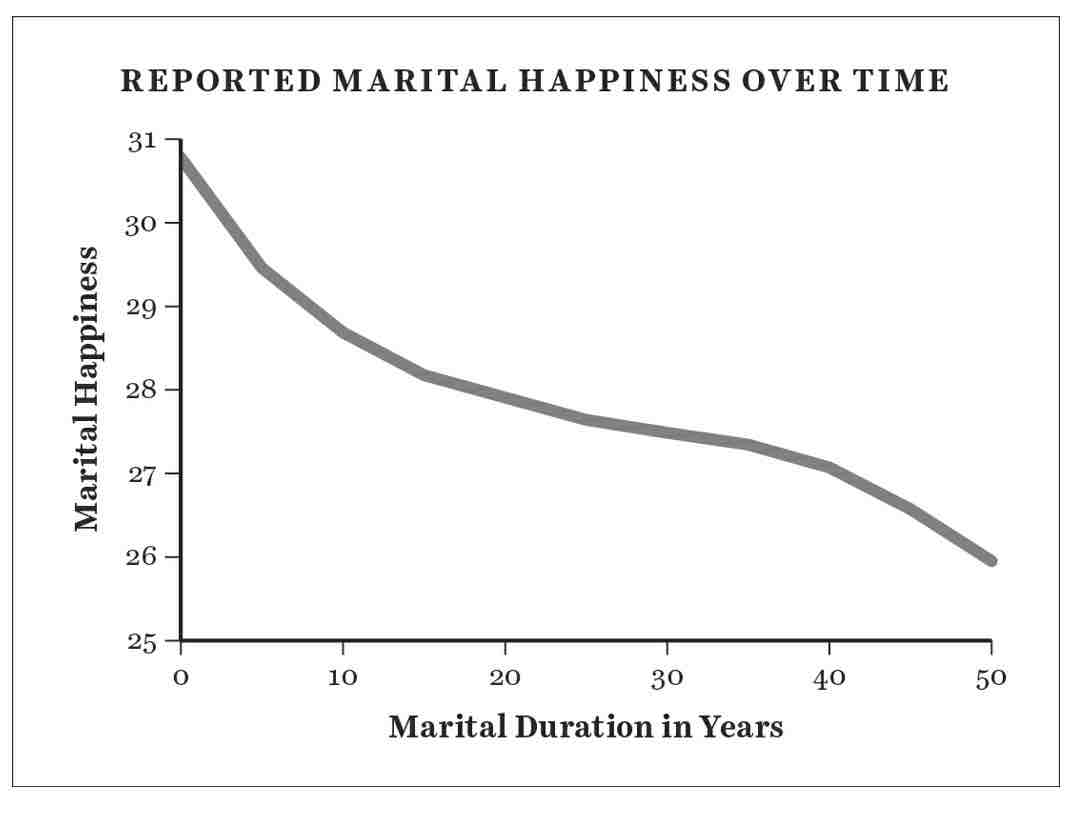
Everybody wants to have a happy marriage. Unfortunately, on average, marriages get less happy with time.
You know this must be true because I have a chart:
Actually, it’s worse than that because you have a lousy memory and your brain plays tricks on you. However happy you think your marriage is, it’s probably been less happy than that.
Researchers asked people how satisfied they were with their partnership. Then they checked in again later with the same subjects. A lot of people said things had gotten better. But they were wrong. People consistently misremembered how good things were the first time they were asked.
So here’s another depressing chart:

From The All-or-Nothing Marriage: How the Best Marriages Work:
Even though people’s actual relationship satisfaction had declined from 5.8 to 5.4, their perceived relationship satisfaction had increased from 4.7 to 5.4. They achieved this self-delusion, which allowed them to believe the falsehood that they were becoming happier in the marriage, by misremembering their Time 1 satisfaction as being 4.7 when it was actually 5.8.
No, shouting at me won’t make this less true.
The “very happy” marriage has taken a seat next to pandas on the endangered species list.

Before you start fumbling with the child-proof cap on the Prozac bottle, let me say there is a silver lining here. While the average marriage has gotten worse, the happiest marriages are better than they’ve ever been.
From The All-or-Nothing Marriage: How the Best Marriages Work:
Marriage, in short, has tilted toward an all-or-nothing state. As its primary functions have ascended Maslow’s hierarchy, and as we’ve spent less time with our spouse, it’s become more difficult for our marriage to live up to our expectations, which means that more of us wind up feeling disappointed. At the same time, as the nature of our marital expectations has changed, the benefits of fulfilling those expectations are larger than ever. Consequently, even as the average marriage is getting worse, the best marriages are getting better.
Alright, enough doom and gloom. How can we make our unions more like those super-duper happy ones?
We’re going to get some answers from Eli Finkel. (He does more than compile depressing charts, I swear.) He’s a professor of psychology at Northwestern University and the director of their Relationships and Motivation Lab. His book is The All-or-Nothing Marriage: How the Best Marriages Work.
Alright, let’s get started quick before those stats sink any lower …
Bad things are exceptions, good things are traits
Everybody screws up. Your spouse is going to screw up. So how should you interpret those screw-ups? People with happy marriages see those mistakes as “external” (caused by context, not character) and “temporary” (as one-offs, not persistent traits).
So, repeat after me: your spouse was late picking you up because “traffic was bad today” and not because they “are and always have been an inconsiderate subhuman pig-man who will never ever change.”
From The All-or-Nothing Marriage: How the Best Marriages Work:
… the tendency to make internal and stable attributions for our spouse’s negative behaviors…predicts greater distress about those behaviors and greater deterioration in relationship quality over time. The tendency to make external and temporary attributions for such behaviors…does just the opposite, reducing distress about the behavior in question… If we’re confident that our partner is, by and large, a decent person who wants to do well by us, there’s a strong argument that we should seek to make attributions that give him or her the benefit of the doubt.
And you can turn this one inside out and double the benefits. When your partner does something good, you want to chalk that up to being “internal” (indicative of their character) and “stable” (a persistent trait).
They got you that thoughtful gift because they “are and always have been the kindest person to ever grace the earth with the imprint of their foot” and not because “every now and then even Satan remembers to do something nice.”
From The All-or-Nothing Marriage: How the Best Marriages Work:
Rather than separating our spouse from the behavior and treating it as a one-off event, relationships benefit when we link our spouse to the behavior and treat it as generally characteristic of him or her — when we make internal, stable attributions … the tendency to make internal and stable attributions for our spouse’s positive behaviors … predicts greater happiness about those behaviors and greater improvement in relationship quality over time.
The point here isn’t to begin a massive campaign of lying to yourself, but to give your partner the benefit of the doubt.
(To learn more about the science of a successful life, check out my bestselling book here.)
By interpreting issues the right way you can keep things positive and continue to see your soulmate as your soulmate.
Oh, by the way — you really shouldn’t see them as your soulmate. Ever …
“Meant to be” equals “not meant to be”
I know, I know — this post is about as romantic as an episode of “Divorce Court.” But believing someone is your “soulmate” has a serious downside.
Psychologists call concepts like this “destiny beliefs” and they’re a pretty black and white way to see things. So when things get difficult, people who endorse ideas like “we were meant to be” tend to flip to “we weren’t meant to be.” Ouch. What’s a better perspective?
Much as with intelligence and learning, you want to have a “growth mindset” toward your relationship. Things aren’t set in stone, difficulties are normal, it’s going to take some work, but we can always improve.
From The All-or-Nothing Marriage: How the Best Marriages Work:
According to the psychologist Raymond Knee, people with strong destiny beliefs think that partners either are or are not “meant to be.” They view conflict and other relationship difficulties as indicators that they may simply be incompatible with their partner. People with strong growth beliefs, in contrast, think that partners can cultivate a high-quality relationship by working and growing together. They view conflict and other relationship difficulties as opportunities to develop a stronger relationship.
Stop talking about your marriage like it’s the fulfillment of an ancient prophecy and start endorsing ideas like, “A successful relationship evolves through hard work and resolution of incompatibilities” or “Challenges and obstacles in a relationship can make love even stronger.”
From The All-or-Nothing Marriage: How the Best Marriages Work:
One promising option for approaching our relationship in a growth mind-set is to take a few minutes every month to think about ways in which such statements are true, ideally focusing on instances in our own lives when, for example, overcoming an obstacle made a relationship stronger.
So see yourselves as a couple that has the skills to work through problems instead of the characters in some epic predestination story. As a general rule, your relationship should have as little in common with Oedipus Rex as possible.
(To learn the two-word morning ritual that will make you happy all day, click here.)
People give a lot of marital advice but one thing nobody ever tells us is “take things for granted.” You know why? Because 1) it’s a terrible idea and, 2) nobody needs to. Sadly, we’re excellent at doing it without a reminder …
Give thanks
When even just one of you feels gratitude, both of you are more satisfied with the relationship. How’s that for a bargain?
From The All-or-Nothing Marriage: How the Best Marriages Work:
Algoe argues that gratitude serves as a “booster shot” for romantic relationships. People tend to experience higher gratitude on days when their partner does something thoughtful for them, and such gratitude predicts elevated relationship quality the next day. In fact, when one partner experiences elevated gratitude on a given day, both partners experience positive relationship outcomes. In the long run, people who experience elevated levels of gratitude also experience stronger relationship commitment and are less likely to break up.
Research shows that merely dedicating a little time to thinking about how your partner has invested in the relationship increases positive feelings toward them and elevates commitment to the marriage. And this often leads to a virtuous cycle.
From The All-or-Nothing Marriage: How the Best Marriages Work:
All of us can find a few minutes per week — before going to bed or while showering, perhaps—to think about ways in which our spouse has invested in our marriage. Doing so has the potential not only to bolster our gratitude and relationship commitment, but also to increase our overall happiness. And here’s the kicker: Because our own experience of gratitude tends to predict our partner’s warm treatment toward us, our decision to pursue a gratitude-increasing lovehack can increase our partner’s positivity toward us, potentially launching a virtuous cycle of mutual gratitude, kindness, and commitment.
Big benefits and you didn’t even have to express gratitude to your partner. Not that it would hurt, mind you. *blogger clears throat*
(To learn 5 secrets from neuroscience that will increase your attention span, click here.)
So it’s good to be thankful for the positive things they’ve done in the past. But what can you do for the positive things in the moment in order to make them that much better?
Capitalization
No, I don’t mean “use the big letters.” When discussing relationships everybody focuses on getting through the hard times. Turns out we have it backwards. Studies show that how you celebrate the good times actually has a much bigger effect on how happy your marriage is.
Capitalization is delighting in your partner’s good news. Being supportive, curious and enthusiastic when they get that big promotion, that big raise, or when the judge says “acquitted.”
From The All-or-Nothing Marriage: How the Best Marriages Work:
…the psychologists Shelly Gable and Harry Reis observe that social support is about much more than helping each other through hard times. These scholars have built a program of research demonstrating the power of delighting in good news together. In particular, communicating with our partner about personal positive events — that is, engaging in capitalization attempts — is linked to positive emotions and mental health, beyond any effect of the events themselves. Such capitalization attempts are also linked to greater feelings of trust, intimacy, and satisfaction in the relationship.
Every night each of you should share the best thing that happened to you that day. Listen intently, ask questions, and be enthusiastic. That’s all you have to do. Yes, really.
From The All-or-Nothing Marriage: How the Best Marriages Work:
… every evening over the subsequent week, the partners took turns discussing their most important personal positive event that day. Couples who had been trained in enthusiastic, celebratory responding — trained to ask questions about the event, show positive emotion about it, and generally be engaged and constructive during the interaction — tended to experience greater love for each other following those nightly discussions.
(To learn the secret to never being frustrated again, click here.)
But sharing good news is just the start. What’s the secret to better communication in a marriage?
Communication Is key
Talking about relationships is good for your relationship. You don’t even have to talk about your relationship, necessarily. In fact, just watch “Casablanca” together and discuss it. Seriously.
Researchers had couples watch movies about relationships and then talk about them. Guess what? Those people were less likely to divorce.
From The All-or-Nothing Marriage: How the Best Marriages Work:
… each week over the next month, they viewed a different relationship-themed movie and discussed the same set of questions. Relative to participants in the no-treatment condition, participants in the intervention condition were about half as likely to separate or divorce over the next three years (13 versus 24 percent).
And try some self-disclosure. Open up. It’s tightly linked with higher relationship quality. And you don’t need to go full-therapy-session. Want to increase the passion in your relationship?
All it takes is a double date and opening up about yourself. When study subjects played a game involving self-disclosure while with another couple, romance was rekindled.
From The All-or-Nothing Marriage: How the Best Marriages Work:
When it came to feelings of satisfaction in the relationship, the self-disclosure task was beneficial regardless of whether the couple was on a double date or by themselves. But when it came to feelings of romantic passion, the self-disclosure task was especially beneficial in the double-date condition. In short, socializing with our spouse and other people can stoke the romantic fire in our marriage, but only if the socializing is fun and intimate.
(To learn 3 secrets from neuroscience that will help you quit bad habits without willpower, click here.)
And going on double dates isn’t the only way socializing can improve your marriage …
See other people
No, don’t have an affair. That would be bad. Very bad. But these days we expect spouses to be our everything emotionally. And that is insane. You still need friends. You still need family.
A ton of research shows we need a “diversified social portfolio.” And we need them to be specialized: the friend who calms you down when you’re anxious, the family member who cheers you up when you’re down, the pal who helps you chill out when you’re angry. Your spouse can’t be expected to be the best at every one of those situations.
So what happens when you have a team of emotional specialist friends in your life? You don’t just feel better personally — your marriage gets better.
From The All-or-Nothing Marriage: How the Best Marriages Work:
In this nine-month study, breadth and specialization also predicted a decreased likelihood of breakup. In addition … having a highly specialized social portfolio protected participants from the typical decline in relationship well-being over time.
Did you catch that last sentence? The effect is so powerful it actually prevents the decline in relationship well-being that we saw in those scary charts up above.

It also has the lovely benefit of not turning your spouse into a widow or widower.
From The All-or-Nothing Marriage: How the Best Marriages Work:
A meta-analysis by the psychologist Julianne Holt-Lunstad reveals that people with high scores on broad measures of social integration — marital status, social network size, and social network participation — are about half as likely to die in a given follow-up interval (say, ten years) as people with low scores. This effect is larger than the effects of well-known predictors of mortality like smoking and obesity.
(To see the schedule that very successful people follow every day, click here.)
So you’ve got good friends and you’re not expecting your spouse to solve every problem you face. Cool. But when you two are together, what should you do?
Try A New Restaurant After You Go Skydiving
When you first start dating you do all kinds of cool stuff. Then you fall into a rut and your life together feels as scripted as a bad sitcom.
You’re not bored — you’re boring. So stop being boring. Keep doing new and exciting things together and the relationship can stay fun.
We all want to learn and grow and be stimulated — psychologists call it “self-expansion theory.” When you continue to do those types of things, relationship satisfaction goes way up. Oh, and something else happens too …
A lot more sex.
From The All-or-Nothing Marriage: How the Best Marriages Work:
In a study from the psychologist Amy Muise, relationship partners completed questionnaires about their relationship for twenty-one consecutive days. They reported how much self-expansion they experienced each day by completing items like: “How much did being with your partner result in you having new experiences?” and “How much did being with your partner expand your sense of the kind of person you are?” They listed activities like shucking oysters for the first time, taking ballroom dancing lessons, and taking a road trip. When participants reported greater self-expansion on a given day, both they and their partner reported experiencing greater sexual desire in — and greater satisfaction with—the relationship. They were also 36 percent more likely to have sex that day.
No, you don’t actually have to go skydiving. But your activities do need to be truly novel and exciting. “Pleasant” doesn’t cut it, bubba.
From The All-or-Nothing Marriage: How the Best Marriages Work:
A study by the psychologist Charlotte Reissman included a more stringent control condition. All couples made a list of activities that they view as exciting and a separate list of activities that they view as pleasant. They were then assigned to engage in either an exciting or a pleasant activity for ninety minutes for each of ten consecutive weeks. Relative to couples in the pleasant condition, couples in the exciting condition were happier in their relationship at the study’s conclusion.
(To learn the 4 secrets to reading body language like an expert, click here.)
Okay, we’ve learned a lot about how to defy those depressing marriage stats. Let’s round it all up and find out the very important — and incredibly simple — last thing you need to do …
Sum up
This is how to have a happy marriage:
- Bad things are exceptions, good things are traits: When they don’t do the dishes it’s because they were busy. When they do do the dishes it’s because they’re a good person who loves you.
- “Meant to be” equals “not meant to be”: A growth mindset prevents your soulmate from becoming not-your-soulmate.
- Give thanks: Regularly think about all the nice things they’ve done to contribute to the relationship. (And maybe even thank them.)
- Capitalization: Be enthusiastic and make their little good things into big good things.
- Communication is key: Self-disclosure is powerful — especially on a double date.
- See other people: Supportive friends don’t take you away from your relationship; they improve it.
- Try a new restaurant after you go skydiving: Novel and exciting experiences together makes for happier marriages and increased sexy-time.
So what else do you need to do? I feel silly even saying it: spend more time together as a couple. Because these days, most people don’t.
From The All-or-Nothing Marriage: How the Best Marriages Work:
According to one major study, the amount of time that childless Americans spent alone with their spouse declined from thirty-five to twenty-six hours per week from 1975 to 2003, with much of this decline resulting from an increase in hours spent at work. The decline for Americans with children at home was from thirteen to nine hours per week, with much of it resulting from an increase in time-intensive parenting.
We expect so much from marriage in the modern era — and it does have the potential to deliver on those big expectations. The happiest marriages today are the best they have ever been.
Just put in a little effort and you can defy the trends and have one of those “very happy” marriages where the charts look upside down:

Join over 320,000 readers. Get a free weekly update via email here.
This article first appeared in 2014 on Barking up the Wrong Tree.
More from Ladders
Want a Happier Marriage? Stop Asking So Much of It

Hundreds of years ago, judging whether a marriage was good or bad was brutally simple. If you weren’t starving to death, the marriage was fine. If you had enough children to help empty the slop buckets, it was good. And if you survived to a ripe old age of 27, you’d be the envy of every pig-herding peasant within walking distance (or, as it was known at the time, “distance.”)
Marriage criteria is much more complicated today, at least for those of us #blessed enough to not have to rely on subsistence farming. In our modern world of Seamless deliveries and abundant Chipotle franchises, our needs are just as urgent but more abstract.
ADVERTISEMENT
Eli Finkel, who runs the Relationships and Motivation Lab at Northwestern University, contends that modern married couples continue to value love and comfort as much as previous generations. The difference is they now expect much more than that from their spouses. Now, partners turn to their spouses for love and material assistance — including but not limited to making money, maintaining the home and raising kids — as well as emotional support.
“These days, that isn’t sufficient,” Finkel said. “It wouldn’t be surprising to hear someone say, ‘Well, you know, I love him. He’s a great man. He’s a good father, but I don’t feel like I’m growing in the relationship,” or ‘It just feels like it’s growing stagnant, and I’m not going to live that way for the next 30 years of my life.’”
Featured Video
Loading Video Content
Modern marriage demands a lot of responsibilities — responsibilities that require considerable time and energy to juggle It’s not surprising then that people are starting to ask if we’re expecting too much from our marriages. Indeed, recent social science research suggests that lowering expectations of our marriages could help. But there are important caveats. Lowering expectations won’t help all marriages. And when it does help, it’s likely to be more complicated than you might expect.
A wide-scale psychological study published in April, 2016 explored how expectations influence marriages. Florida State University Psychology Professor James McNulty observed 135 newlywed couples from eastern Tennessee for four years. The couples were surveyed every six months about their expectations for their marriages and whether their marriages lived up to those expectations. In that same period of time, the couples participated in recorded interviews where researchers observed their behavior and how they communicated with each other.
McNulty found that expectations affected couples differently. For couples capable of providing mutual care, support, and independence, high standards improved marital satisfaction. When members of weaker marriages had high expectations, tension arose between their demands from their marriages and what they were capable of attaining. Ultimately, those expectations eroded the already vulnerable relationships.
“Some people demand too much from their marriages because they are requiring that their marriages fulfill needs that they are not capable of achieving, either because they have limited time, energy, effort, or skills to apply to their marriages,” McNulty said.
The Tennessee couples didn’t only go suffer from high expectations. McNulty also found that expectations for marriages could be too low. “Other people demand too little from their marriages, he said. “Their marriage is a potential source of personal fulfillment that they are not exploiting.”
ADVERTISEMENT
McNulty said expectations for marriage should be tempered to a Goldilocks-esque “just right” point resting between too high and too low. He advised spouses to ask of their marriages only as much as their marriages are able to give them.
Finkel, a reviewer on McNulty’s paper, said the study closely related to the research he undertook for his 2017 book, The All or Nothing Marriage. When Finkel started the book, he expected to find that people needed to expect less from their marriages. His research, however, pointed to a more complicated answer. It revealed that the most successful marriages of today are far more fulfilling than ones that came before. But not every marriage is a supremely high performing marriages. Moreover, those marriages require time and effort that are beyond the reach of most married couples. Nonetheless, all married couples expect those ideal results.
“What I realized as I delved in a little bit deeper is that it’s not good or bad to ask that much [from marriage], Finkel said. “The important thing is to calibrate your expectations to what the relationship can realistically provide.”
Finkel views the evolution of marriage expectations through the psychological concept of Maslow’s hierarchy of needs, a five-tiered pyramid that has basic survival as a foundation and peaks with abstract needs such as self-actualization and love. He believes American marriage expectations have shifted from the bottom to the top of Maslow’s hierarchy and writes that today, married couples generally expect their partners to help them attain the best possible version of themselves.
ADVERTISEMENT
These emotional expectations can box spouses into tight corners. They might have us assure our partners we love and accept them as they are one minute and inspire them to improve in the next. Sure, it’s possible to tell someone they’re perfect but can also be better, but the margin of error is razor-thin. It’s also exhausting to keep up with.
While it’s sometimes helpful to acknowledge the difficulty meeting marriage expectations entails, Finkel said the answer isn’t to lower our expectations of our marriage overall.
“From my perspective, the issue isn’t whether you should have high expectations, low expectations, or something in the middle,” Finkel said. In other words: neither relationships or people are monolithic. A spouse might communicate well but not be responsible about keeping up the house. Or while they’re a great parent, you feel they don’t prioritize your shared sex life. In light of the differing aspects of marriage, we need to break out the different aspects of our marriages, recognize where our spouses are succeeding, and where they’re falling short and set our expectations à la carte.
“The issue is where should have high expectations?, where should you have low expectations?, and how can you play to the strengths of this particular relationship?” he said. “Who you are, who I am, who we are together in order to leverage or strengths, and how can we ask a little bit less for those areas where we’re not as good.”
ADVERTISEMENT