Category Archives: marriage advice

5 Truths About Marriage We Learned From The FX Show 'The Americans'

“The Americans” teaches us not just what it takes to spy, but what it takes to love.

Last week, I said goodbye to Phillip and Elizabeth Jennings as The Americans wrapped up its amazing six-year run on FX.

I’m really going to miss the plot twists, disguises, awesome 80’s wardrobe, retro answering machines, and tape recorders.

But more than that, I am going to miss the richness of the rich relationship narratives. I was first drawn to The Americans for the spy drama, but what kept me coming back was the marriage between Elizabeth and Phillip.


RELATED: 20 Absolute Worst Movie Husbands And Wives Ever


In many ways, Elizabeth and Phillip are quite different than the typical American couple today. They’re Russian. They’re KGB spies. They didn’t meet and fall in love; they were matched to be co-workers with a cover of marriage.

And, yet, their relationship brings up so many intricacies of marriage that are relatable and pertinent so many couples.  

Here are 5 truths about marriage that we can all learn from The Americans:

1. People change. 

Elizabeth and Phillip were matched based on their mutual goals and shared vision — their sexual chemistry comes later. They are both committed to their KBG cause and work together for years.

But, at a certain point, the work catches up with Phillip and it becomes more and more difficult for him to partake in manipulating, seducing, and murdering. His conscience becomes more vocal for him and he just can’t do it anymore.

Elizabeth, on the other hand, doesn’t go through the same dissonance and internal conflict until much later on. Only in the final season does Elizabeth’s respect for the Center start to crumble, but until that point, there is considerable tension in their marriage due to being on different pages.

When two people commit to spend the rest of their lives together, the idea that they will each undergo changes as life evolves is something that can feel foreign and irrelevant — after all, when you’re in love it’s easy to hear common relationship obstacles and think, “Well, we’re not gonna be that couple.”

But, the truth is that change is inevitable. Perhaps one spouse decides to switch career paths, or no longer wants to live in the city, or changes their political affiliation. Or maybe one spouse goes through life circumstances that influence who they are and what they believe in.

These shifts are common and the question is not whether change will happen, but how you are able to stay connected as a couple connected despite it.

2. The kids know more than you think.

Elizabeth and Phillip try to shield their children from their relationship tensions and their identities as KGB spies. But, in as early as season one, we see Paige questioning Elizabeth being in the laundry room in the middle night, and the season finale showing Paige going down to do some surveying of her own.

It’s clear that while Elizabeth and Phillip succeed for years in concealing themselves to the outside world, they underestimate how attuned their children are to their absences, sudden departures, urgent travel agent emergencies, and overall distraction over the years.

It’s not clear from the show whether any of the handlers had children of their own, but they often acted as the stand-in family therapist for Elizabeth and Phillip. What was so clearly missing was an understanding of how much children can sense things in their parents and how much they need authenticity and consistency.

Elizabeth and Phillip themselves lived a life lacking that and there’s a sad symmetry in its transmission to their children. Paige’s choice to not go back to Russia can be seen as a rejection of her parents, but also as a decision to stay close to Henry, who she had to take care of for many years when her parents weren’t around.

3. Yes, men are emotional.

The Americans poignantly shows a complex man who is equally tough as he is sensitive. Phillip can be violent, manipulative, and angry. He also is heartfelt, loving, caring, and kind. We see his strong emotions throughout the series — his love for his children, Elizabeth, and even the women he worked with.

We see his emotions really come up when he is tasked to getting close to Kimmy, who is just a teenager and young enough to be his own daughter. Or his concern over Martha’s welfare and getting her out safely. More intensely, we see Phillip’s ability to touch emotion when he attends EST and in the series finale when he says goodbye to Stan.

While there are certainly exceptions to the rule, pop culture often portrays men as having bulletproof egos, only caring about sex as a physical release, and walking around just thinking about “nothing” (thanks, Jerry Seinfeld).

The truth is that men are emotional too; they have all the same emotions as women. Maybe some men don’t express themselves in the same way — machismo has a powerful hold — but behind the ‘tough guy’ there is often a reservoir of feelings, hopes, and fears.


RELATED: The 50 Best Marriage Tips Of All Time (From 50 Marriage Experts)


4. The most important part of marriage isn’t communication.

Like many couples, Elizabeth and Phillip struggle with communication. And like many couples, that’s not their biggest problem. It’s mutual respect.

In the first episode, we see Phillip ready to defect and Elizabeth’s anger and shock at the prospect. As time goes on, their differences over Paige and whether she should join the cause keep them at odds. As Phillip pursues EST and finds meaning in it, we watch Elizabeth give it a shot, and though it resonates she comes back and shows her disdain.

When Phillip eventually leaves the spy work and Elizabeth continues to go on solo missions, we see their struggle for mutual respect at its peak.

Their union was based on a shared mission, but it changes and they look at each other and they are faced with a difficult scenario.

How do you respect your partner when they have become someone whose opinions and actions feel wrong to you? How do you reconcile that this person with whom you share a life, a home, a family, is someone you struggle to respect? What does it mean to find a place in your heart to love them anyway, to accept that this is where they are at today?

Good communication isn’t just about saying the right thing; it’s about the level of mutual respect that subtly lays underneath.

5. Vulnerability bonds us and binds us.

There’s a reason why we viewers were rooting for America’s enemy: We were invited into the vulnerable insides of Phillip and Elizabeth. As we watched them wrestle with vulnerability, both as individuals and as a couple, we saw how they struggled with uncontrollable forces of getting attached.

In their work, vulnerability is a weakness that they capitalize on in others, and their disguises are as figurative as they are literal. It is meaningful that both of them show their true selves to the agents they got closest to: Gregory for Elizabeth, and Martha for Phillip.

Both Phillip and Elizabeth endure loneliness, and they only have each other to lean on for support and empathy. But that means they have to be okay with vulnerability, feeling their feelings, and taking the risk of opening up to each other.

Today, vulnerability is an endangered species, and when it does happen it is usually buffered by a glass screen. It’s easy to hide behind the disguise of social media profiles, emojis, and catchy hashtags, and rely on time in between text messages to come up with something witty to answer.

But, love happens in real time, and it’s facilitated and deepened through risks of vulnerability. Through taking chances and opening up, even though we don’t know how exactly it will be received, it’s in those moments where we can truly connect with another person.

I’ll miss the way the characters on The Americans showed us the imperfect tapestry of relationships. How love and hate are not black-and-white; that it’s harder to be in the grayness because it means our heart is pulled in different directions.

This is epitomized in the final confrontation with Stan in the garage: That our emotions run deep, often beyond our control, and that sometimes the scariest part of relationships is not in learning the truth, but realizing just how attached we’ve become.


RELATED: 25 Pieces Of The Best Marriage Advice Ever (Collected Over 13 Years)


Rachel Hercman, LCSW is a psychotherapist in New York City. She has been a featured relationship expert on Marriage.com, the Better Sex Blog, and the TheHealthSite.com. You can find her online on her website and on Facebook @LiveBetterLoveBetter. 

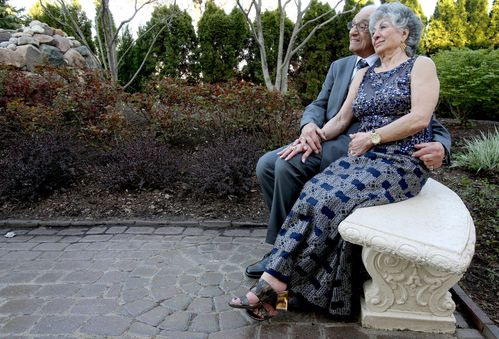
After 71 years together, death has separated a Macomb Township couple

Tony and Sophia George were married 71 years — a milestone fewer than 1 percent of married couples ever see — when he died Sunday at age 94.

The story of the Macomb Township couple’s long marriage, including its ups and downs — Sophia left Tony twice, though never stopped loving him — and how they grew into a solid team was featured in the Detroit Free Press last year. “You have to open your eyes before you get married and keep them half-closed after you get married,” Sophia had said when asked for advice on marriage.

More on Tony and Sophia:

How one couple survived 70 years of marriage

Vivacious, outgoing and in charge, Sophia, 89, was a great complement to Tony’s wry, man-of-few-words personality. He was the only man Sophia ever dated. Tony said he had loved her ever since he first saw her at a Detroit roller rink. They married on April 12, 1947.

The couple hosted a gala 70th anniversary party last year. Tony rallied for the event, though his health had been a bit precarious. Since then, he has had more health problems, including congestive heart failure. He had been in the hospital for a week before he died, Sophia said.

And now, 89-year-old Sophia said, “He’s gone. I’m just going to miss him very much. I got no more tears left.”

In addition to Sophia, Tony is survived by a daughter, Marsha Gies, and by a son, Anthony George. He is also survived by three grandchildren and four great-grandchildren.

Visitation is scheduled for 3 to 9 p.m. Tuesday and 1-9 p.m. Wednesday at Wujek-Calcaterra & Sons, 36900 Schoenherr, Sterling Heights. The funeral is to take place at 10 a.m. Thursday at Wujek-Calcaterra.

“He’s my lost love,” Sophia said.

© 2018 Detroit Free Press

Compromise… for what?

Image: Getty Images

As long as you’re not changing who you are and abandoning yourself in the name of keeping a relationship going, you’re on the right track

There’s an old Eartha Kitt video interview that resurfaces on social media every couple of years because it holds a lesson worth remembering.

While talking about relationships and compromise, the iconic singer and actress throws her head back and laughs dramatically, gloriously, and says: “Stupid. A man comes into my life and I have to compromise? … For what? A relationship is a relationship that has to be earned!”

Kitt makes an important point when she talks about compromising oneself in a relationship to make someone else happy. Compromise is a good thing — self-compromise is not.

That’s how I’ve come to understand the video: Kitt isn’t referring to watching a movie you don’t want to watch, or spending a weekend with your in-laws. She’s talking about doing things that go against the essence of your beliefs and who you are. She’s talking about diminishing yourself for someone else’s benefit.

For a long time, I couldn’t distinguish between the two. I thought all compromise was bad: after all, the idea that umakoti uyabekezela is really about compromising your values to stay in a marriage, isn’t it?

Or at least, that’s how it’s been sold to black women; that it doesn’t matter what your husband does and how unhappy it makes you: you stick things out and keep the marriage going because it’s your duty as a woman to do so.

But since I made the decision to get married, I’ve learned – in my short time as a wife – that a marriage is about the people within it and you establish your own boundaries, and terms and conditions. This isn’t the marriage of our mothers and fathers. It’s supposed to be something that’s on our own terms – whatever they may be.

That was the only way I could get into marriage as a feminist. Because for a long time, I felt that a heterosexual marriage was a noose around a woman’s neck: something that benefits men far more than it does women. Since women, now more than ever, are independent financially, or at the very least capable of being so – why bother getting married?

After I made the decision to become someone’s wife, I started reading up on marriage and marriage advice (probably should have done that before saying “yes”, but that’s crying over spilt milk). One of the phrases I came across – and I’m most probably misquoting – was: “Marriage is about learning to forgive every day.”

This made me balk, because it felt like a fancier way of insisting that a woman must bekezela. What kind of things are we talking about forgiving? Could marriage really be so messed up that you had to let your lover get away with murder daily?

It took a while for me to realise what exactly that phrase meant.

Daily forgiveness is not about the big things, but rather learning and choosing to forgive the smaller things. Think of the Beyoncé quote from her song All Mine, where she implores her lover to “stop making a big deal out of the little things”. There will be many “little things” to get upset over when you’re in a serious relationship with someone, especially one that’s a little harder to walk away from, because it involves families, the law, and sometimes even children.

Those little things might seem cute and insignificant at first, but, as the old proverb goes “familiarity breeds contempt”. Some of those things can slowly grow from being adorable to becoming agitating, but it’s best to try to get over them, because there will always be big things to worry about.

Why spend time fighting over the little things when you will undoubtedly need your energy for the bigger things? Forgiveness in a marriage – and any intimate relationship – is a must. And so is compromise.

But as long as you’re not changing who you are and abandoning yourself in the name of keeping a relationship going, you’re on the right track.

When Does 'The Proposal' Premiere? 'The Bachelor' Creators Have A New Speed Dating Show For You

If you love the romance and drama of The Bachelor and The Bachelorette, but feel like it takes forever to see a proposal, it’s time to rejoice. ABC is bringing you a new show to obsess over called The Proposal, and it’s going to bring you maximum feels in a ridiculously short period of time. So when does The Proposal premiere, and what can you expect from this all-new dating series?

Get your popcorn ready, because The Proposal premiere is just around the corner. The show will debut on Monday, June 18 at 10 p.m. EST on ABC, right after The Bachelorette. The show will be like a mash-up of The Dating Game, The Bachelor, and a beauty pageant, and will be set in four pageant-style rounds where 10 eligible bachelors or bachelorettes will compete to win the heart of a mystery suitor or “suitress” whose identity will be hidden from the contestants.

Each hour long episode will consist of a first impression round where daters introduce themselves and use their words to charm the mystery suitor. Then in the second round, the contestants will flaunt their stuff in a swimsuit round, similar to a beauty pageant. The third round consists of a question and answer session in which the suitor will ask the remaining contestant their most pressing love questions, and in the fourth and final round, the contestants will try to their best to get approval from one of the suitors family members.

Byron Cohen/ABC

Each round is an elimination round, so at the end, when just one contestant is left, the mystery suitor will reveal their identity and have the opportunity to propose marriage if they choose to. So, if a love connection is made, the episode could end with an engagement. As insanely fun as it will be to watch, I wonder if the show will produce lasting relationships. It’s not impossible, because I know tons of couples (my parents included) who’ve had arranged marriages that have lasted for decades. But in this day and age, with the culture of instant gratification and Tinder, I don’t know how viable such a rushed relationship like that would be.

While the show isn’t going to be an official part of Bachelor nation, it does have deep roots in the franchise. It was created by The Bachelor creator Mike Fleiss, and will even be hosted by Season 5 Bachelor, Jesse Palmer. Palmer, a former NFL quarterback. Palmer was a fan favorite back in the day, but his engagement to Season 5 Bachelor winner Jennifer Bowlin only lasted a few months. While he may not be able to give the best marriage advice, if anything, he’ll be able to give the contestants and suitor some insight on what not to do.

Byron Cohen/ABC

In one ABC promo, Palmer described the new show as a “soulmate pageant”, and as confusing as that sounds, it does seem intriguing. No dating show in history has had a fan following like The Bachelor franchise, so I can see why the creators are trying their hand at new approaches. But I really doubt that The Proposal will have as strong or loyal of a following as The Bachelor. There is an emotional investment fans develop over the weeks and months that they get acquainted with Bachelor contestants. Plus, the subsequent revival of contestants on shows like The Bachelorette and Bachelor In Paradise sort of solidify that fan commitment and loyalty.

The show will definitely be a fun and quick dose of romance each week, and if The Bachelorette is your main course, I think The Proposal will be the perfect dessert.