



Getty Images/E! Illustration
Category Archives: marriage advice
The Surprising Ways Prince Harry and Meghan Markle's Marriage Follows Prince Charles and Princess Diana

At first blush, it seems hard to find any similarities between Prince Harry‘s new marriage to Meghan Markle and the union his parents once shared.
For starters, well, they really seem to like each other. And though it seems clear they were confident in their bond by roughly date three, when Harry swept the Suits actress off to Botswana, one of the places he treasures most, they spent an extra 16 months together just to be completely sure.
By contrast when Prince Charles proposed to then-19-year-old nursery school teacher Lady Diana Spencer in 1981, they’d enjoyed just 13 dates. “He wasn’t consistent with his courting abilities,” Princess Diana had told her speech coach. “He’d ring me every day for a week, then wouldn’t speak to me for three weeks. Very odd. I thought, ‘Fine. Well, he knows where I am if he wants me.'” However, each time he did call, she struggled to hide her delight: “The thrill when he used to ring up was so immense and intense. It would drive the other three girls in my flat crazy.”
And while the attention trained on Meghan during her courtship with Harry was even more intense than she anticipated—”I think you can have as many conversations as you want and try to prepare as much as possible, but we were totally unprepared for what happened after that,” Harry shared in their post-engagement chat with the BBC of the period after he revealed she was officially his girlfriend—she could at least rest easy in the knowledge that her charming prince was unlikely to ever become king.
But Diana was all too acutely aware of what she was signing up for when Charles pulled out that oversized sapphire mere months into their romance. According to Andrew Morton’s 1992 book Diana: Her True Story she laughed at his initial proposal causing him to reply, “You do realize that one day you’ll be Queen.” Diana’s reaction, said Morton, was to think to herself, “You won’t be Queen, but you’ll have a tough role.”
She wasn’t wrong. Three-plus decades later their turbulent union is well-documented, with their marriage simply unable to survive Charles’ continuing affection for the true love of his life, Camilla Parker Bowles. And though there’s no indication Harry and Meghan are headed towards the same tragic ending, or any ending at all, really, their beginnings are remarkably similar.

Anwar Hussein/Getty Images
Certainly both women were under an inordinate amount of pressure in the lead-up to their vows, some 37 years apart. Endless speculation over their dress, watching as their faces were emblazoned on everything from commemorative china to souvenir mugs to tea towels and the knowledge that millions of people around the world would be tuning in to watch—and inevitably judge—the most important and special day of their lives would wear on any bride.
And yet both were determined not to lose themselves in the process. Just 20 at the time of her July 1981 nuptials, Diana nonetheless refused to walk a step behind Charles and had the bit about the bride agreeing to “obey” her husband stripped from the vows. Though controversial at the time, it was removed entirely when the traditional Anglican vows were rewritten in 2000, and neither Kate Middleton, nor Meghan had it re-inserted for their day in church.
Meghan took statement-making a step further as she put together her thoroughly modern wedding ceremony. Tapping The Most Rev. Michael Bruce Curry—the first black presiding bishop of the Episcopal Church—to deliver an impassioned sermon using the words of civil rights leader Dr. Martin Luther King, Jr. and having a predominantly black gospel choir perform a moving rendition of “Stand By Me” was seen as her way of celebrating both sides of her American heritage and it sent an important message of inclusivity.
Though both women were said to be appropriately nervous (Diana even mixed up her new husband’s name, vowing to “take thee Philip Charles Arthur George” rather than Charles Philip Arthur) on their wedding days, any anxiety was trumped by waves of pure bliss. “There were several times when I was perilously close to crying from the sheer joy of it all,” Charles reportedly told a cousin, per Lady Colin Campbell‘s 1998 book The Real Diana. “It was heaven, amazing, wonderful, though I was so nervous when I was walking up the aisle that I swore my knees would knock and make noise.”
Unlike Harry and Meghan, who celebrated with a slew of bold-faced names including Serena Williams and a Casamigos-slinging George Clooney, Charles and Diana skipped their Queen Elizabeth II-hosted evening reception to get a jump start on their honeymoon, a working trip of sorts that required them to pose for numerous press photos along the way. Traveling in an open carriage affixed with a “Just Married” sign, they were shepherded to Waterloo Station, where they caught a train to Broadlands and then boarded the royal yacht Britannia for a two-week cruise around the Mediterranean and Aegean Seas before they landed at Balmoral, the royal family’s Scottish residence.
While correspondence that went up for auction last year revealed Diana wrote to her personal secretary Jane Parsons about the vacation being “a perfect opportunity to catch up on sleep,” the extended trip wasn’t entirely relaxing. At each stop the newlyweds were expected to wave and smile for photographers, a happy facade they didn’t necessarily keep up between ports. Though their yacht was teeming with upwards of 200 staffers, they didn’t go to great lengths to hide their discord. While Charles hoped to wile away their days reading and painting, Diana preferred to spend her time swimming and sunbathing, resenting her groom’s devotion to watercolors and Laurens van der Post books.
Even worse, Penny Junor detailed in her book The Duchess: The Untold Story, was the time a photograph of Camilla dropped out of Charles’ diary. “Another time,” Junor continued, “when they were in formal dress for dinner, she noticed the Prince was wearing a pair of gold cufflinks engraved with interwoven Cs.”
As in Charles and…well, not Diana.
By the time the newlyweds landed in Scotland, their romance wasn’t the stuff of fairytales. In The Real Diana, Campbell details messy fights where Diana would scream at the top of their lungs and hurl Charles’ books across the room.
Still, in her infamous 1995 post-separation interview with the BBC’s Martin Bashir, Diana insisted their early days were relatively happy, if more than a bit stressful. “Well, we were a newly-married couple, so obviously we had those pressures, too, and we had the media, who were completely fascinated by everything we did,” she explained. “And it was difficult to share that load, because I was the one who was always pitched out front, whether it was my clothes, what I said, what my hair was doing, everything—which was a pretty dull subject, actually, and it’s been exhausted over the years—when actually what we wanted to be, what we wanted supported was our work, and as a team.”

Tim Graham/Getty Images
Due to their protracted honeymoon, Charles and Diana didn’t have their first joint engagement as a married duo until that October, but when they did venture to Wales for a three-day tour, Diana stunned.
Her natural way with people shining through from the very beginning, Diana is said to have gained points for refusing to use an umbrella in the wet, windy weather so that she wouldn’t be any more dry than the crowds of people waiting to meet her. As former British Prime Minister Tony Blair recalled in the 2017 special Diana, 7 Days, reflecting on the week following her death, “She was the first member of the royal family who people really felt behaved and acted like a normal human being.”
An impressed Charles “was proud of me,” Diana would later recount to Campbell of the trip. “And I was thrilled to see that proud look in his eyes.”
Much like his parents, Harry and Meghan got right down to the business of being working royals. Back on the job just three days after their wedding, the new duchess slipped on a fascinator (and panty hose!) to attend a Buckingham Palace garden party in honor of Charles’ upcoming 70th birthday.
They were also on hand for June’s Trooping the Colour procession, which included Meghan’s Buckingham Palace balcony debut, the Royal Ascot and the former actress’ first solo outing with the queen to open Cheshire, England’s Mersey Gateway Bridge.
But before all of that, they were able to slip away for a honeymoon that didn’t involve a single member of the press. Nor have they shared any details of their restorative African excursion except to clear up a rumor that they decamped to one country in particular. “No, we didn’t go to Namibia,” Harry told a guest at June’s Young Leaders Awards, according to HELLO! magazine. “I’m not going to say where.”

Max Mumby/Indigo/Getty Images, Tim Graham/Getty Images
Like the mother-in-law she would never meet, Meghan has earned rave reviews for her effortlessly charming style at walkabouts. Grant Harrold, former royal butler to Charles, Camilla, William and Harry noted her decision to offer an embrace to a young girl at one early 2018 event was a move the People’s Princess would have made.
“You look at the energy of Princess Diana and she was very much somebody that would hug people. She was famous for it, wasn’t she?” he told E! News. “None of the rest of the royal family hugged. It just wasn’t the done thing. Now the younger royals, Princes William and Harry, you see them hugging… So it’s their way of doing it. They are very much copying what their mother did, which is fantastic.”
Meghan’s warmth has been on display throughout the first week of her and Harry’s 16-day trip through Australia, New Zealand, Fiji and the Kingdom of Tonga. Their choice for their first joint tour is especially notable as it was the same spot for Diana’s initial overseas trip. In 1983, she and Charles spent 41 days racking up 23,601 miles of travel, including visits to Sydney Opera House, Ayers Rock and Alice Springs.

JSH TOUR/REX/Shutterstock
By then the newlyweds had a special guest in tow. In November, just four months after 750 million watched England’s presumptive future king take a bride, royal watchers reveled in the good news that an heir, one that would be born with the unique pressure of one day ascending to the throne, was on the way.
Harry and Meghan’s future Lord or Lady won’t feel that particularly crushing weight. Born seventh in line for the throne, he or she won’t even be designated a prince or princess unless Great-grandma steps in to deem it so. But that didn’t prevent fans from feeling the same unbridled joy last week when Kensington Palace officials announced that Prince Henry Charles Albert David and his new bride, Rachel Meghan Markle, were due to become parents next spring, the announcement coming just five months after they tied the knot, keeping the pair on the same accelerated track as his parents.
Throughout their days on tour, the couple have accepted a stream of gifts from the expected (a kangaroo stuffed animal which Meghan proclaimed “our first baby gift!”) to the perplexing (a bushel of homegrown carrots?) along with endless name suggestions.
And while Diana (bookies’ current top choice) would certainly be a fitting tribute, the way Harry lives his life, constantly in honor of his late mom, is tribute enough.
From a young age, the boys joined the princess at homeless shelters and hospitals. “I take them round homelessness projects,” she told the Bashir during their 1995 sit-down, “I’ve taken William and Harry to people dying of AIDS—albeit I told them it was cancer—I’ve taken the children to all sorts of areas where I’m not sure anyone of that age in this family has been before.”
They’ve since made it their mission to champion her most closely held causes, with Harry recently teaming with Elton John to from a coalition aimed at expanding the treatment of HIV, and embrace a few more of their own as Harry has with wounded military veterans and William does with his commitment to stopping wildlife poaching. No doubt their work would bring a smile to Diana’s face as she once proclaimed her deepest wish was for her boys “to have an understanding of people’s emotions, people’s insecurities, people’s distress and people’s hopes and dreams.”

KHAPGG / MEGA TheMegaAgency.com
And that Harry has found a bride that not only embraces this as her life’s work, but chose it for herself long before that fateful first blind date, well, that’s even sweeter. “My mother raised me to be a global citizen, with eyes open to sometimes harsh realities,” Meghan wrote on her now-defunct lifestyle blog The Tig in a passage that sounds like it could have been describing Diana herself. “I’ve never wanted to be a lady who lunches—I’ve always wanted to be a woman who works. And this type of work is what feeds my soul, and fuels my purpose.”
So as Harry said in his engagement interview, he found a woman his mom would have wholeheartedly approved of. “Oh they’d be thick as thieves, without question, I think she would be over the moon, jumping up and down, you know so excited for me,” he said, “but then, as I said, would have probably been best friends—best friends with Meghan.”
Most importantly, though, she would have loved that Harry was best, best friends with his bride.
Remembering in her 1995 interview how she broke the news of her split with Charles to her eldest, she said, “I went to the school and put it to William, particularly, that if you find someone you love in life you must hang on to it and look after it, and if you were lucky enough to find someone who loved you then one must protect it.”
It’s advice Harry has particularly held dear, as he’s worked to shield Meghan from the less desirable parts of his world while taking care to show her the ropes and how she can make good on her plan to help create true change. Their romance is an entirely modern, monogamous twist on the one his parents once shared, but their mission to connect with and affect young hearts and minds, well, that’s pure Diana.
Amy Dickinson: Emotional affair makes the workplace wobbly
Dear Amy: I have worked closely with a colleague since the beginning of our careers. We are both in our 30s and extremely close — she was there for me during my divorce, I attended her wedding, our kids have met and we do “non-work” stuff together.
She returned to work after a year off for maternity leave and something was different. We realized pretty quickly that we were actually in love with each other.
Though I am single, she is still very much married. We have been dancing around the issue, and have toed the line but never broken into a physical affair.
Ultimately, she has decided that in lieu of choosing between her husband and me, she is going to focus on her marriage.
Regardless of whether this love between us was mutual or one-way, we still work very closely together.
Do you have anything to offer as to how I should deal with working so closely with someone I very much want but cannot have? — Work is Tough Enough
Dear Enough: Your characterization of her as focusing on her marriage “in lieu of choosing” between you and her husband sounds like a red herring.
You should assume that she has actually made this choice, and she is choosing him, and her family, over the personal destruction this affair could cause.
This is a very tough situation, but people do survive from emotional love affairs.
It is not easy to roll back this sort of intimacy, but it will get easier with time. You have a large emotional gap to fill.
You have to “behave” your way out of this, and your feelings will follow.
For now, you and she should not communicate outside of work. Talking with her about your mutual feelings reinforces the emotional intimacy.
If working together is triggering too much emotion or sadness for you, you should pursue different assignments, which will take you into other professional and personal realms.
You need to build up a life that is separate from this person. You should force yourself to meet new people.
Get out there. Take up a new activity outside of work. Give other women the opportunity to get to know you.
Dear Amy: My wife has a friend, “Donna.” They’ve been close since college.
Donna is high maintenance and selfish, but I’ve always been nice to her, and have no trouble interacting with her.
I do not like the way Donna treats my wife. She is demanding, completely self-centered and domineering.
My wife works full time. We have two children. Donna works from home and is single. Everything is based around Donna’s scheduling, and if my wife objects, Donna flips out.
My wife has cried many times over something hurtful Donna has said to her. When my wife doesn’t go along with Donna, she tends to cancel all future plans, ignore all communication and wait for my wife to come crawling back, which she always does.
My wife is planning a group trip for my 40th birthday. I’ve asked her not to include Donna on the invite list. She is very concerned about how Donna will react and what this might do to their friendship.
How do I get my wife out of this cycle? How can I make her see that this relationship is bad for her? — Worried Husband
Dear Husband: You should not feel obliged to invite your wife’s bully to join you on your 40th birthday trip. Hold firm on that.
Otherwise, you should determine not to give this relationship any attention at all.
You will not get your wife out of this cycle, because you are a small part of it: “Donna” bullies your wife. She cries to you. You react either with sympathy or annoyance. You two discuss Donna at length. This relieves some of the pressure. Time passes, and the cycle begins again.
Your wife is going to have to determine for herself that she is sick of being bullied and burned.
Dear Amy: I’m responding to the question from “Not So Fat,” whose mother bullied him over his weight.
After a particularly nasty visit to my father-in-law, my husband and I made a plan: At the first nasty remark during the next visit, we just got up, walked out of the house and drove home. By the time we got home, he was calling to apologize. The visits got much better after that. — Success!
Dear Success!: I highly recommend this quick and quiet exit. I call it, “Gee, look at the time…!”
You can contact Amy Dickinson via email: askamy@amydickinson.com. Readers may send postal mail to Ask Amy, P.O. Box 194, Freeville, NY 13068. You can also follow her on Twitter @askingamy or “like” her on Facebook.
Eastern prelate urges 'prudence' on married priests
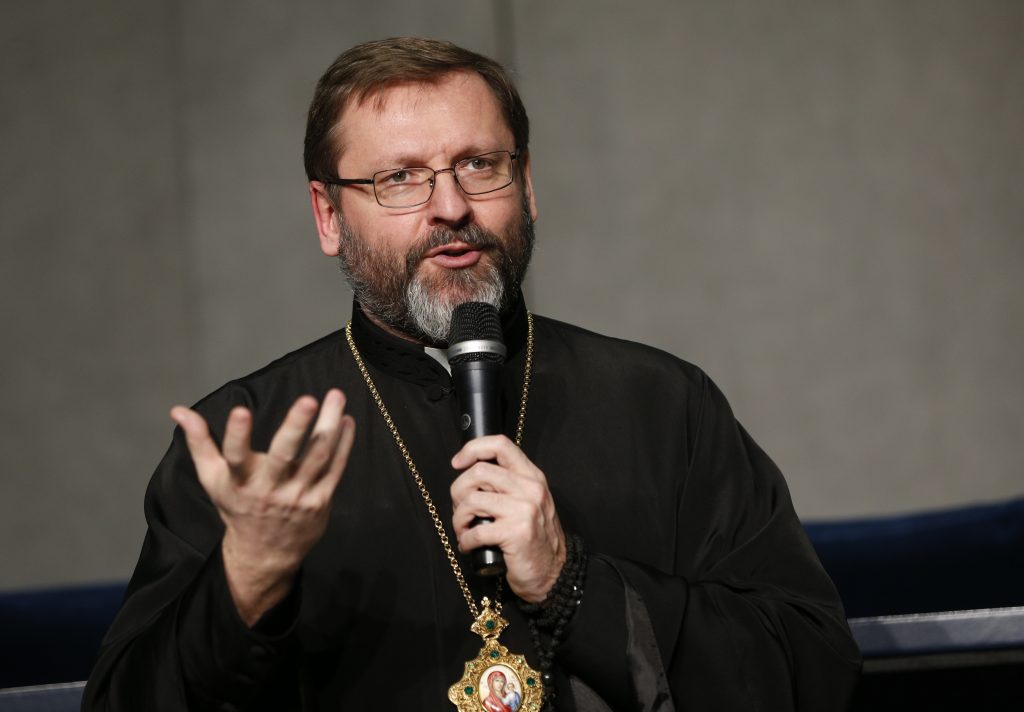
[Editors note: This is part two of a Crux interview with Archbishop Sviatoslav Shevchuk of Ukraine. Part one can be found here.]
ROME – So far there really haven’t been any great political battles during this month’s Synod of Bishops on young people, but when another group of 300 bishops or so gathers in Rome next year for a summit on the Amazonian region, some forecasts call for tension around a long-standing flashpoint in Catholic debate: Married priests.
Priest shortages are often terribly acute in parts of the Amazon, and some bishops from the area have long favored the idea of ordaining the viri probati, meaning tested married men.
Meanwhile in the West, some voices have revived the idea of a married priesthood as a response to the clerical sexual abuse crisis, arguing that marriage would provide priests the chance to express their sexuality in healthy and non-abusive ways.
Yet Archbishop Sviatoslav Shevchuk of Ukraine’s Greek Catholic Church, the largest of the 22 Eastern Catholic churches in communion with Rome that carry centuries of experience of married priests, has a basic message for his Western counterparts: “Not so fast!”
“If we must give advice, I would say that to remove celibacy from the priesthood will not resolve the problem. My experience is that there are holy priests who are married … this holiness, this maturity, is a great treasure, but it’s not a direct consequence of the state of life,” Shevchuk said in an interview with Crux.
Asked what advice he would give, the Ukrainian prelate, formally referred to as “His Beatitude,” was succinct: “To be prudent!”
Moreover, Shevchuk said, married priests create entirely new challenges in formation and priestly life, ones which debates entirely focused on a “yes” or “no” response often overlook.
“Often, our bishops are worried not only about the seminarian but also his girlfriend, and we’ve created a program for these women too,” he said. “Sometimes after two or three encounters they realize that they don’t want to be the wives of a priest. This can also make things more complicated.”
On other matters, Shevchuk:
- Praised the presence of young people at the synod: “They are the most vivacious nucleus of our group, which produces the most ideas and new solutions. So, it is a very important fact for the success of the synod.”
- Said there are few real tensions in the synod hall: “When you have in front of you a person who has needs, who needs to be accompanied, understood, cared for, a person to whom the Church today, as a good mother, is called to donate its spirit, this motherly warmth, it unites us all.”
- Said the Eastern churches haven’t yet been rocked by major sexual abuse scandals: “In a sense, we’ve been protected from the abuses of power and clericalism by the fact that, in the Soviet Union, our Church had no authority whatsoever.”
- Yet insisted that’s no excuse for complacency: “We must be careful not to lose our moral authority, because it is our only treasure. If the Church loses its moral authority in Ukraine, then our loss would be even more dramatic.”
The interview with Shevchuk took place Oct. 13 in Italian, and it was translated by Crux into English.
What’s your impression of the synod?
This is already my fourth synod. The first was on New Evangelization, in the time of Pope Benedict. At that time, I was named to the ordinary council of the synod, so I was one of those who prepared the synod, both the ordinary ones and the extraordinary ones. And now I participate in this synod as head of the Catholic Ukrainian Church ex ufficio.
I must say that my impression is very positive. Particularly the Instrumentum laboris, compared to the ones from other synods, it’s one of the best. Obviously, it’s a text destined to vanish, to die. Today we argue, we criticize, work in the small groups, but as a start it was very good.
The other very interesting part is the great participation of young people who feel like protagonists in this synod. In my small circle we have four young people, one from Australia, one from Nigeria, a girl from Russia and a girl from the Netherlands. They are the most vivacious nucleus of our group, which produces the most ideas and new solutions. So, it is a very important fact for the success of the synod.
The part which the pope set aside as a moment of listening has already taken place. But now we have to move forward, because to simply listen is too little. We need to discern and make some concrete decisions and get to work.
My impression is that in this synod there aren’t great tensions, great discussions. Is this your impression?
Absolutely. The topic itself, including the subjectivity of the young people, is awakening a paternal feeling in the heart of the Church and also among the synod fathers. It’s not about arguing over ideas, because this creates tensions, because everybody has different ideas. But when you have in front of you a person who has needs, who needs to be accompanied, understood, cared for, a person to whom the Church today, as a good mother, is called to donate its spirit, this motherly warmth, it unites us all.
Obviously, we come from different contexts. That which in one place is a pastoral emergency is not so in Nigeria, or in Ukraine. But the fact is that there aren’t great tensions. The synod is unanimous, it feels like one heart and one spirit. For this reason, I must say that the spirit of the participation in communion is also great. We share our opinions. And it’s also interesting that the young people present in the room react to each speech and take a position. You can sense if that which we say and think corresponds to their expectations. There’s an immediate response, there’s feedback. And this truly has created a very positive climate.
According to you, what are the great topics of this synod over which there’s a need to make decisions?
The question I would like to pose to the synod is an ecclesiological one. Up to what point is the Church an institution?
Why?
Because there’s a certain mistrust from young people towards institutions today. This we see in Ukraine when it comes to the government and other institutions. What young people today need is community. Obviously, the institutional form must be re-interpreted, because the institution is an instrument to the service of the community. Many young people feel abandoned by the family, by society, and there’s this great expectation that the Church will not abandon them. The Church must be a community where you can have the conditions to mature and develop, with education and formation both Christian and human.
It’s a very interesting time. I must say that for a long period of my priestly life, I was the formator in seminary. The issue of vocational discernment is central not only for the formation in seminary, but also for youth ministry.
This person who does the accompanying, this spiritual father, this spiritual councilor, has to be present in the life of every young person. Several bishops have said that we see few people capable of accompanying. How to promote this ministry that is a vocation within the Church’s ministry? According to me, the choices about the way to accompany must be pastoral.
The Church always, in my opinion, has to deepen the concept of the Church as a community that is generative. There’s a section of the document that speaks about the Church as generative, because the Church is a mother that generates. Through the grace of the Holy Spirit, it generates children of God and of the Church. But today, for many reasons, we’re becoming more and more a society of orphans. It’s fundamental to rediscover the maternal face of the Church that seriously takes care of its children.
Speaking about the maternal face of the Church, you know very well that, in many parts of the world, it’s difficult for young people to see this because of the scandals, particularly those of a sexual nature. Is this a problem for your churches too?
I think it’s an issue that is relevant for everybody because, regarding the issue of abuse, sexual abuse is only one form. There are many kinds of abuse: abuse of authority, of money, of trust, not only in the Church but in the culture in which we live. We’re not immune to these issues. For the moment, in our Church, at a global level, the issue of sexual abuse is not as dramatic as we have seen in the context of the Church in Ireland, Chile or the United States. In a sense, we’ve been protected from the abuses of power and clericalism by the fact that, in the Soviet Union, our Church had no authority whatsoever.
The only authority we had, and that we continue to have to this day, is a moral authority. Why? Because we were persecuted because of our faith. We were persecuted for that which we are. In this persecution, today we see authenticity emerging. Because to be a Christian in an atheist country is not popular, it’s to go against the tide.
Perhaps today, being a Catholic in Ukraine is not fashionable, but we’re Catholic. We’re truly convinced that we have a mission, to be witnesses of the unity of the Church. If we speak of Ukraine, in the 20th century there were so many abuses of power and trust, even within the Church, while in Western society we were placed by the Lord in a different situation.
But I must say that we too are pardoned sinners. We cannot say that we will be forever immune to certain problems.
Is there a fear that now that the situation for the Ukrainian Church has changed, because you can obviously be a Catholic in Ukraine, there’s going to be a “delay” and that all these problems that have affected the universal Church for the past 100 years will now become a problem also for you?
Yes. I believe that we have many things to learn from the Latin Church in many counties in the world. I’m in agreement that all these modern ways of living are beginning to arrive to Ukraine. Ukraine is a society in a period of a strong emancipation. For example, the sexual revolution that the West had in the 1960s is arriving in Ukraine only now. We’re conscious that, as Christians and as a Church, we’re challenged.
Nevertheless, I think that we can learn from the experience of the Church in Western countries. It can serve as a warning to us, not only to adopt certain practices and disciplines, but to be particularly attentive to the protection of minors, and to promote an integral education of the Church’s sexual moral education. We must be careful not to lose our moral authority, because it is our only treasure.
But, if the Church loses its moral authority in Ukraine, then our loss would be even more dramatic.
Could it be said that also in Ukraine the policy of the Church when it comes to clerical sexual abuse is that of zero tolerance?
Yes. We have also discussed this at our own synod, in September. We wrote a synodal letter to the pope, supporting the successor of Peter in his ministry and sharing his pain for the Church. We declared zero tolerance for these abuses and our commitment to protecting, working in favor of those who can be victims of any kind of abuse: of power, of trust, of conscience, sexual abuse, at the hands of any representatives of our Church.
Also, in each part of the world, our bishops belong to the Latin-Rite bishops’ conferences, so they adopt these measures of protection in their dioceses, according to the discipline of the country.
For us in Ukraine, together with the conference of Latin bishops, we’ve issued an instruction on how to proceed if a case of pedophilia is discovered. This document was produced at the explicit request of the Congregation for the Doctrine of the Faith. I would like to thank this Congregation that has asked us for this, even if for the moment we haven’t perceived a practical need in Ukraine. We have to learn from the Church in the West. We must be prepared, warned, and sensitized on this issue.
In February there will be a meeting in Rome with all the presidents of bishops’ conferences from around the world on sex abuse. Are there experiences that the Oriental churches can share with the Latin Church …
Yes. I will participate in this encounter. For me, it will be a great occasion of listening, of sharing with others. I will participate because this meeting is part of the zero tolerance policy that the Holy Father wants to apply in the most transparent way. It is also something that we want to adopt, not only as a policy, but also through concrete measures.
All the heads of the oriental churches will participate?
I hope so because in every organism of the Apostolic See, presidents of the bishops’ conferences and heads of the Oriental Churches are equal. For this reason, I think that I will have to participate ex-ufficio.
I must say that our Church also has some experiences also to share, because the great majority of our priesthood is married. The fact of having married priests does not mean that we’re immune against this evil. We know that, in the world, the great majority of cases of pedophilia take place in families. We need to create a culture of protection, of zero tolerance, not a system, that hides this evil.
I must say that, by the fact that they have their own children, our priests have a more natural relationship with children. They are often educators of their children and also of the children of those who attend their parishes. This experience of being father of one’s own family helps them to treat children in a healthy way. And the Church is called to help these children to mature.
As you have said, the vocation to the priesthood in the Ukrainian Church is a bit different because priests can marry. Do you have any recommendations for those today who ask the Latin Church to allow priests to marry?
To be prudent! If we must give advice, I would say that to remove celibacy from the priesthood will not resolve the problem. My experience is that there are holy priests who are married … this holiness, this maturity, is a great treasure, but it’s not a direct consequence of the state of life.
In the process of vocational discernment, it’s another challenge. It’s not easy to accompany a seminarian about what state, to be married or celibate, he should choose as he approaches priesthood.
At what point according to your rules do seminarians make this decision?
Right now, during their time in the seminary. Obviously, there are exceptions. Our seminaries accept only young men who are not married. This is because it is almost impossible to ensure a calm period of discernment during formation [after marriage]. If a married man entered seminary, they’d basically have to leave their family for six years.
I remember in the early 1990s, when our Church emerged from the underground, we accepted everyone in the seminaries, because there was a great need for priests. Every week, I saw with my own eyes the suffering of these families who were deprived of their father. This was a tragedy from a human perspective, a spiritual perspective, and also an economic one.
When I was the rector of the seminary, with the agreement of my bishop, I created a program for late vocations. If a father of children wanted to begin the path of formation to the priesthood, having a college education, we helped him live a community life in the seminary without making him leave his family. We helped him to to study and receive formation without leaving his profession, because he had to support his family. It was a very individual process, something we could do in our seminary. We were partially successful, because this program produced six priests.
Seminarians cannot marry while they are in the seminary. Nevertheless, in the second half of their studies, they often have a girlfriend. This is also a very delicate period. Relationships through email and skype are so strong, that sometimes during formation it’s hard to focus the attention of the seminarian in the community, because there’s someone from outside pulling on him.
They have to choose if they’re going to marry or remain celibate before the diaconal ordination. It often happens that a candidate who is called to be married, a father, has to wait a few years to find the right person. Many of our seminarians aren’t ordained because, after completing seminary studies, they come to Rome for advanced studies. Only after completing these studies can they be ordained. You can’t live as a married priest in a Roman college.
The crisis of the family touches priestly families too. Often, our bishops are worried not only about the seminarian but also his girlfriend, and we’ve created a program for these women too. Often, after two or three encounters they realize that they don’t want to be the wives of a priest. This can also make things more complicated.
So, to answer your question, we’re open to sharing our experience, but the decision has to be made by the Latin Church. I must say that this is not a topic of this synod, the issue of celibacy is not being discussed in the hall or in the small groups.
Emotional affair makes the workplace wobbly

Dear Amy: I have worked closely with a colleague since the beginning of our careers. We are both in our 30s and extremely close – she was there for me during my divorce, I attended her wedding, our kids have met and we do “non-work” stuff together.
She returned to work after a year off for maternity leave and something was different. We realized pretty quickly that we were actually in love with each other.
Though I am single, she is still very much married. We have been dancing around the issue, and have toed the line but never broken into a physical affair.
Ultimately, she has decided that in lieu of choosing between her husband and me, she is going to focus on her marriage.
Regardless of whether this love between us was mutual or one-way, we still work very closely together.
Do you have anything to offer as to how I should deal with working so closely with someone I very much want but cannot have?
– Work is Tough Enough
Dear Enough: Your characterization of her as focusing on her marriage “in lieu of choosing” between you and her husband sounds like a red herring.
You should assume that she has actually made this choice, and she is choosing him, and her family, over the personal destruction this affair could cause.
This is a very tough situation, but people do survive from emotional love affairs.
It is not easy to roll back this sort of intimacy, but it will get easier with time. You have a large emotional gap to fill. You have to “behave” your way out of this, and your feelings will follow.
Read more:
For now, you and she should not communicate outside of work. Talking with her about your mutual feelings reinforces the emotional intimacy.
If working together is triggering too much emotion or sadness for you, you should pursue different assignments, which will take you into other professional and personal realms.
You need to build up a life that is separate from this person. You should force yourself to meet new people. Get out there. Take up a new activity outside of work. Give other women the opportunity to get to know you.
Dear Amy: My wife has a friend, “Donna.” They’ve been close since college.
Donna is high maintenance and selfish, but I’ve always been nice to her, and have no trouble interacting with her.
I do not like the way Donna treats my wife. She is demanding, completely self-centered and domineering.
My wife works full time. We have two children. Donna works from home and is single. Everything is based around Donna’s scheduling, and if my wife objects, Donna flips out.
My wife has cried many times over something hurtful Donna has said to her. When my wife doesn’t go along with Donna, she tends to cancel all future plans, ignore all communication and wait for my wife to come crawling back, which she always does.
My wife is planning a group trip for my 40th birthday. I’ve asked her not to include Donna on the invite list. She is very concerned about how Donna will react and what this might do to their friendship.
How do I get my wife out of this cycle? How can I make her see that this relationship is bad for her?
– Worried Husband
Dear Husband: You should not feel obliged to invite your wife’s bully to join you on your 40th birthday trip. Hold firm on that.
Otherwise, you should determine not to give this relationship any attention at all.
You will not get your wife out of this cycle, because you are a small part of it: “Donna” bullies your wife. She cries to you. You react either with sympathy or annoyance. You two discuss Donna at length. This relieves some of the pressure. Time passes, and the cycle begins again.
Your wife is going to have to determine for herself that she is sick of being bullied and burned.
Dear Amy: I’m responding to the question from “Not So Fat,” whose mother bullied him over his weight.
After a particularly nasty visit to my father-in-law, my husband and I made a plan: At the first nasty remark during the next visit, we just got up, walked out of the house and drove home. By the time we got home, he was calling to apologize. The visits got much better after that.
– Success!
Dear Success!: I highly recommend this quick and quiet exit. I call it, “Gee, look at the time…!”
You can contact Amy Dickinson via email: askamy@amydickinson.com. Readers may send postal mail to Ask Amy, P.O. Box 194, Freeville, NY 13068. You can also follow her on Twitter @askingamy or “like” her on Facebook.
Read or Share this story: https://www.freep.com/story/life/advice/2018/10/22/emotional-affair-work-advice/1669400002/