Gisele Bündchen explained that there’s no ‘secret’ to her successful marriage to New England Patriots star quarterback Tom Brady in an upcoming interview.
The 38-year-old Brazilian supermodel spoke with Arianna Huffington for a future episode of the Greek-American journalist’s Thrive Global podcast.
The Vogue model’s interview with Arianna was part of the publicity tour for her new book, Lessons: My Path To A Meaningful Life.
No shortcuts: Gisele Bündchen explained that there’s no ‘secret’ to her successful marriage to New England Patriots star quarterback Tom Brady in an upcoming interview; pictured May 7 in New York City
A kiss for his lady” The model and the athlete have survived many ups and downs
The runway model went on to say that it’s important to ‘keep the communication also loving and respectful and current.’
She also stressed the importance of letting go of painful topics.
‘I’m not going to talk about something that happened, you know a year ago. We address it, and then we let it go. Because I think with acceptance comes freedom.’
Gisele and Tom have been married since 2009. The two started dating in 2006.
Married life: The 38-year-old Brazilian supermodel spoke with Arianna Huffington for a future episode of the Greek-American journalist’s Thrive Global podcast; shown with husband Tom Brady at the Metropolitan Museum in May
In addition to marriage advice, the Brazilian beauty revealed that she had turned to meditation to cope with severe anxiety.
‘I started meditating in my early 20s, after having severe panic attacks…that’s one of the very important tools that helped me…it actually gave me a new life,’ she told Ariana.
Gisele’s husband Tom came under massive public scrutiny in 2015 when he was suspended while investigators probed whether he had intentionally deflated footballs before a game.
Keeping her cool: the Brazilian beauty revealed that she had turned to meditation to cope with severe anxiety; shown at Milan Fashion Week in September 2017
Gisele even tried to talk her star quarterback husband into giving meditation a try.
‘He has meditated, but I don’t think he’s as diligent as I am with meditation,’ she revealed. ‘For me, it came from something that has helped me heal from something that was so challenging in my life. Maybe because he hasn’t had the same need as me, maybe for him, it hasn’t become something so consistent.’
Last week, the author and philanthropist told Ellen DeGeneres that she had been unsuccessful in getting her husband Tom to retire from football.
As for herself, she said, ‘I’m the farthest I’ve ever been from retiring.’
No stopping her: Gisele said, ‘I’m the farthest I’ve ever been from retiring’; pictured with her family
The good news is that if you live with someone who can’t load the dishwasher to save their life, always waits until the last possible moment to shower or steals fries off your plate at every opportunity, take heart in knowing you’re certainly not alone.
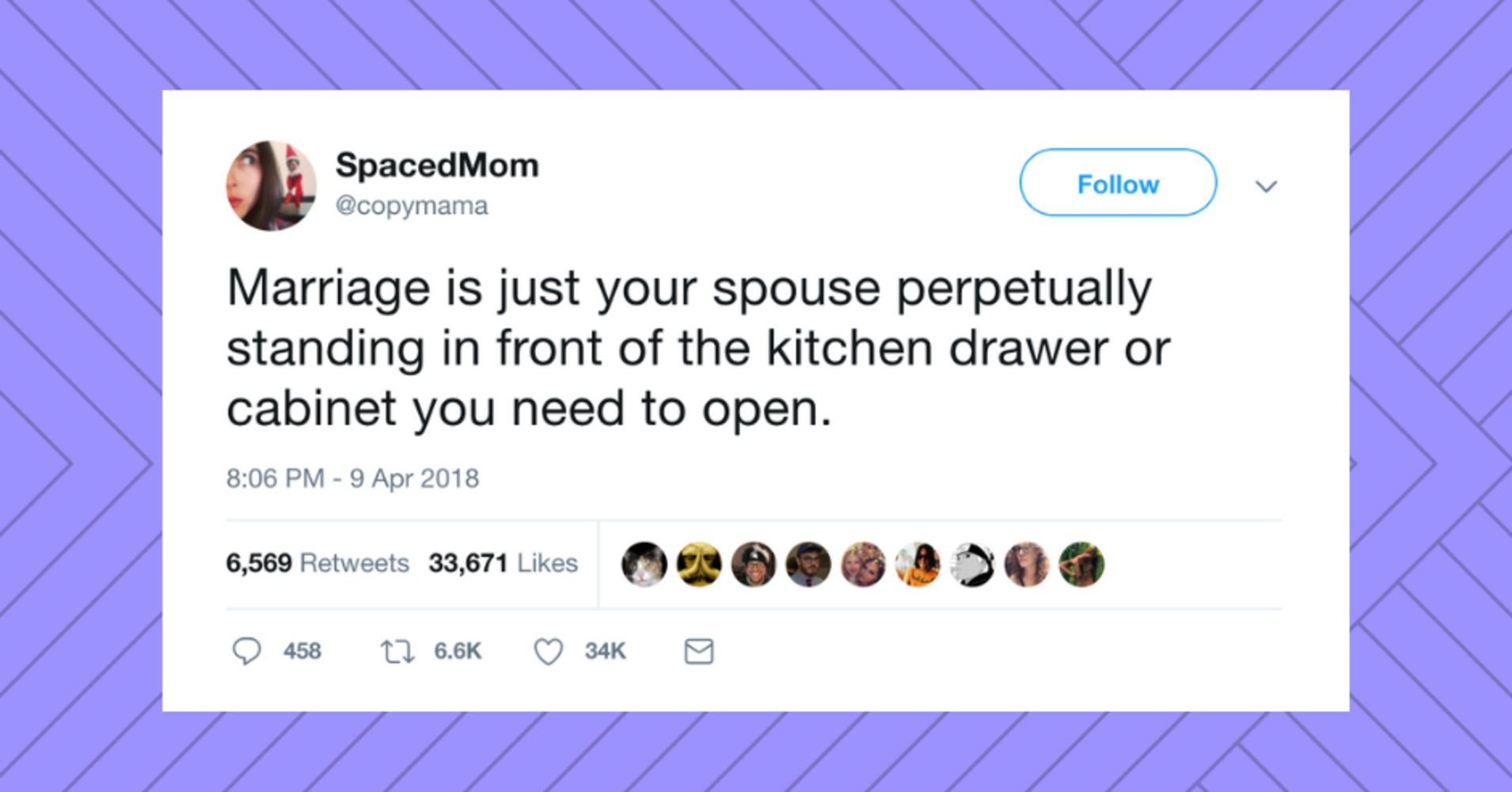
For your entertainment, we’ve gathered 50 of the funniest and most relatable marriage tweets we’ve seen this year.
Q: I plan on getting married next year (or in 2020 if plans aren’t finalized). We want to have a small event after the religious ceremony. I’ve been estranged from my younger sister for several years.
She recently moved back in with my parents after being evicted and becoming unemployed. I don’t live at home but whenever I visit, we do not speak.
Visibly leaving out a sibling in one’s wedding party is just asking for drama, writes Ellie. (Richard Lautens / Toronto Star)
I do not want her to be a huge part of my wedding. I’m sure I will have no choice but to invite her, but if I decide on having my other sisters as part of the bridal group, I don’t want to be forced to include her.
I’m no longer angry with the things she did many years ago. I’d summarize my feelings towards it all as “indifferent.” I’m not interested in having a relationship with her.
Now that I’m planning this new chapter in my life, I want as little drama as possible. Is this wrong of me?
Article Continued Below
Wedding Without One Sister
A: Misguided, is the word I’ll use in response. By visibly leaving out one of your sisters in your wedding party, you’re the one inviting drama.
You say you feel indifferent about her, yet you’ll arrange a public insult to her… a slight even more visible and ripe for gossip at a small event.
You don’t have to be close to her. But don’t fool yourself that you’re ready for “starting a new chapter” when you’re still willing to punish her for the past.
The point of a religious wedding ceremony is not just about the bride and groom … it’s about truly new beginnings, with vows before witnesses — family, friends, and guests — such that all are participants in the wedding covenant.
Include this sister in the bridal party among your other sisters, who’ll help deflect/avoid awkwardness between you two.
Q: Once again, my sister-in-law’s brother emailed that he’s coming for Christmas dinner. My wife and I invited him when he was single, and five years later he just assumes he’s invited, and brings his girlfriend-of-the-month.
Article Continued Below
Last year, even his sister hadn’t met her until they arrived, bringing nothing, though he’d been asked to contribute a dessert because everyone contributes something to the meal.
The girlfriend was embarrassed when he was asked what they’d brought, loudly telling him off for not getting something. He lamely answered, that he remembered “too late.”
We’re happy to invite our own family which has us, three teenage-to-adult children and two longtime significant others, plus my wife’s brother and wife, along with their three adult children and partners and two grandkids. That’s 17 of us already.
We understand that he’s just one guy and don’t want him to be alone, but his taking the invitation for granted and coming empty-handed, rankles me.
How do we handle this without losing the goodwill we want to feel at Christmas?
Fed Up
A: Send him an email reminding him that everyone who attends contributes to this Christmas dinner. Then be specific about what he needs to bring as his offering — e.g. exactly what kind of pie for dessert. Even tell him where he can get it and when is the best time to buy it for freshness.
Since he brings his own guest, ask him to also bring a drink of their choice — if you don’t serve alcohol, then a juice. Also, if you have certain house rules — e.g. no smoking inside – remind him to tell this to his latest companion.
Ellie’s tip of the day
A wedding event’s “fresh start” attitude is more possible if old baggage isn’t carried forward and in public view.
A married couple may want to file separately to enable one spouse to claim certain deductions or other breaks that would be reduced, or even lost, on a joint return.
Photo:
For most taxpayers, the answer probably seems obvious. But for some, it can be surprisingly tricky to determine which tax-filing status will hold the most advantages.
The choices may involve more thought and number-crunching than might be apparent at first glance. A few issues may be important for some taxpayers to consider before New Year’s Day because of tax-law changes enacted late last year and other factors.
Here are a few suggestions from tax pros on avoiding an identity crisis, and making sure you don’t wind up paying more in taxes than you need to pay.
Joint or separate
For starters, married couples can file either jointly or separately. The choice is important since your filing status is used to determine such things as the standard-deduction amount, eligibility for certain tax credits and other breaks, and, ultimately, how much tax you will owe.
Most married couples file joint returns. About 54.1 million returns received by the Internal Revenue Service for 2016 were joint returns (or returns of “surviving spouses”), according to the latest IRS data. Only 3.1 million returns came from married couples filing separately. The reason is simple: Generally, married couples would pay more combined tax if they file separately than if they file jointly.
But not always, says Mark T. Nash, a tax partner at PricewaterhouseCoopers. When in doubt, run the numbers both ways.
Here are some powerful reasons to consider filing separately:
Untrustworthy spouse: Beware of filing a joint return if you suspect your spouse is hiding taxable income or isn’t telling the truth about deductions, credits or other issues, says Bryan Skarlatos. a lawyer at Kostelanetz & Fink in New York. If you file jointly, you are responsible for what’s on that joint return—unless you can qualify for special relief. But winning “innocent-spouse” relief can be “very complicated and difficult to accomplish,” Mr. Skarlatos says.
Thus, filing separately can be a smart move in cases where you want to be responsible only for what is on your own return, says Eric L. Green, a lawyer at Green & Sklarz in New Haven, Conn.
Special Factors: In some cases, it might be better for a married couple to consider filing separately to enable one spouse to claim certain deductions or other breaks that would be reduced, or even lost, on a joint return.
One example is a lower-earning spouse who has large amounts of medical expenses or might be eligible for a large casualty-loss deduction, says Mark A. Luscombe, principal analyst at
Tax & Accounting. Filing separately might enable that spouse to deduct more of those items than he or she would on a joint return because the expenses are deductible only to the extent they exceed certain thresholds.
Also check if there are any state-tax issues that might affect the calculations, says Sidney Kess, senior consultant at Citrin Cooperman and of counsel to Kostelanetz & Fink.
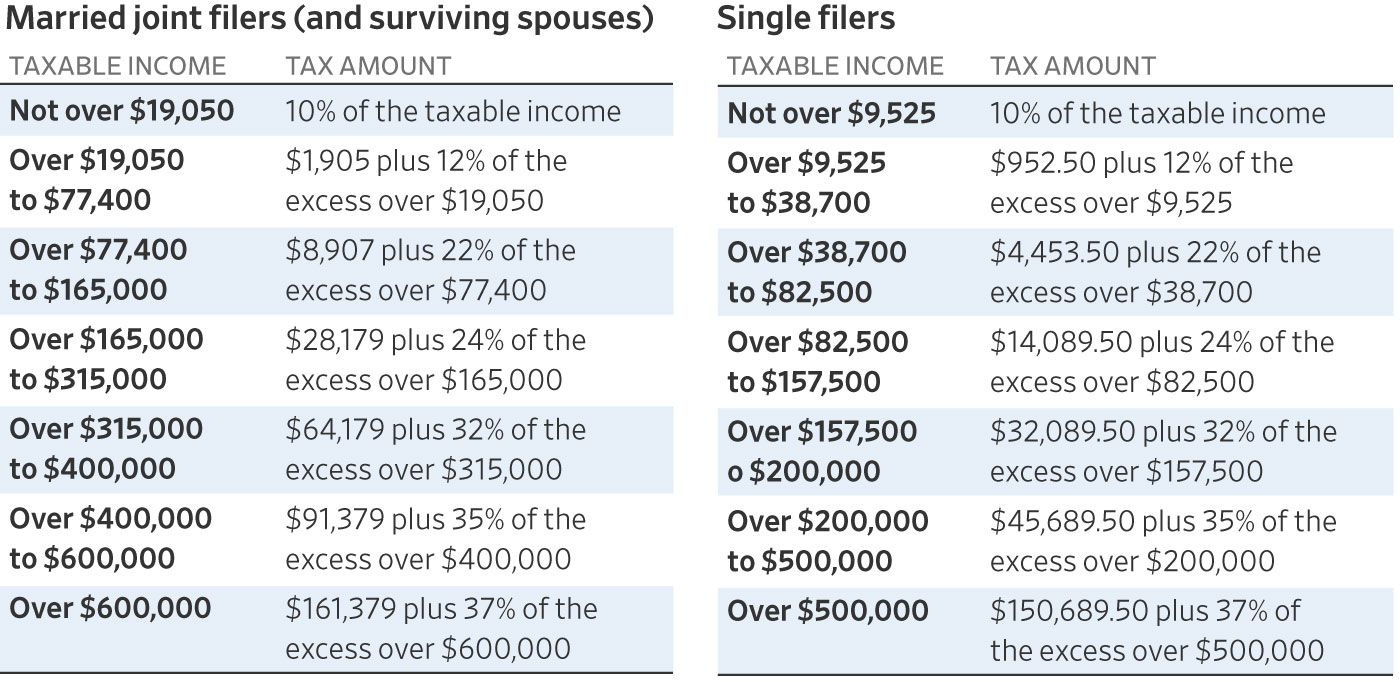
What’s Your Bracket?
Federal income-tax rates and income brackets for 2018 tax year`
Note: The numbers for people who are married but file separately are the same as those for most singles, except for the two highest brackets. For separate filers, the 35% rate applies to income of over $200,000 to $300,000, while the 37% rate applies to income over $300,000.
Source: IRS and Wolters Kluwer Tax & Accounting
Marriage bonus or penalty: Getting married this month, or postponing the official ceremony until next year, might have a surprising impact on your taxes in certain cases. For example, some two-income couples who get married this year and are in the top brackets may wind up owing more in combined federal income tax than they would if they had each remained single—commonly known as the marriage penalty tax. But in other cases, a married couple winds up paying less total tax than if each spouse had remained single. Lawmakers have taken steps to reduce or eliminate the marriage penalty in certain cases and to increase the amount of the bonus in many others. But these issues haven’t disappeared entirely.
Pass-through businesses: The new law includes a 20% deduction for owners of various types of “pass-through businesses.” Such businesses, which include partnerships, sole proprietorships and S corporations, pass along profits to their owners, who report them on their personal returns. The deduction has limits that begin above certain amounts of taxable income. Because of these limits, an owner who files separately might be eligible to make greater use of this deduction than by filing jointly with a spouse who has significant amounts of income.
It’s complex and details can vary widely depending on individual circumstances, so it’s best to consult a tax expert.
Implications for divorce
Part of the new law generally says you won’t be allowed to deduct alimony payments you make under a divorce or separation agreement executed after 2018. This new restriction won’t apply to agreements finalized this year or in prior years, says Elena Karabatos, a matrimonial lawyer at Schlissel Ostrow and Karabatos PLLC. Alimony payments will continue to be tax-deductible under agreements signed this year or in prior years, she says.
Another change: Recipients of alimony payments under agreements executed after this year won’t be taxed on those payments. The new law doesn’t change the tax treatment of child-support payments, says Mr. Green of Green & Sklarz.
Head of household
This category can be a source of significant confusion and taxpayer errors, both honest and otherwise. “Generally, you may claim head of household filing status on your tax return only if you are unmarried and pay more than 50% of the costs of keeping up a home for yourself and your dependent(s) or other qualifying individuals,” the IRS says on its website.
For exceptions to this general rule and other key points, search the IRS website for “head of household.”
When a spouse dies
Suppose your spouse died this year and you haven’t remarried. It might seem logical to assume you are single. However, you’re eligible to file a joint return with your deceased spouse for this year. Also, for the next two years, you may be eligible for special benefits as a “qualifying widow(er).” See IRS Publication 501 for more details.
***
For those who want more information about what status they should use, the IRS offers an online interview, “What Is My Filing Status,” a tool that asks individuals questions and offers answers that can help them decide. Tax-preparation software can also be helpful in wading through these issues.
Mr. Herman is a writer in New York City. He was formerly The Wall Street Journal’s Tax Report columnist. Send comments and tax questions to taxquestions@wsj.com.
Appeared in the December 17, 2018, print edition as ‘Tips on Deciding Which Filing Status Is Best.’
















0 Comments