



Category Archives: Marriage & Divorce
My wife wants to have a baby but says it won’t be mine: Ask Ellie – Toronto Star

Q: I’m a man, married to a woman whom I love and adore, and respect more than anything in the world.
The thing is that she sees other men for sex and is open about it. She doesn’t have actual sex with me anymore. She says I’m too small down there. But she likes that I’m a great provider.
She expects me to accept this situation and to remain faithful to her, which I am.
Now, she wants to have a baby, but says it won’t be mine and she insists that I accept this, too.
She knows how much I love her and that I’ve always accepted how our marriage is. I don’t want to lose her. What should I do?
Just A Provider?
A: I find it hard to believe that you can truly love and respect her once you admit to yourself that this woman has no regard for your feelings or dignity.
She uses you mainly for financial support, and leads a life that will increasingly demean you and eventually exclude you.
Whatever your size “down there” is, it’s possible to be intimate with a willing lover through oral sex, fondling, and other creative means.
But your wife has apparently shown no accommodating to you, other than for your money. And once there’s a child in the picture, plus its biological father, and her various sex partners, your role in her life will be minimized even further… to just handing over the cash to pay for her growing demands.
What should you do? See your doctor about “size” and a sex therapist about learning how to satisfy a lover who’s a real partner.
Then, Run. Staying in this marriage is self-imposed entrapment.
Reader’s Commentary regarding couples with a significant age difference that attracts attention:
Reader: “I’m in a same-sex marriage with a man who’s 32 years younger than me. We’re often aware of people looking at us and in one case (the only one in more than 10 years) a person actually made a comment to me, that “you must be very rich.”
“We’re sure that people often think that my husband is a “kept boy” and that the only way I can have a young “hot” partner is because I pay for it.
“But we know what the truth is and we tend to ignore the whispered comments and the stares.
“There’s nothing wrong with a “spring-December” relationship, provided that both members of the couple are on an equal footing (and that means age-appropriate).
“The gossips will have their day, for all kinds of reasons. Our job in this marriage is to make both members of the couple comfortable in our relationship.
“When we go out to a restaurant, for instance, my husband usually pays the bill. And we dress as is appropriate to our own ages.”
Ellie: It’s clear that neither of you is unaware of the speculation and gossip, and aren’t very bothered by it.
But to put the “chatter” in context, the ongoing #MeToo awareness and reaction to sexual abuses/assaults and coercion that occurs to both women and men, heterosexuals and LBGTQ people, has aroused some questions as well as unsubstantiated unfair gossip, too.
In a couple with such a visible age gap, people may (wrongly) assume that there was an initial predatory nature to the union, or that an ongoing power imbalance exists, forcing the younger partner to comply.
However, what matters is that both you and your husband are fully equal in the relationship.
Ellie’s Tip of the Day
Some “accommodations” in a marriage are too demeaning to accept.
EXPERT ADVICE. IN YOUR INBOX: Sign up for the Star’s advice newsletter, get the latest on relationships, etiquette and more.
Ellie Tesher is an advice columnist for the Star and based in Toronto. Send your questions via email: ellie@thestar.ca
Wedding Planner Bruce Russell Shares His Top Tips For Newly Engaged Brides | Entertainment | Culture – Luxury London

Bruce Russell: wedding planner extraordinaire, expert on all nuptial matters and the man with London’s ultimate little white book of contacts
Key decisions early on: date, venue and number of guests. When, where, who!
“I used to think a wedding was a simple affair. Boy and girl meet, they fall in love, he buys a ring, she buys a dress; they say ‘I do’. I was wrong. that’s getting married. A wedding is an entirely different proposition.” So said Steve Martin’s character despairingly in the definitive 90s wedding film, Father of the Bride, which most of you will know is funny, heart-warming, nostalgic and, actually, ridiculous at times because of scenes involving Franck, the flamboyant wedding planner with an accent of indeterminate origin. Thankfully, if you got engaged over the Christmas and New Year period (the most popular time of year for proposals), London has a rather less eccentric and much more confidence-inducing alternative to Franck and this man goes by the name of Bruce Russell.
After spending an hour in his company, we can confirm that Bruce is everything you’d hope a wedding planner would be; immaculately turned out, impeccably polite, extremely experienced in the wedding planning arena and, most importantly, he just gets ‘it’. He also only deals in superlatives – the prettiest, most beautiful, the best – so whether you’re an ‘over the top, luxurious, extravagant’ or ‘low-key, beautiful, elegant’ kind of couple, if you want your dream wedding to take shape before your very eyes, without having to stress over details and planning yourself, Bruce is your man.

What is your advice to anyone who just got engaged?
Have an honest discussion about what you both want, whether it’s a particular venue, or type of entertainment, or time of year – decide what’s important to you. From there, you can have the conversation about what is a realistic budget. That’s the first thing you need to work around to be able to start the process. You don’t want to get halfway through and say – oh, we’ve spent all our money… Couples sometimes get so caught up in the emotion that they can forget to think rationally.
What are the key decisions early on, apart from budget?
Date, venue, and, ideally number of guests, because that can dictate the venue. So when, where, who!

What’s the ideal amount of time for planning a wedding?
We’ve done a week and we’ve done a year. It’s really about understanding how quick the couple is to make decisions, whether they need to save up for certain elements of the wedding, and that the shorter the timeframe, the fewer options you have. Is it realistic to think you’d like a June wedding in the South of France if you just got engaged? Chances are the venues will be booked. Although…we can make anything happen!
What personal details have you particularly loved?
For one couple, who had an outdoor garden at their venue, we created a tree hung with individual roses for each guest, which had a laser-cut leaf with their name and table number on it, in memory of the bride’s grandmother who was named Rose. All the girls in family have the middle name Rose too, and that kind of details comes from having conversations with the bride and groom, and getting to know them.

Do couples tend to come to you with a clear vision of their dream wedding?
It’s a mixture. Many of the couples don’t have time to think and they want us to provide sound-bites and threads for them to pick up and inspire them. They normally know what they don’t like! I try to understand why someone really wants something – they might love street food and vendors as a concept but if you’re in a London ballroom it doesn’t really work – and make sure that everything works together.
What are the main considerations for a destination wedding abroad?
Relinquishing control a little bit – if you’re having a panic moment at home, you can meet the supplier, but for a destination wedding, you can’t always do that. We manage the process – it can take people lots of time to come back to you – and it does involve pre-trips to the destination together to meet vendors, and check the ceremony is going to flow as you wish. Then there’s a clear visual understanding between everyone of what’s going to happen.

What are the common elements in the best weddings you’ve seen?
If a couple has a clear vision of what they want and it flows – and when they trust me to produce an almost theatrical production that flows seamlessly between acts. As long as people aren’t waiting for anything, we’re good! At the end of the day, it’s about the guest list – make sure you’ve got a great group of people. We can throw the most amazing party and celebration but the guests have to really feel that.

How do you handle last-minute requests?
At a recent wedding we did, the mother of groom approached me and said she wanted to do a surprise for the bride and groom, with ten days to go. By that point every moment of the day is planned and orchestrated to a tee. I suggested fireworks, as it was in a marquee with a clear roof, and she was set against it to start with, but I explained it and she loved the idea. Then I realised that the wedding was on Bonfire Night so finding someone to do it was a… challenge! But we did it, and it was incredible. We aim to make the process seamless from start to finish; it’s about us understanding where to focus the budget, going above and beyond, and making sure it’s just perfect!

Here are some of the best life lessons on parenting %%sep%% Ladders – Ladders

The buckle on my favorite cowboy belt broke apart that morning, and I presented the remnants to my father. He surveyed the damage and announced, “I think it’s a goner, Johnny.”
I don’t remember why that belt was such a vital part of my fashion ensemble, but the thought of appearing in my second-grade class without it had me nearly apoplectic. Dad dropped me off at school, and with slumped shoulders, I shuffled off to class.
Illustrations by John P. Weiss
My father was an administrative law judge, and his work involved long daily commutes. The crickets were in full song by the time Dad made his way back home each night.
He would spend the remainder of his evenings correcting my homework and reading. Before dawn, he would drive off to repeat the ritual.
An investment in pure love
A few hours after dropping me off at school that day, the hurly-burly of class activity was interrupted by a loud knocking. Our teacher opened the door, and there he stood, with a brand-new cowboy belt in hand.
Smiling broadly, I ran to the door. “Here you go, Johnny,” he said, handing me the belt and with it a lesson about love and sacrifice.
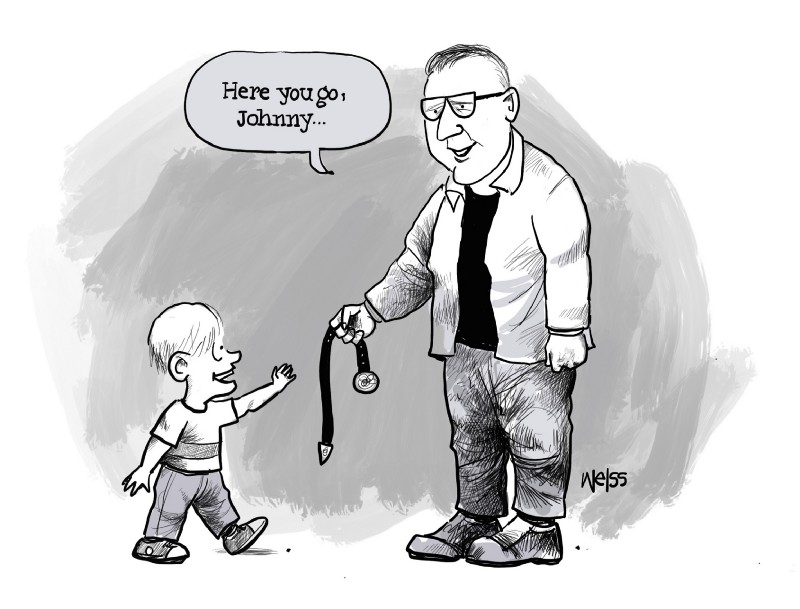
It had been a rare day off for my father, and he no doubt had better things to do than shop for cowboy belts. Yet, he focused on me, knowing that no errand or leisure activity could trump an investment in pure love.
Dad’s simple act of kindness was just one more brick laid in the foundation of my childhood development. A foundation made of love, discipline, sacrifice, and character.
Many well-intentioned parents today dive into their careers, spend thousands on daycare, invest in private schools and save for their children’s college funds. All of these things are useful, but it’s the early years of parental role-modeling and interaction that matter most.
Fatherly lessons on life
Not a week went by without fatherly lessons on life. I recall Melinda, the developmentally disabled girl, who needed a ride home after school. Dad offered to take her. We pulled into her driveway, and I was instructed to walk her to the door, “like a gentleman.” The lesson learned: Treat women with respect.
There was Ted Strollo, a homeless immigrant who was struck by a car. Dad came to his aid, brought him to our home to recuperate and found him a low-cost apartment.
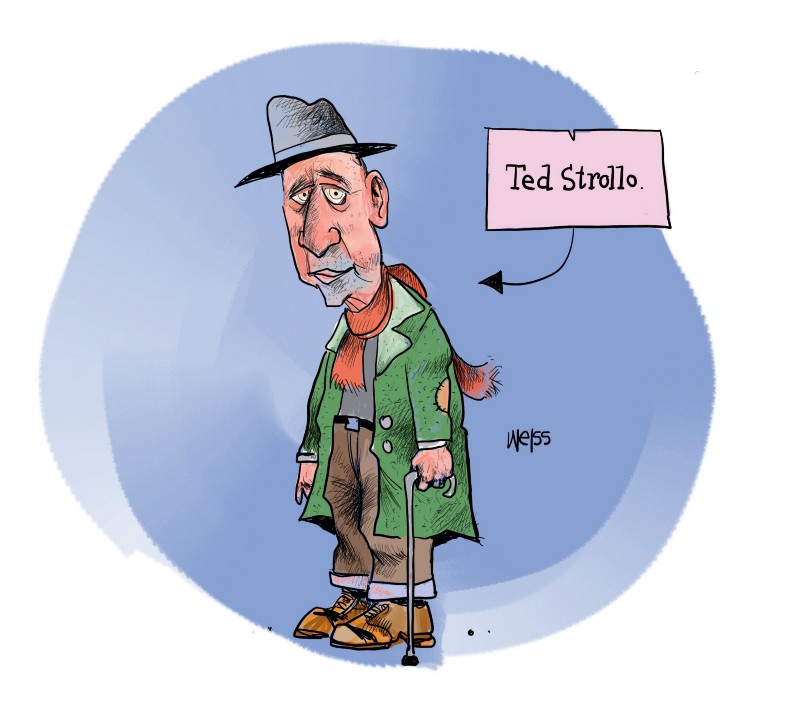
Every weekend, we visited “Mr. Strollo” to drop off snacks, socks, and magazines. Mostly, we would just talk; he reminisced about the old country. Driving home, Dad explained that the elderly are often forgotten and their wisdom untapped. The lesson learned: People matter, and should be treated with dignity.
Whenever undercharged for groceries, Dad would always drive back to the store to pay the difference. For me, it was a lesson about ethics.
My father was always reading, and the connection between books and his vast intellect was not lost on me. Our living room library contained endless shelves of books. The Harvard Classics, history, politics, art and more. The lesson: Feed your mind.
During my college years, Dad’s guiding hand-penned weekly letters. Reports on the home front, advice, newspaper clippings, and the underlying message — I love you and care about you. I kept all his letters.
Following college and graduate school, I pursued a career in law enforcement, married and had a son named Conner.
Building a foundation
Whenever we visited “the Judge,” as we affectionately referred to my father, dinner discussions often focused on societal issues.
I used to share my frustrations in dealing with people who refuse to take personal responsibility for their lives. As a police officer, I faced desperate parents who pleaded with me to do something about their delinquent children. I didn’t have the heart to tell them that the problem should have been addressed long ago when they were too busy putting their own needs ahead of their children’s.
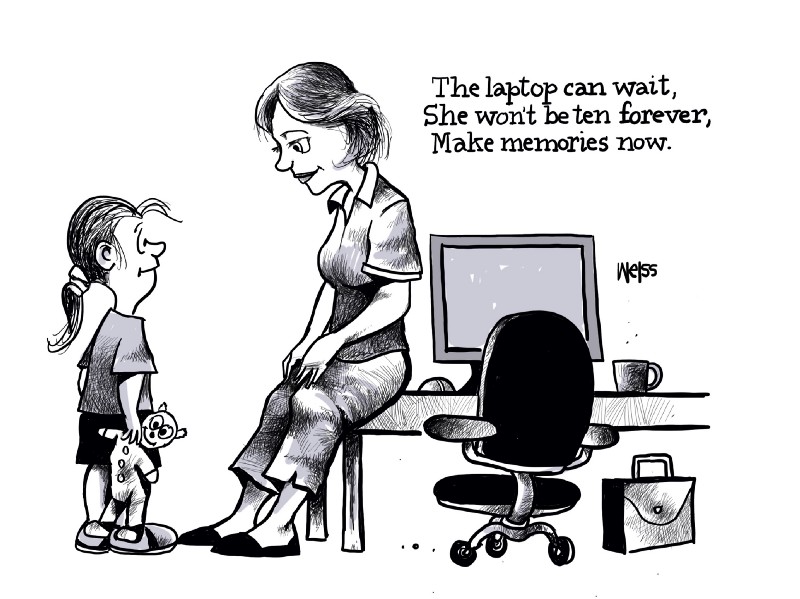
Not that it’s easy. After Conner was born, I discovered the challenges of sleep deprivation, dirty diapers, reduced free time and relentless fatigue. Plans to read to my baby boy were replaced by communal naps. Shift work didn’t help, and I began to wonder how anyone could muster the energy to parent as my father had.
Gradually, I learned the art of juggling my time and responsibilities. I made time to go to the park and read nightly stories. Bad behavior was corrected, and I insisted on good manners. All of this took time, but I was building a foundation, just like my father did.
A dilemma
One day, while cleaning Pop-Tart crumbs off the floor, Conner ran upstairs with a dilemma. His belt had broken, and he didn’t have another to wear.
It was a school day for Conner and a much needed day off for me. I told him that I would buy a new belt on the weekend. Conner traipsed downstairs, clearly disappointed. As I stood there, Pop-Tart crumbs in hand, it hit me. I buckled Conner in the car, and we headed out.
Even at 5 years old, Conner was perceptive enough to know whenever I deviated from our usual morning route.
“Daddy, where are you going?” he asked.
“To buy you a cowboy belt, my little Pop-Tart … to buy you a cowboy belt.”
Before you go

I’m John P. Weiss. I draw cartoons, paint landscapes and write about life. Thanks for reading.
(Above post adapted from my article: Best Parenting Is Done by Setting An Example – San Jose Mercury News, May 19, 2004).
Top 10 Questions You Should Ask Your Retirement Financial Advisor – Forbes

Top 10 Retirement Financial Advisor QuestionsLukas (pexels.com)
There are several financial transitions throughout life. One of the most significant financial transitions is retirement. The shift from pre-retirement when you are earning, saving, and growing assets to retirement when you are withdrawing assets is monumental. A successful retirement transition can make or break retirement. It’s important your retirement financial advisor is able to make this journey with you. If you’ve never worked with a financial advisor or if you already have a financial advisor but are not sure if they can help you make the retirement financial transition, the following ten questions will help you better understand their capabilities, experience, and philosophy when it comes to helping their clients create a successful retirement.
(1) Are you a True Fiduciary?
It doesn’t make sense to pay for advice when the advice doesn’t have to be in your best interest. Period. A True Fiduciary is someone who is legally obligated to give you advice that is in your best interest. Yes, this means there are advisors (the majority of them, actually) who get paid by their clients and who do not have to put their client’s interests ahead of their own. Ridiculous. Ludicrous. Preposterous. Why in the world would you pay someone for advice when what the advisor is recommending may actually be in their best interest? I just don’t understand this. Imagine going to a marriage therapist and paying her to help you improve your marriage but knowing that she is also a divorce lawyer who can help you get divorced if your marriage doesn’t go well. Why in the world would you pay for her marital “advice”? I’m hopeful that one day all financial advisors will be fiduciaries who are required to put their clients’ interests first, but until then, this should be your first question to any potential financial advisor.
(2) Why do you do what you do?
This is a question that doesn’t get asked often enough. At the end of the day, you don’t just want an advisor to legally put your interests ahead of their own (see #1). In fact, you don’t even want an advisor that has a moral obligation to put your interests ahead of theirs. You want a financial advisor that is honored to always put your interests ahead of his/her own – an unbiased and independent steward of your money. Talk to the advisor. Find out what makes him tick. Why does she do what she does? Ask why they do what they do so you can learn why they want to work with you.
(3) How do you make money?
There is nothing wrong with getting paid to provide expertise and a service. At the same time, you need to know who you are working with and how they get paid. It’s important that you are getting value and expertise that exceeds what you are paying. If you work with a good retirement financial advisor, this shouldn’t be too difficult. There are many ways to reduce your taxes, plan your estate, build an appropriate retirement asset allocation, and help you create lifetime income to live on in retirement. Good retirement advice should more than make up for the fee.
(4) How long have you been working as a retirement financial advisor?
I’ve written about the 10,000 hour rule before. This rule was coined as a result of the work by psychologist Anders Ericsson on exceptional performers. His research shows that great performers practice a lot. The 10,000 hour rule is a rule-of-thumb for how much practice is required to develop an expertise in a field of study. What this means is that it often takes at least 10 years of focused effort and experience in order to gain mastery in an area. Keep this in mind when you interview retirement financial advisors.
(5) Do you have any regulatory/legal issues?
You’re counting on your financial advisor to help you navigate retirement. Let’s think about this. You’ve worked hard for 30 or 40 years and now you want to make sure your assets are safe and managed judiciously so you can travel and enjoy your retirement. If you are relying on your retirement financial advisor to help you throughout this process, it makes a lot of sense to verify your advisor has not had any legal, regulatory, or license issues. A quick way to do this is to use the FINRA BrokerCheck website as a starting point. If the retirement financial advisor has any licenses or designations (e.g., CFP), check these organizations’ websites to see if anything has been reported there as well.
(6) Does your firm hold my money and investments?
What you want to hear is no. There is a subtle, but significant, difference between a firm that manages your investments and one that manages and holds your investments. It is hard to overemphasize the importance between these two types of retirement planning firms. Why is this question important and something I’ve written and talked about for years? It has to do with investment fraud. If the firm managing your money also holds your money, there is a greater opportunity for embezzlement. The goal is to protect yourself and your finances as much as possible. This is why I feel so strongly about having a custodian — an unaffiliated and large firm – hold your investments (such as Charles Schwab, TD Ameritrade, Fidelity, etc.) and a separate RIA retirement advisory firm to manage the assets.
(7) Do you manage retirement portfolios the same or differently from non-retirement portfolios?
What you are trying to understand is their philosophy to retirement investing. I’d argue that it makes sense to at least think of pre-retirement and retirement investing differently. This doesn’t mean your portfolio needs a complete shift the day after you retire, but there should be a re-evaluation of the portfolio, the allocation, and an income strategy as you approach and throughout retirement. Someone who is 35 and is focused on saving and growing their money requires a different strategy than someone who is 68 and is living off their investments.
(8) Can you help me create an income strategy for retirement?
In retirement, this is one of the most critical and overlooked areas. Retirement is all about income. Once you stop working, the only sources of income for most retirees is Social Security, maybe a retirement pension if they are lucky, and their investment portfolio. A good retirement plan is one that provides the necessary income to live on and one that lasts a lifetime. This requires special planning and an investment approach that may look different from the accumulation phase during the working years. Your retirement financial advisor needs to be well-versed in creating retirement portfolios that provide for lifetime income and be able to communicate their approach to you in a way that makes sense.
(9) Do you provide comprehensive financial planning?
Comprehensive financial planning is just as important at age 35, 55, 65, or 75. Although the type of advice may look different at each phase of life, each stage offers its own challenges and opportunities. In fact, I could argue that having a comprehensive financial advisor is even more important in retirement because you have more at stake. A good retirement financial advisor will be able to look at your entire financial picture and make adjustments and recommendations in areas such as taxes, asset preservation, insurance planning, cash flow, and income strategy. Since you have less time to overcome mistakes or bad decisions in retirement, it is critical your retirement advisor can see the big picture and how the seemingly small decisions affect your overall retirement success.
(10) What do you see as the biggest risks in retirement?
A red flag is to hear there are no risks or that they eliminate all risks. A response like that is either ignorant, arrogant, or deceptive. None of these are great qualities for an advisor. There are financial and non-financial risks at every age. Most advisors don’t want to scare potential clients, but at the same time they should be aware of and be honest about the risks retirees face. Being blind or sugarcoating these risks is not a good strategy. A better approach is to identify them and come up with a plan to eliminate or reduce them.
In addition to these ten questions, there is another tool you can use to help evaluate potential financial advisors. It’s called AdvisorFit and it’s a free website I created to help people ask the right questions to financial advisors and to help them understand the responses. It’s not foolproof and it doesn’t guarantee you’ll get a great advisor, but I’m hoping it helps.
I also hope you find a good retirement financial advisor. After working with retirees over the past 20+ years, I know how hard people work and save and how much they look forward to a comfortable retirement. You deserve someone you can trust and who knows how to help you reach your goals.