



Category Archives: Relationships
Three Black Millennial Women Share Why They Quit Their Successful Jobs to Launch Startups


1 of 3
Nicole Gibbons, Founder & CEO, Clare, New York
Why did you want to found a startup? At my old day job, I was Global Director of Communications & Events. While I was very successful in my PR career, there was no passion about what I was doing. I loved interior design and was dabbling on the side while working in PR, and eventually I took the leap to build my design business full-time. I became founder & creative director of Nicole Gibbons Studio, my design firm. Most recently, I pivoted to launch a direct-to-consumer paint startup called Clare that makes buying paint for your home easier and more inspiring. I’m now on my third career evolution. Where did your business idea come from? My love for design was solidified at a very young age having grown up with a mom in the design industry. When I was working in PR, I started exploring my love for design on the side, first launching a design blog, then setting up an LLC and taking on any small design project I could. I tried my best to build my design brand while working full-time. I had no doubt that I could do this, but I wanted to feel really prepared and confident first. That meant saving up enough money to have a nice cushion if the business didn’t take off right away and also learning the design industry inside and out before quitting my current job. It was 5 years before I left corporate America to focus my design business full-time. My goal was not just to build a design-firm but also create a brand…and it took another 5 years before I launched my startup, Clare. How did you personally feel empowered, worthy and skilled enough to start your own business? Confidence is key. I learned the business inside and out, and was also confident that I had the right background, skills and grit to launch my startup. One of the most important traits of a good leader is being confident in what you know, and equally confident in what you don’t know. You also have to be a quick, voracious learner that can adapt, be really comfortable with ambiguity and figure things out quickly. Those are definitely traits I have and for any key areas of expertise that I lack, I’ve hired people who can fill in the gaps and who know far more about their areas of expertise than I do. Being able to build a strong team is important. What adversity and challenges have you faced thus far? In starting this new business, the biggest challenge has been operating lean and with limited resources. I launched Clare with small team and everyone is wearing many hats and working really hard. Hiring and building a team the right way takes time, and with what feels like a giant roadmap and so much to get done, It’s a constant challenge to balance the workload among such a small team. Every day, I struggle with prioritizing. I am pulled in a million different directions and daily there’s always something important that’s left undone. It’s taken some time to get comfortable with the idea that there just aren’t enough hours in the day and some things will be left undone. Hopefully that will change in time as my team grows and there is more support. I’m so passionate about the company and it keeps me going. Clare just launched and it’s only the beginning. The business has so much potential. I’m incredibly excited for what’s to come. What do you need in order for your business to be successful? This business is nothing without a strong team of smart, talented people. I’m very invested in building and growing my team and building a strong, collaborative company culture. I feel successful when I’ve achieved a goal and feel proud of what I’ve accomplished. Success is when I’m just happy with who I am and what I’m doing with my life.


2 of 3
April Johnson, Founder & CEO, Happied, Washington, D.C.
Being a D.C. lawyer is an ultimate dream for many, why the career change? My motto is that you only have one life, so you should live it doing something that makes you happy. I wasn’t miserable at my job as a corporate real estate attorney for a big-law firm, but knew it wasn’t my passion. I primarily represented banks and other financial institutions in commercial real estate finance transactions. At the time of my recent departure, I was considered a senior associate with an impressive annual salary and bonus. I started Happied while still practicing law and after a few months, I felt confident enough to transition my law career to just part-time work. As Happied prepared to enter monetization, I knew that it required full-time attention and took the full leap. I always asked my friends, “where should we go for happy hour?” The answer to that question depended on what type of happy hour spot we were looking for that day – did we want craft cocktails, quality cuisine, or just a quick beer? I then realized that there wasn’t anything out there that allows people to search for happy hour locations based on metrics that actually matter to them, so I thought, I’m going to create it! By the time I decided to focus full-time on Happied, the monetization streams were clear with a fair amount of traction and users. How did you feel empowered to start Happied? Happied isn’t my first business and it won’t be my last. Shortly after college, my roommate and I started a profitable tutoring company in Los Angeles. At the age of 21, we had a team of tutors working for us all over LA county. This business taught me that if you have a great idea and the ability to execute it, you just have to go for it! Every great company started with an idea. My former business partner Stella Ashaolu, is also now running her own successful startup, WeSolv, out of Chicago. What keeps you going? I have the ability to learn anything that I put my mind to. Quite frankly, I always figure stuff out! No one has all the answers, but I take pride in surrounding myself with people that have complimentary skills and strengths to balance me out. If there’s something that I do not know, someone in my team does. I am also flexible and ready to learn and grow. My mom gives me confidence and inspires me. She came from a relatively poor family in South Carolina in the 1950s, went on to become an attorney (a solo practitioner), and previously started two small businesses in Los Angeles – a beauty salon and a boutique. She taught me that it doesn’t matter who you are and where you come from, but what matters is passion, your ability to learn, and commitment to consistently delivering excellence. What challenges have you already faced as an early startup founder? Happied is for any and everyone looking for happy hour. In pitching Happied to business owners, I’ve repeatedly encountered the question, “What is your demographic?,” with the implication being, “Are you trying to fill our seats with a whole bunch of black folks?” I constantly defend the company as one that attracts a wide audience, showing photos of our diverse subscribers and user profiles. I can’t imagine that a white woman with a happy hour app would repeatedly face the same demographic question, and I find it sad that even if our audience was all black, we’d have to defend it.

3 of 3
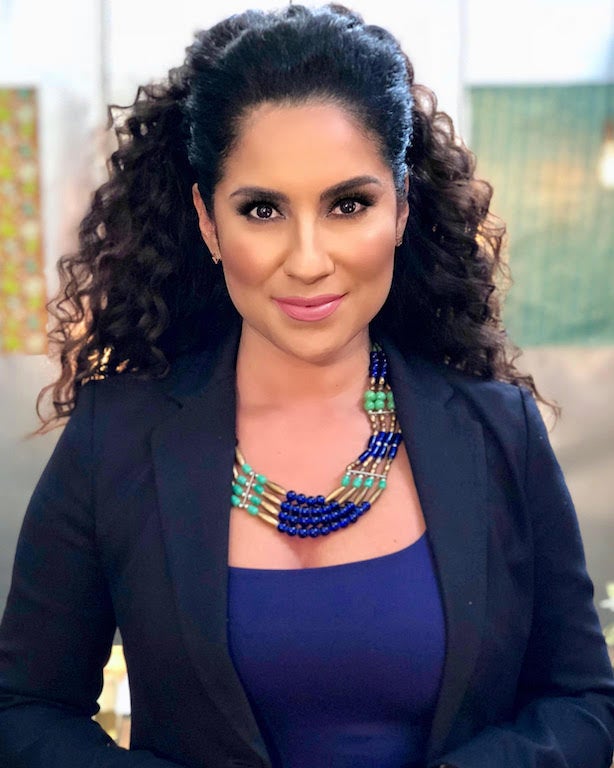
Spicy Mari, Founder & CEO, Relationship Expert, The Spicy Life, Los Angeles
Why did you create a startup? I was living a split life between Maricela Ferguson-Soto and Spicy Mari. Maricela Ferguson-Soto was the Sales Development Executive for a large television network and Spicy Mari was the On-Air Radio Personality who everyone turned to for relationship and dating advice. My education permitted me the security of being comfortable working a 9-5 PM job, while I was moonlighting and counseling overnights as a relationship expert. After sparking several love connections matchmaking, I decided that I wanted to enrich my ability to add value to singles and couples in a digital dating era. I obtained a Masters in Communication Management from the University of Southern California. From research, I discovered the formula to building a successful relationship and a method for evaluation. With the goal of transcending traditional boundaries, The Spicy Life Inc., was formed to provide self-improvement through effective communication and relationship building. My vision is to spread the S-P-I-C-Y gospel of, “Self, Passion, Intimacy, Communication & learning to say YES!” These are the key ingredients to forming and maintaining relationships. I want to change the way people think about relationships. I want the world to live the spicy life. Spicy Tips were also great for radio content. Kindling romantic flames for others ignited a fire in me that led me to receive my certification as a dating coach. The popularity of my relationship advice landed me on a leading radio station in Los Angeles. Did you believe that you had all of the necessary expertise to be a startup founder? I had this great idea and research to support it, but what I was not confident about how to start and operate the business. What I did was leverage my network. I had a fiancé that was a business consultant, a friend who was a brand manager, classmates who believed in me, and another friend who was an attorney. A CEO is not great on their own, they are only as strong as the people they surround themselves with. Where do you get your confidence from? My mother is my hero and my inspiration. For the majority of my life I grew up in a single parent household, where my mother made sacrifices for the people she loved. Her marriage and children were her priority. A part of me admired her dedication to her family, another piece of me grew up resenting her for sacrificing her own ambitions. However, I now know that the sacrifices that you make in the short term lead long-term prosperity. This valuable lesson is something that I took to heart when launching my startup. My husband was also an inspiration and motivating force within my life. He is a testimony to why you need to choose your life partner carefully. I sought my purpose mate. A purpose mate is a partner that recognizes your gifts and propels your path to fulfilling your destiny. He believed in me and in The Spicy Life. What daily challenges do you face? Running a business is not easy, but it is the most gratifying thing you will do in your life. All I want to do is coach people and share my knowledge and gifts, but I realize there’s an entire imperative business operations side from acquiring funding, to sales, marketing and beyond. The day-to-day business operations are something that I continue to work on. My career priority is penetrating the hearts and minds of my clients, but, without a good team, I can’t deliver services to clients. I am confident that I am walking in my purpose and realize that God is using me to help others believe in themselves and believe in love again. What does success look like to you? Success for me is transforming a client’s perspective. Seeing a client attain a healthy and passionate lifestyle, attract a partner that is equally yoked with them, or get that promotion at work because of better interpersonal skills is the greatest success story in the world. Knowing that I was a part of someone’s journey to greatness is more than I can ask for.
Study Reveals Mental Health Risks Of Rekindling Past Relationships

In her 2012 album, “Red”, Taylor Swift makes it pretty clear she’s done with on-again, off-again relationships, claiming “we are never, ever getting back together” eleven times throughout the song. Love her or hate her, the pop music queen of oddly personal dating advice may have a good point if the results of a new study published in Family Relations hold true.
Led by a team of researchers from the University of Missouri-Columbia and the University of Illinois at Urbana-Champaign, the study used responses from 545 couples to show that cycling in and out of the same relationship was correlated with statistically significant increases in symptoms linked with anxiety and depression. Importantly, the findings were the same across both heterosexual and homosexual couples, which is notable because few past studies have incorporated a diversity of intimate relationships in their analysis.
“I embarked on this research because there are a lot of misleading media messages in popular songs and TV Shows, as well as famous narratives saying things like, ‘If you love someone, let them go, if they come back then you know it was meant to be’ – and although breaking up and getting back together isn’t always a bad omen, on average, we find that a continued pattern can impair personal and relational well-being.” Kale Monk, Ph.D, the study’s lead author tells Inverse in an emailed statement.
It’s obvious that terminating a relationship is stressful. But what about entering into one? While both experiences feel different, they’re both transitional periods, which can be difficult for couples to navigate.
In their paper, Monk and his colleagues note that “times of transition lead to tumultuous interactions and uncertainty about the future of the relationship.” This is what researchers call “Relationship Turbulence Theory,” and previous studies examining this theory have suggested that transitional periods can result in emotional polarization on both sides.
These issues are the classic hallmarks of breakups. A big change happens, you start to doubt whether your relationship will survive, and you eventually withdraw from one another. However, the authors’ interpretation of their findings suggest that even getting re-involved with an ex counts as a transitional period that can contribute to mental anguish:
“In other words, not only can transitions out of a relationship affect psychological adjustment but transitioning into relationships without deliberation and dedication to seeing the relationship continue can also be distressing,” they write.
Monk says this doesn’t mean that getting re-involved in a past relationship is doomed to fail. Instead, he clarifies that the issues arise from getting back into a relationship for the wrong reasons.
“Spend some time thinking about the reasons why reconciliation is being considered,” he advises. “Why do you want or feel like you need to get back together? Is the reason rooted in dedication and positive feelings, or more about obligation and convenience? The latter reasons are more likely to lead down a path of continual distress.”
How to deal if your date tries to “rebate” you

If you’re dating in 2018, apologies in advance—it’s been a rough year on the love front. Just when you finally figured out how to navigate ghosting, breadcrumbing, and orbiting, a new trend swoops in to cause even more chaos. And this time it’s coming for your sanity and your bank account.
Normally, getting a rebate is a very exciting thing. But in the dating world, “rebating”—coined by dating coach Jess McCann—involves the following: You go on a date with someone, then afterward if there’s no interest in moving forward with the relationship, you get a Venmo request prompting you to cough up half the cost of the date.
New York City-based psychologist and relationship expert Paulette Sherman, PhD, hasn’t seen the trend come up with her own clients yet (though, sidenote: it’s a topic that’s come up in the Well+Good office), she definitely doesn’t think the move is justified. “When it comes to going on a date, there are no strings attached. No one knows ahead of time whether they’ll like each other, or for how long,” she says. “If either party believes in going Dutch from the get-go, that should be determined upfront. But I don’t advise anyone asking for money back just because they didn’t see a future afterward. Dating is a pay-as-you-go type adventure, like life. Sometimes you win and sometimes you’ll lose, but at least you can try to play the game gracefully.”
I’m really just in disbelief that I went on a date with a guy and nicely told him I didn’t think we were compatible and he Venmo requested me for dinner, I had a damn grilled cheese 💀💀💀 pic.twitter.com/aTzs23oQAX
— Ashleigh Bradley (@ashhbradley) August 21, 2018
Even though rebating isn’t as widespread as ghosting (for now, that is!), it’s always smart to be prepared whether it’s you or your date who determines there’s no future. And if you see that Venmo request pop up, there’s a classy way to handle it: “You could tell them if they wanted to split the check, they should have mentioned it at the time because now their approach seems rude and you don’t want any part of it,” Sherman says. “Wish them well, then don’t respond to any further Venmo requests.”
In the end, never ever feel guilty about letting someone know you didn’t feel a connection with them. If they through a tantrum and decide to pull a distasteful move afterward, that’s just further proof your gut instinct was right.
Here are five must-know tips for dating an introvert from a psychologist who is one. Or check out three tips to avoid dating a narcissist.
First-years: Don't fall in love, according to math
For first-years at Duke, stress comes in various forms: making friends, struggling in class, missing the bus. For many of these novel pressures, Duke attempts to provide some feeble remediation. But for perhaps the most stressful of all—finding love—even Duke can provide no help.
From first-year move-in to commencement, you have around 1,352 days to find the best possible person to start your Duke romance with. But finding love, especially mathematically optimal love, is no small feat. Settle down too early, and end up missing out on an even better future partner. Wait too long, and all your best suitors may already be taken. You may try your luck at Shooters—but rarely can one find oneself among the sweat and iniquity there, let alone their one true love. Or you may take your chances on a dating app—but those become easily saturated and still don’t solve the problem of who to choose.
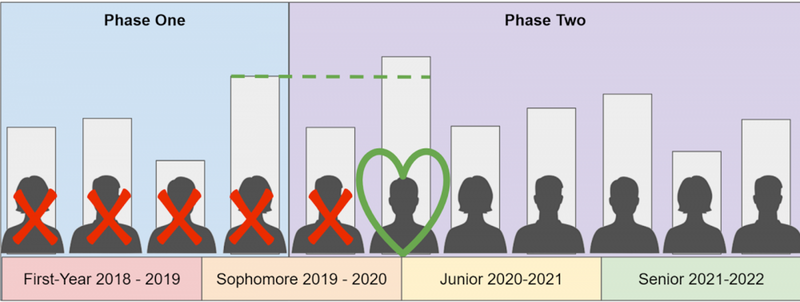
Luckily for you, mathematics provides a straightforward solution: for the first 37 percent of your Duke career, don’t fall in love. You can achieve the greatest verifiable odds of finding your perfect match—all you have to do is follow dating advice from a mathematician.
Through the centuries this problem has come in many forms: “the secretary problem,” “the sultan’s dowry problem” and most recently as “optimal stopping theory.” The mathematical phenomenon was popularized when Martin Gardner wrote about it in Scientific American in 1960 and has since inspired research in economics, finance, biology, and statistics. The 37 percent rule it generated has been found everywhere from fish mating behavior to choosing optimal toilets at music festivals. And now the power of optimal stopping theory is going to help you find the perfect partner at Duke. It works in two phases.
During the first phase, call it the rejection phase, you cannot fall in love. Always keep track of the best person you’ve met, but it is imperative that you keep moving. For the first 37 percent of your time at Duke—500.2 days—your only goal is to establish your baseline. You can have flings, go on dates and swipe on Tinder, but you cannot fall in love. No matter how intelligent, compatible or great of an investment banker you think they may be, you must leave them behind during the rejection phase. You must resist the urge of love until Thursday, January 3rd, 2020 around 4:48 AM, just before the start of your sophomore spring. That’s when you’ll enter phase two.
During this second phase, call it the commitment phase, your strategy is simple: continue to play the field until you find the first person who is better than the best person you met during the 500.2 days of the rejection phase. This lucky contestant has the highest probability, out of everyone that came before them and may come after them, of being your optimal Duke partner. At this point, you need only convince them to date you—which is coincidentally where optimal stopping theory and I run out of advice.
Sure, this method does not come without risks. For example, in the commitment phase, you may not find someone better than the best person you’ve discarded during the rejection phase. In this case, you’ll have to try again out in the wild of the real world or try to return to them and explain your miscalculation. Worse still, citing rigorous mathematics for your break-up may get you into some trouble during your first 500.2 days at Duke. On the other hand, I could not cook up a more quintessentially Duke reason for ending a relationship.
Despite all its potential pitfalls, this method for finding love is the best we have to work with—so first-years, don’t fall in love. In some ways this advice may match the conventional wisdom, and in others, its operationalization may seem impractical. But, I hope that aside from its practicality, this bit about the mathematics of love may persuade you to have a bit more love for mathematics.
Luke Farrell is a Trinity senior and requests that you don’t cite him when working through your rejection phase. His column, By The Numbers, runs biweekly on Thursdays.