


Category Archives: marriage advice
Help! We Got Married, Then He Dumped Me. Do I Have to Finish the Thank-You Notes?

Photo illustration by Slate. Photos by Thinkstock.
Daniel Mallory Ortberg is online weekly to chat live with readers. Here’s an edited transcript of this week’s chat.
Daniel Mallory Ortberg: Put down your glitter pens, stop rifling through your employees’ desks—it’s time to chat.
Q. Wedding thank-yous: I got married in September, and then in February I found out my husband had kept a longtime girlfriend from me. It was all very traumatic and awful. Now we are getting divorced, and all I am concerned about is staying afloat during this difficult time. His mother and my mother keep asking about the thank-you notes for our wedding gifts. I never finished them. But how can I possibly write thank-you notes for money that’s already gone, and gifts that we got as a couple?
A: I’ll be honest, I’m anxious about answering this one after being so off the mark about thank-you notes last time. I’m so sorry your mother and mother-in-law, who presumably know you’re getting divorced due to your ex’s infidelity, are badgering you about thank-you cards. If there are any gifts you haven’t used, I believe it’s common practice to return them to the gift givers, although you might want to enlist a friend or relative’s help in doing so if you don’t have the time and energy to mail back a bunch of kitchen gadgets while navigating the sudden end of your marriage. For gifts you have used, a standard thank-you note is just fine: “Thanks for X product, which I’ve enjoyed using while committing Y task. Looking forward to seeing you during Z event.” There’s no need to reference your divorce. I also imagine, if your social circle is at all aware of the circumstances of your marriage’s bust-up, no one else is going to be hassling you over thank-you notes quite like your mother and mother-in-law.
Q. Bi-ex-ual: My ex has some issues around his sexuality and tends to discover he’s “actually straight” or “actually gay” once a year or so—usually by cheating on his girlfriend with a guy, and then the other way around. I was once that girlfriend and definitely thought I would be the one whose love would change him. Spoiler! It did not.
That was a few years ago. He is now dating Max, a co-worker of mine that I am work-friendly with. My family and friends all say I should warn Max, who knows my ex and I used to date, about my ex’s habits. I don’t think it’s any of my business—maybe my ex is finally happy with himself!—and that it’s best to keep my personal life out of work. However, it will be awkward if my ex hasn’t changed his ways and Max wants to know why I didn’t warn him. So, should I tell or stick to my minding-my-own-business guns?
A: I think the bar for telling Max should be higher than this, especially since you two work together. If you knew your ex were cheating on him now, that would be different, but if the only information you have is “several years ago he cheated on me, and I know he’s cheated on other people,” I don’t think that merits getting involved with a co-worker’s love life.
The peculiar twist your ex has put on his own infidelity—the idea that every year or so he “discovers” his true sexuality, the implication being that his cheating doesn’t really count as cheating if it occurred in the process of self-discovery—is cheap and shallow. But you’re several steps ahead of yourself if you assume that were your ex to cheat again, Max would somehow discover that the same thing had happened to you, and would blame you for not going into detail about the end of your relationship with him sooner. Continue to be friendly with Max at work but don’t go out of your way to get any more involved in his personal life than you already are, and tell your friends that you appreciate their input but aren’t interested in any more. The less you can have to do with your ex, even tangentially, the better off you’ll be.
How to Get Advice From Prudie:
• send questions for publication to prudence@slate.com. (Questions may be edited.)
• join the live chat Mondays at noon. Submit your questions and comments here before or during the discussion.
• call the voicemail of the Dear Prudence podcast at 401-371-DEAR (3327) to hear your question answered on a future episode of the show.
Q. Wrong number: My girlfriend and I recently had the Discussion about our past sexual experience. She asked, in these exact words, “How many women have you been with?” I answered honestly: one. However, my number is actually seven—one woman and six men. That phase of my life is behind me. Since then, I’ve been tested and received a clean bill of sexual health. I’ve been 100 percent faithful to my current girlfriend and will continue to do so. Still, I can’t help but feel like I’ve lied by omission. Do I owe her the full story?
A: I’m of several minds here! I don’t think anyone owes a current partner a total rundown of everybody they’ve ever slept with. While many couples may decide to volunteer that information to one another, asking point blank, “How many people (or any more specific derivative thereof) have you slept with?” is a lousy thing to do. Just because someone has asked you an invasive question does not mean you are obligated to answer it.
That said, I’m not sure exactly what you mean when you say “that phase of [your] life is behind [you].” Even if you don’t anticipate being interested in or sleeping with men again, I worry that you consider it a shameful part of your past that’s best left unacknowledged. If your relationship with this woman is predicated on the assumption that you’re both 100 percent heterosexual (or that you’ve only ever been with members of the opposite sex), then you might feel increasingly misunderstood and closeted with her. You don’t “owe her” the full story of everyone you’ve ever slept with, but if part of the reason you’re holding back is because you think she would judge you for having been with men, then I worry she’s not the right woman for you.
Q. Dog etiquette: I live downtown in a busy city area. I have a dog and we’re frequenters of a pet supply shop near my apartment. They have been wonderful over the last five years with helping socialize my nervous rescue dog by giving her treats and cuddles. The only problem comes when the employees dispense unwelcome health advice. My dog is prone to weight gain, and her latest veterinarian-prescribed diet plan includes low calorie treats purchased from the vet’s office. I bring these with me to the pet store and give them to the employees to give to my dog. Recently, when I gave the diet treat to a young employee, she raised her eyebrows and asked me what it was. I told her, and she launched into a lecture about how these treats were just empty carbs and how they wouldn’t help my dog lose weight at all. I kept my mouth shut, but I was annoyed. My dog is my dog, and I didn’t ask this girl for her judgmental advice. What can I say in the future if something like this happens?
A: Since these are people you see regularly and are generally friendly with, I don’t think you should look for a withering dismissal. I agree that her approach wasn’t ideal, but given how many years you’ve been going to this shop for help socializing and caring for your dog, I don’t think it was excessively over the line for one of the employees to express an opinion about pet care. That doesn’t mean you have to entertain their opinions about your dog’s diet, of course. Stick with something bland but discouraging, like, “I trust my vet’s advice and I’m going to give these a try, thanks,” and keep the conversation moving along.
Q. Speaking of wedding gifts … : My husband and I got married over a year ago. It was a second marriage for both of us and we are both older, in our 30s. We didn’t register for gifts, and when guests asked, we suggested they pick out a bottle of wine for us to enjoy. The thing is, out of 50 people who attended, we got three bottles of wine. The wedding was expensive, and we paid about $120 per meal. We weren’t asking for anything expensive, but a bottle of wine is a reasonable celebratory gift! The lack of thought our friends and family put into our celebration left me a little disappointed. I expected people would write a congratulatory card and give us a $20 bottle of wine. Instead, we got one card and three bottles of wine. Obviously there’s nothing we can do about it, but it’s made me rethink our friendships. I can’t imagine attending a wedding without a small gift and card! Are our friends rude, or are my expectations out of line?
A: My guess is that upon learning you didn’t have a registry, most of your friends gathered that you weren’t interested in gifts at all, and that you merely mentioned the idea of a bottle of wine as an option. It would have been lovely if all 50 of your friends had gotten you a carefully selected bottle of wine and a nice note, and I can understand nursing some slightly hurt feelings for a little while. But I don’t think your friends meant to be rude, I think they genuinely assumed that since it was your second marriage and you didn’t have a registry, you weren’t especially interested in gifts, just their presence.
While it’s perfectly fair to feel stung about the lack of cards or even token gifts, I don’t encourage you to connect that feeling with the amount of money you spent on the wedding. That was your choice, and not something your friends asked you to do!
Q. Break it up: I have been an avid reader of this column for years—of your writing as well as that of your predecessor. I have begun to notice a discernible trend and difference in advice from the previous Dear Prudence author and yourself: You quite frequently advocate for breaking up. You do your due diligence and suggest counseling, of course, but I can’t help but notice that you often leave the advice with an almost pessimistic assurance that the letter writer should just skip that nonsense and break it off now rather than later. I also can’t help but notice you don’t speak of a partner for yourself. Is there a reason you advise people to break up rather than have them work toward a reconciliation?
A: The implication here, I think, is that no one with a partner would advocate so frequently for couples to break up, because a partnered person would understand the importance of working through one’s problems and staying together. I don’t agree with that premise! It’s an eternal advice-column issue (others in my position have been asked similar questions in the past; Dan Savage even came up with the shorthand DTMFA because he was spending so much time advising people to end their relationships), in part because people with serious relationship problems are likelier to write to advice columns in the first place.
I think that peaceful solitude is infinitely preferable to an unbearable relationship. My definition of what makes a relationship unbearable may differ from yours, of course, but there are some problems that I don’t think can be improved by counseling or increased communication—differences on wanting children, for example, a lack of basic respect for someone else’s autonomy, extreme jealousy or controlling behavior, etc.
Q. Fuck-up flowers, forever: I occasionally do minor things that justifiably annoy my girlfriend. For example, I will accidentally get so drunk that she has to take care of me. This isn’t the problem. We are both flawed humans who sometimes do dumb things, but we’re very happy and in love. The thing is, whenever I do something like that, I get her flowers. She loves flowers, so this is a good system, but she doesn’t like flowers that wither and die, so I get her potted plants. The problem is, she’s a really great gardener and has kept them all alive! All of the plants in her apartment are now flowers I have gotten her after some dumb thing. I’m worried that my mistakes are now immortalized through these flowers, but they’re her favorite thing, and I don’t want to stop getting them for her. What should I do?
A: Get her flowers when you haven’t done something stupid.
Q. Update—He’s already trying to fix me: I wrote to you last about my boyfriend who thought his frequent, unsolicited advice was going to change my life! I ended up breaking up with him a few months after that, and then I noticed what a relief it was not coming home to him! I didn’t realize how stressful and dreadful it was having him in my life until he wasn’t there.
A: Anytime a breakup is followed by immediate relief that your ex is no longer in your home is a sign you made the right choice in breaking up. Congratulations!
Q. Worried about the big one: My husband, infant daughter, and I live in a two-unit condo building in a very expensive and earthquake-prone area. Given the extremely high risk of tremblors, we would like to perform a modest seismic upgrade to our building, which was built in 1928. We’ve even secured a grant from the state to offset some of the costs. The problem is that our downstairs neighbor has no interest in this. She is in her early 70s, and while she’s on a fixed income, she does not seem to be destitute by any means. I know she recently paid for much more extensive repairs to the building before we moved in. Should I keep pushing for the work to be done? While we bought the unit knowing that it hadn’t been upgraded, this seems like a reasonable step to protect both of our investments (and perhaps our lives).
A: If she’s on a fixed income and paid for extensive repairs somewhat recently, she may not have the money to contribute to another one now. It’s unclear if you’re looking for financial support or simply her permission—if it’s the former, I think you should move ahead without her participation.
Q. Re: Wedding thank-yous: I think the letter writer whose mom and mother-in-law—for real!?—are badgering her to finish up the thank-you notes while she tries to navigate divorcing her new husband over his infidelity should explain that, due to his actions, the thank-you notes are now his responsibility, and they should feel free to direct their badgering toward him from now on.
A: Oh, there it is; that’s the one. Perfect.
Discuss this column with Dear Prudence on his Facebook page!
More Dear Prudence
My Mom Got Pregnant at the Same Time as Me—and I Resent Her for It
My Friends’ Triumphs Make Me Feel Like I’m Falling Behind in Life
My Husband Got a Vasectomy Without Telling Me
I’m Mexican American. My Father Is a White Supremacist. Do I Have to Talk to Him?
And find even more letters in the Dear Prudie archive.
Slate Plus members get more Dear Prudence. Every week, Daniel Mallory Ortberg answers more questions from readers, for members only. Members also get complete, ad-free episodes of the Dear Prudence podcast, and a host of other benefits—and they help support Slate’s journalism.
Membership starts at just $35 your first year. Join today.
7 signs you should marry your current partner

Over the years, you’ve probably often heard the line, “You complete me” (thank you, “Jerry McGuire”). However, Jeffrey Sumber, psychotherapist and author of “Renew Your Wows: Seven Powerful Tools to Ignite the Spark and Transform Your Relationship,” feels there is more to it.
“In spite of popular opinion and what’s said in movies, a partner doesn’t complete us,” he told Business Insider. “Although life with them feels complete, it’s more important to feel complete yourself. Meaning, you feel a sense of peace, a ‘rightness’ to your own life when you’re interacting with them, and feel most like yourself near them.”
Relationship specialist Jen Elmquist, MA, LMFT, and author of “Relationship Reset: Secrets from a Couples Therapist That Will Revolutionize Your Love for a Lifetime,” agrees. “A sign is that your significant other makes you a better version of yourself,” she told Business Insider.
You don’t have to hide anything about yourself from a partner who’s a good match for the long haul, Elmquist said. “They seem to know how to challenge you and accept you at the same time, giving you the courage and inspiration to grow.”
For a Happy Life, Love Your Spouse More Than Your Kids, Says One Marriage Counselor

If your kid isn’t your whole life, boy, are you gonna hear it from the mom-shamers.
“Selfish,” “bad mom,” “neglectful,” are all used to describe parents who take (much-needed) time for themselves and think, “hey the kid will be OK.” They just want their relationship with their significant other to survive — and thrive. And that’s a good thing.
Living for your kids and forgetting about quality time with your partner, like dinners, traveling, and sending the kids away for the weekend can be detrimental to a relationship. And yes, you can still love your kids and take a weekend away.
But guess what? Many therapists and experts believe that only focusing on your child or children is bad for the whole family in the long run.
Miriam Liss, a psychologist at the University of Mary Washington in Virginia, wrote a study published in the Journal of Child and Family Studies on “intensive parenting” and found that “women who believed that parenting should be child-centered had reduced life satisfaction.”
Then there’s “helicopter parenting,” but if you’re hyper-focused on meeting every single need of your child, you’re likely neglecting your own, which can lead to depression.
Marriage coach Lesli Doares tells Personal Space that in today’s society, many moms can make you feel that “if you’re not slavishly devoting your life to your kid 24/7 you’re a bad parent” and so marriages often begin to suffer before the couple even realizes what’s going on.
Doares suggests, “leaving for a long weekend,” and sending your kid to grandma’s, which they actually think of as an adventure away from mom and dad.”
“If you experience any guilt, think ‘I’m taking care of my marriage which is actually the best gift anyone can give their children,’” she adds. “We think if we don’t do all this things our kids are going to suffer, but they’re not. And they get to spend special time with others where they do fun stuff.”
No matter what we choose to do as parents, there’s always guilt attached.
“You’re a bad mom if you go to work, or if you stay home and no longer have a career, so what’s the alternative? Someone is always out there judging you,” Doares says. “There’s a lot of fear that comes with parenting and I do think there is questioning when both parents work outside the home, so when they can spend time with their kids that’s what they do.”
If parents aren’t confident in their own choice to put their own relationship first, “that leaves space for guilt,” Doares explains, saying it takes a thick skin to brush off judgments form other moms.
“Judging comes form other moms’ own insecurity…I have confusion about what to do, I’m gonna project it onto other people,” she says.
Author David Code wrote a book in 2010 on the subject called, To Raise Happy Kids, Put Your Marriage First. He sums up that “as we break our backs for our kids, our marriage and self-fulfillment go out the window while our kids become more demanding and dissatisfied.”
He tells The Guardian that overly-devoted parents “do not produce happy children,” and if you want the best for your kids, spend less time trying to be the perfect parent and more time striving to be the perfect spouse.”
“Today’s number one myth about parenting is that the more attention we give our kids, the better they’ll turn out,” he says. “But we parents have gone too far: our over-focus on our children is doing them more harm than good. Families centered on children create anxious, exhausted parents and demanding, entitled children. We parents today are too quick to sacrifice our lives and our marriages for our kids.”
Code even suggests that kids who receive too much attention from parents become troubled. “By killing ourselves to provide a perfect, trauma-free childhood for our children, we’re wasting our energy. The greatest gift you can give your children is to have a fulfilling marriage yourself,” he says.
Plus, they have to learn to become independent at some point, it may as well be early on, he adds.
A few tips on how to navigate your relationship if your children have been ruling the roost.
Acknowledge the stress
Talk about your relationship and what’s been going on and express that loving your spouse does not diminish your love for your children and does not make you a bad parent or person.
Focus on making the marriage number one, not the kid
Most experts say that kids raised to believe that they are the center of the universe have a tough time understanding they aren’t really that special in the real world.
A healthy marriage is a healthier family
A good relationship with your significant other helps every other area of your life, including parenting. Plus, as your kid grows, they want to see mom and dad happy and in a happy relationship.
Personal Space is Bravo’s home for all things “relationships,” from romance to friendships to family to co-workers. Ready for a commitment? Then Like us on Facebook to stay connected to our daily updates.
Butler: Marriage is just one of those crazy things
Driving to work and tuned to my favorite jazz station, I heard Cole Porter’s song, “Just One of Those Things.” I thought about my 45th wedding anniversary, which was on Saturday, as the song’s lyrics included the stanza, “We’d have been aware that our love affair — was too hot not to cool down …”
Well as it turned out, ours has cooled down but in a positive sense of the term. In our case, “love at first sight” occurred at a wedding reception in 1971 and was just one of those things which has led to a wonderful wife, a family of two children and now four grandchildren since we just received news that our latest granddaughter has been born in Brooklyn. Cool. I can’t imagine anything more important or gratifying.
But this is a retirement advice column, so what’s the connection? Terry Gross on NPR’s “Fresh Air” spends every day interviewing various notables. On a vacation once, she complained that the room in her bed and breakfast didn’t have the TV she had requested. The proprietor said, “Why don’t you just try conversation?”
Probably that’s good advice for all of us. But, there’s a book that can help.
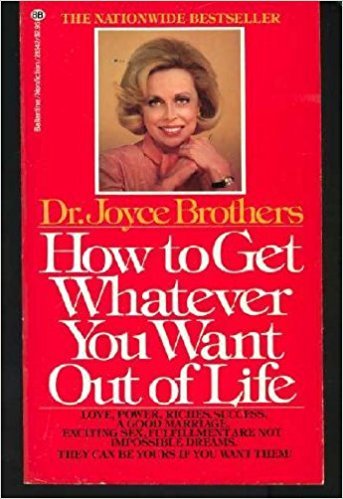
In 1978, Joyce Brothers wrote, “How to Get Whatever You Want out of Life.” Brothers, some of us may recall, was a known genius who won the quiz show “The $64,000 Question” by picking boxing as her specialty. She won fair and square on a show that was otherwise marked by a cheating scandal.
So there I was many anniversaries ago with a book written by my favorite pop psychologist — a book my wife describes as “the book that used to dog our anniversaries.” Why? Because it offers a list of questions that constitutes a referendum on the health of a relationship.
The idea is for spouses (or those in relationships) to answer the questions in writing by reflecting quietly apart from each other and then getting together to share the answers.
The questions are as follows:
What delights me most about my spouse? What is the worst thing that happened to you in the past year? What is the best thing that happened? What are the worst and best things that happened to the two of you as a couple? Then, name one thing you think your spouse would want to change in you. And finally, what are the 10 things you enjoy doing the most? What are the 10 things you think your spouse enjoys doing the most? What are the 10 things the two of you together enjoy doing the most?
What spouses create on these lists can come as complete surprises to each other. However, they establish a dialogue that leads to communication, and communication oils the workings of any successful relationship. As Brothers says, it’s the tone of the discussion as much as the content that is critical. If you can laugh about the extent at which you see things differently, that is the sign of a healthy relationship. If there are more serious issues that rise to the surface as a result of sharing these lists, then that can be the start of some constructive changes.
Keeping a relationship together and working through the rough spots can offer rewards later in retirement that go way beyond whatever monetary advantages a loving relationship offers. Companionship, support with health issues, sharing of enjoyment, and more effective decision-making all make relationships worth what can sometimes feel like effort. It’s what’s there when hot relationships begin to cool down.
Steve Butler is the CEO and founder of Pension Dynamics Company LLC. To read past columns and learn more about his book, visit www.pensiondynamics. com and click on resources. Steve can be reached at 925-956-0505 ext. 228 or sbutler@ pensiondynamics.com.or email:sbutler@pensiondynamics.com.