



Tag Archives: dating advice
Study Reveals Mental Health Risks Of Rekindling Past Relationships

In her 2012 album, “Red”, Taylor Swift makes it pretty clear she’s done with on-again, off-again relationships, claiming “we are never, ever getting back together” eleven times throughout the song. Love her or hate her, the pop music queen of oddly personal dating advice may have a good point if the results of a new study published in Family Relations hold true.
Led by a team of researchers from the University of Missouri-Columbia and the University of Illinois at Urbana-Champaign, the study used responses from 545 couples to show that cycling in and out of the same relationship was correlated with statistically significant increases in symptoms linked with anxiety and depression. Importantly, the findings were the same across both heterosexual and homosexual couples, which is notable because few past studies have incorporated a diversity of intimate relationships in their analysis.
“I embarked on this research because there are a lot of misleading media messages in popular songs and TV Shows, as well as famous narratives saying things like, ‘If you love someone, let them go, if they come back then you know it was meant to be’ – and although breaking up and getting back together isn’t always a bad omen, on average, we find that a continued pattern can impair personal and relational well-being.” Kale Monk, Ph.D, the study’s lead author tells Inverse in an emailed statement.
It’s obvious that terminating a relationship is stressful. But what about entering into one? While both experiences feel different, they’re both transitional periods, which can be difficult for couples to navigate.
In their paper, Monk and his colleagues note that “times of transition lead to tumultuous interactions and uncertainty about the future of the relationship.” This is what researchers call “Relationship Turbulence Theory,” and previous studies examining this theory have suggested that transitional periods can result in emotional polarization on both sides.
These issues are the classic hallmarks of breakups. A big change happens, you start to doubt whether your relationship will survive, and you eventually withdraw from one another. However, the authors’ interpretation of their findings suggest that even getting re-involved with an ex counts as a transitional period that can contribute to mental anguish:
“In other words, not only can transitions out of a relationship affect psychological adjustment but transitioning into relationships without deliberation and dedication to seeing the relationship continue can also be distressing,” they write.
Monk says this doesn’t mean that getting re-involved in a past relationship is doomed to fail. Instead, he clarifies that the issues arise from getting back into a relationship for the wrong reasons.
“Spend some time thinking about the reasons why reconciliation is being considered,” he advises. “Why do you want or feel like you need to get back together? Is the reason rooted in dedication and positive feelings, or more about obligation and convenience? The latter reasons are more likely to lead down a path of continual distress.”
How to deal if your date tries to “rebate” you

If you’re dating in 2018, apologies in advance—it’s been a rough year on the love front. Just when you finally figured out how to navigate ghosting, breadcrumbing, and orbiting, a new trend swoops in to cause even more chaos. And this time it’s coming for your sanity and your bank account.
Normally, getting a rebate is a very exciting thing. But in the dating world, “rebating”—coined by dating coach Jess McCann—involves the following: You go on a date with someone, then afterward if there’s no interest in moving forward with the relationship, you get a Venmo request prompting you to cough up half the cost of the date.
New York City-based psychologist and relationship expert Paulette Sherman, PhD, hasn’t seen the trend come up with her own clients yet (though, sidenote: it’s a topic that’s come up in the Well+Good office), she definitely doesn’t think the move is justified. “When it comes to going on a date, there are no strings attached. No one knows ahead of time whether they’ll like each other, or for how long,” she says. “If either party believes in going Dutch from the get-go, that should be determined upfront. But I don’t advise anyone asking for money back just because they didn’t see a future afterward. Dating is a pay-as-you-go type adventure, like life. Sometimes you win and sometimes you’ll lose, but at least you can try to play the game gracefully.”
I’m really just in disbelief that I went on a date with a guy and nicely told him I didn’t think we were compatible and he Venmo requested me for dinner, I had a damn grilled cheese 💀💀💀 pic.twitter.com/aTzs23oQAX
— Ashleigh Bradley (@ashhbradley) August 21, 2018
Even though rebating isn’t as widespread as ghosting (for now, that is!), it’s always smart to be prepared whether it’s you or your date who determines there’s no future. And if you see that Venmo request pop up, there’s a classy way to handle it: “You could tell them if they wanted to split the check, they should have mentioned it at the time because now their approach seems rude and you don’t want any part of it,” Sherman says. “Wish them well, then don’t respond to any further Venmo requests.”
In the end, never ever feel guilty about letting someone know you didn’t feel a connection with them. If they through a tantrum and decide to pull a distasteful move afterward, that’s just further proof your gut instinct was right.
Here are five must-know tips for dating an introvert from a psychologist who is one. Or check out three tips to avoid dating a narcissist.
First-years: Don't fall in love, according to math
For first-years at Duke, stress comes in various forms: making friends, struggling in class, missing the bus. For many of these novel pressures, Duke attempts to provide some feeble remediation. But for perhaps the most stressful of all—finding love—even Duke can provide no help.
From first-year move-in to commencement, you have around 1,352 days to find the best possible person to start your Duke romance with. But finding love, especially mathematically optimal love, is no small feat. Settle down too early, and end up missing out on an even better future partner. Wait too long, and all your best suitors may already be taken. You may try your luck at Shooters—but rarely can one find oneself among the sweat and iniquity there, let alone their one true love. Or you may take your chances on a dating app—but those become easily saturated and still don’t solve the problem of who to choose.
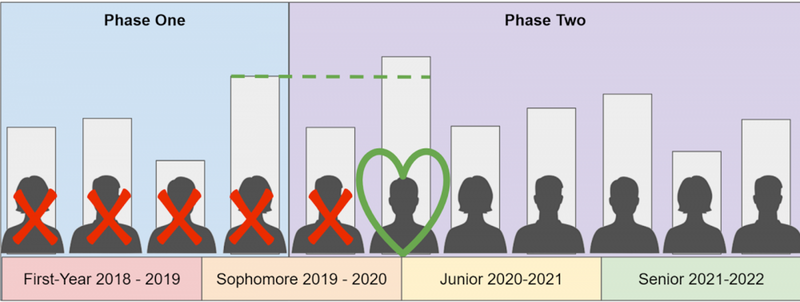
Luckily for you, mathematics provides a straightforward solution: for the first 37 percent of your Duke career, don’t fall in love. You can achieve the greatest verifiable odds of finding your perfect match—all you have to do is follow dating advice from a mathematician.
Through the centuries this problem has come in many forms: “the secretary problem,” “the sultan’s dowry problem” and most recently as “optimal stopping theory.” The mathematical phenomenon was popularized when Martin Gardner wrote about it in Scientific American in 1960 and has since inspired research in economics, finance, biology, and statistics. The 37 percent rule it generated has been found everywhere from fish mating behavior to choosing optimal toilets at music festivals. And now the power of optimal stopping theory is going to help you find the perfect partner at Duke. It works in two phases.
During the first phase, call it the rejection phase, you cannot fall in love. Always keep track of the best person you’ve met, but it is imperative that you keep moving. For the first 37 percent of your time at Duke—500.2 days—your only goal is to establish your baseline. You can have flings, go on dates and swipe on Tinder, but you cannot fall in love. No matter how intelligent, compatible or great of an investment banker you think they may be, you must leave them behind during the rejection phase. You must resist the urge of love until Thursday, January 3rd, 2020 around 4:48 AM, just before the start of your sophomore spring. That’s when you’ll enter phase two.
During this second phase, call it the commitment phase, your strategy is simple: continue to play the field until you find the first person who is better than the best person you met during the 500.2 days of the rejection phase. This lucky contestant has the highest probability, out of everyone that came before them and may come after them, of being your optimal Duke partner. At this point, you need only convince them to date you—which is coincidentally where optimal stopping theory and I run out of advice.
Sure, this method does not come without risks. For example, in the commitment phase, you may not find someone better than the best person you’ve discarded during the rejection phase. In this case, you’ll have to try again out in the wild of the real world or try to return to them and explain your miscalculation. Worse still, citing rigorous mathematics for your break-up may get you into some trouble during your first 500.2 days at Duke. On the other hand, I could not cook up a more quintessentially Duke reason for ending a relationship.
Despite all its potential pitfalls, this method for finding love is the best we have to work with—so first-years, don’t fall in love. In some ways this advice may match the conventional wisdom, and in others, its operationalization may seem impractical. But, I hope that aside from its practicality, this bit about the mathematics of love may persuade you to have a bit more love for mathematics.
Luke Farrell is a Trinity senior and requests that you don’t cite him when working through your rejection phase. His column, By The Numbers, runs biweekly on Thursdays.
Join the Dating App Throwing Parties for London's Elite

Inner Circle is London’s experiential dating app, co-founded in 2012 by David Vermeulen. It now boasts one million eligible users across the world
After a long relationship, I decided to try online dating. I tried two apps and was disappointed by both the quality of people and the actual user experiences of these services. I thought, this could be done better, so I started to build a dating platform with a focus on the highest quality and the best experience. Thus, Inner Circle was born.
Growth came organically for the app. It was the perfect mix of a great idea and the luck of starting at the right time and with the right people. We launched in Amsterdam and invited our friends, who invited their friends, and it snowballed from there. Before we knew it, we were living in cities around the world and hitting big membership milestones. I think the breakthrough moment was seeing a gap in the market for a dating app that focussed on experience.
There is no typical Inner Circle member. Our initial screening makes sure that everyone is genuine and who they say they are, and also looking for a real relationship. After that, it’s really an eclectic mix – there are bankers, teachers, actors, artists. Our members are young, attractive professionals from across the world and we work to ensure there is a variety of eligible people. To put that in a real-life example, in the early days we got picked up by KLM airline and attracted a lot of KLM staff. However, after a while we became worryingly close to becoming KLM-Dating.com, so the screening altered to provide a mix of members.
Our vetting process is a closely guarded secret, as it’s our recipe for success. All of our screenings are done in-house by a team who crosscheck Facebook and LinkedIn pages. They take into consideration the profile of the individual and the balance of members already on the platform.
The biggest reason for turning a member away is that the picture doesn’t show their face – you’d be surprised by how often this happens. If you cover your face with a Snapchat filter, you’re not going to get through.
The biggest dating faux pas is trying too hard. When you’re in a dating environment, everyone wants to meet someone and make it work, so if you relax and be yourself, you’ll be much more likely to find someone who you genuinely get on with. The absolute worst thing you can do is not be honest, because even if it works and you get on with someone, eventually they will realise that you weren’t being yourself and feel cheated; then you’ll be back at square one. Remember that you’re a catch, and the right person will see that.
We have had so many Inner Circle love stories. We actually have a baby wall in our office and on occasion, when people have met us directly at events, we have been invited to their weddings.
Going through a break-up sucks but remember, you’ve got this. Take some time for yourself and remember who you are.
My best piece of dating advice is simple – just be yourself. There’s nobody else like you and somewhere, out there, someone is looking for you.
https://www.theinnercircle.co/